39,95 €
39,95 €
inkl. MwSt.
Sofort per Download lieferbar

20 °P sammeln
39,95 €
Als Download kaufen
39,95 €
inkl. MwSt.
Sofort per Download lieferbar
20 °P sammeln
Jetzt verschenken
Alle Infos zum eBook verschenken
39,95 €
inkl. MwSt.
Sofort per Download lieferbar
Alle Infos zum eBook verschenken
20 °P sammeln

Andere Kunden interessierten sich auch für
") Glocalising Teaching English as an International Language (eBook, PDF)39,95 €
Glocalising Teaching English as an International Language (eBook, PDF)39,95 €") English for Research Publication Purposes (eBook, ePUB)42,95 €
English for Research Publication Purposes (eBook, ePUB)42,95 €") Teaching and Learning in English Medium Instruction (eBook, ePUB)37,95 €
Teaching and Learning in English Medium Instruction (eBook, ePUB)37,95 €") Understanding English Language Teaching in EFL Context (eBook, ePUB)39,95 €
Understanding English Language Teaching in EFL Context (eBook, ePUB)39,95 €") A History of Applied Linguistics (eBook, ePUB)42,95 €
A History of Applied Linguistics (eBook, ePUB)42,95 €") Introducing Researching English for Specific Purposes (eBook, ePUB)37,95 €
Introducing Researching English for Specific Purposes (eBook, ePUB)37,95 €") Autonomy in Language Education (eBook, ePUB)42,95 €
Autonomy in Language Education (eBook, ePUB)42,95 €
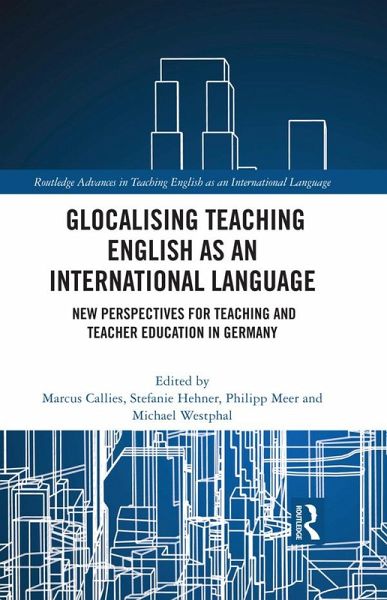
The worldwide spread, diversification, and globalization of the English language in the course of the twentieth and early twenty-first centuries has significant implications for English Language Teaching and teacher education.
We are currently witnessing a paradigm shift towards Teaching English as an International Language (TEIL) that aims to promote multilingualism and awareness of the diversity of Englishes, increase exposure to this diversity, embrace multiculturalism, and foster cross-cultural awareness. Numerous initiatives that embrace TEIL can be observed around the world, but ELT and teacher education in Germany (and other European countries) appear to be largely unaffected by this development, with standard British and American English and the monolingual native speaker (including the corresponding cultural norms) still being very much at the center of attention. The present volume addresses this gap and is the first of its kind to showcase recent initiatives that aim at introducing TEIL into ELT and teacher education in Germany, but which have applicability and impact for other countries with comparable education systems and 'traditional' ELT practices in the Expanding Circle. The chapters in this book provide a balanced mix of conceptual, empirical, and practical studies and offer the perspectives of the many stakeholders involved in various settings of English language education whose voices have not often been heard, i.e., students, university lecturers, trainee teachers, teacher educators, and in-service teachers.
It therefore adds significantly to the limited amount of previous work on TEIL in Germany and bridges the gap between theory and practice that will not only be relevant for researchers, educators, and practitioners in English language education in Germany but other educational settings that are still unaffected by the shift towards TEIL.
We are currently witnessing a paradigm shift towards Teaching English as an International Language (TEIL) that aims to promote multilingualism and awareness of the diversity of Englishes, increase exposure to this diversity, embrace multiculturalism, and foster cross-cultural awareness. Numerous initiatives that embrace TEIL can be observed around the world, but ELT and teacher education in Germany (and other European countries) appear to be largely unaffected by this development, with standard British and American English and the monolingual native speaker (including the corresponding cultural norms) still being very much at the center of attention. The present volume addresses this gap and is the first of its kind to showcase recent initiatives that aim at introducing TEIL into ELT and teacher education in Germany, but which have applicability and impact for other countries with comparable education systems and 'traditional' ELT practices in the Expanding Circle. The chapters in this book provide a balanced mix of conceptual, empirical, and practical studies and offer the perspectives of the many stakeholders involved in various settings of English language education whose voices have not often been heard, i.e., students, university lecturers, trainee teachers, teacher educators, and in-service teachers.
It therefore adds significantly to the limited amount of previous work on TEIL in Germany and bridges the gap between theory and practice that will not only be relevant for researchers, educators, and practitioners in English language education in Germany but other educational settings that are still unaffected by the shift towards TEIL.
Dieser Download kann aus rechtlichen Gründen nur mit Rechnungsadresse in A, B, BG, CY, CZ, D, DK, EW, E, FIN, F, GR, HR, H, IRL, I, LT, L, LR, M, NL, PL, P, R, S, SLO, SK ausgeliefert werden.
"The English language has been exported all over the world and as such, it has taken on new forms in terms of grammar, vocabulary and accent, tied to various regions, countries and societal groups within. At this point, most speakers of English are not, in fact, so-called 'natives'. This has far-reaching implications for communication with English as a lingua franca and yet, this has not caught up in EFL pedagogy to the extent it needs to. This edited book addresses this gap in the German context, and in doing so, moves beyond monolithic models such as British and American English, which themselves are actually far from unified. By bringing the Englishes - and subsequent voices and identities - of non-inner circle Englishes into the classroom, the book has the following benefits. First, it addresses the need for equality on a linguistic level, with language a proxy for identities based on ethnicity and regional origin. Second, the book helps students to approach language with more objectivity, by realising that Indian English, for example, is no less 'logical' than, say, standard American English, and likewise, not 'better' either. Finally, the implications for 'communicative competence' in a global world using a global language in all its varieties is addressed."---Alex Baratta, University of Manchester, UK
"'Glocalising Teaching English as an International Language' consists of scholarly works that collectively build a solid bridge between the theory and practice of teaching EIL. Not only has this book made a theoretical contribution to the field, but it has also provided fresh ideas on how TEIL can be operationalised at the classroom level. The pedagogical principles and practices discussed by the contributors of this book are largely relevant not only to the German context, but also to many other teaching contexts where English serves as a foreign language. The balanced mix of theory, research, and practice on teaching EIL makes this edited volume a must-read for researchers, teacher-educators, and practitioners who wish to challenge native-speaker supremacy in ELT, to promote lingua-cultural diversity in ELT and language teacher-education, and to inspire language learners to learn how to communicate effectively and respectfully across cultures."---Roby Marlina, SEAMEO-RELC, Singapore
"The editors provide a timely and excellent publication on English language teaching in Germany - an expanding circle context in the Kachruvian three circles model. It is an important contribution to the field of Global Englishes that encompasses World Englishes, ELF, EFL reflecting the pluricentric nature of English. It suggests a paradigm shift in ELT away from native-speaker norms in the German context with pedagogical implications for other expanding circle contexts as a solution to the changing needs of English language learners in an increasingly multilingual and multicultural world. The chapters in the book include examples from various stakeholders from K12 to university level with a critical stance towards TEIL curriculum development, materials evaluation, and teacher education. In this respect, it invites readers to imagine how the English language should be taught in the 21st century by questioning teaching standard varieties of English while people from all other linguistic and cultural backgrounds use English as a means of communication all around the world. Various emprical studies reported in the chapters of the book highlight the need for reimagining ELT and provide evidence for what is actually happening in the classroom when a TEIL approach is used. This book invites readers to think beyond the traditional boundaries of ELT. It is a must read book for teacher educators, curriculum and materials developers, as well as undergraduate/graduate students specializing in ELT in the German educational context to develop an understanding of how change might occur in ELT from a TEIL perspective in the 21st century with implications for other expanding circle contexts. It is a great contribution to both the GELT and TEIL literature."---Yasemin Bayyurt, Bogaziçi University, Istanbul, Turkey
"'Glocalising Teaching English as an International Language' consists of scholarly works that collectively build a solid bridge between the theory and practice of teaching EIL. Not only has this book made a theoretical contribution to the field, but it has also provided fresh ideas on how TEIL can be operationalised at the classroom level. The pedagogical principles and practices discussed by the contributors of this book are largely relevant not only to the German context, but also to many other teaching contexts where English serves as a foreign language. The balanced mix of theory, research, and practice on teaching EIL makes this edited volume a must-read for researchers, teacher-educators, and practitioners who wish to challenge native-speaker supremacy in ELT, to promote lingua-cultural diversity in ELT and language teacher-education, and to inspire language learners to learn how to communicate effectively and respectfully across cultures."---Roby Marlina, SEAMEO-RELC, Singapore
"The editors provide a timely and excellent publication on English language teaching in Germany - an expanding circle context in the Kachruvian three circles model. It is an important contribution to the field of Global Englishes that encompasses World Englishes, ELF, EFL reflecting the pluricentric nature of English. It suggests a paradigm shift in ELT away from native-speaker norms in the German context with pedagogical implications for other expanding circle contexts as a solution to the changing needs of English language learners in an increasingly multilingual and multicultural world. The chapters in the book include examples from various stakeholders from K12 to university level with a critical stance towards TEIL curriculum development, materials evaluation, and teacher education. In this respect, it invites readers to imagine how the English language should be taught in the 21st century by questioning teaching standard varieties of English while people from all other linguistic and cultural backgrounds use English as a means of communication all around the world. Various emprical studies reported in the chapters of the book highlight the need for reimagining ELT and provide evidence for what is actually happening in the classroom when a TEIL approach is used. This book invites readers to think beyond the traditional boundaries of ELT. It is a must read book for teacher educators, curriculum and materials developers, as well as undergraduate/graduate students specializing in ELT in the German educational context to develop an understanding of how change might occur in ELT from a TEIL perspective in the 21st century with implications for other expanding circle contexts. It is a great contribution to both the GELT and TEIL literature."---Yasemin Bayyurt, Bogaziçi University, Istanbul, Turkey