Sie sind bereits eingeloggt. Klicken Sie auf 2. tolino select Abo, um fortzufahren.
Bitte loggen Sie sich zunächst in Ihr Kundenkonto ein oder registrieren Sie sich bei bücher.de, um das eBook-Abo tolino select nutzen zu können.
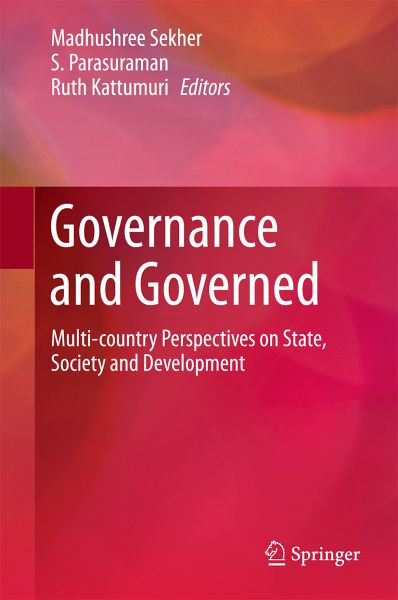
Looks critically at the status, models, and new challenges of governance across countries like India, China, South Africa, and Brazil Provides insights into disputed topics regarding governance, from the perspective of state-society interrelationships and collaborative partnerships Addresses key questions that have surfaced in the current discourse on 'governance and the governed'
Looks critically at the status, models, and new challenges of governance across countries like India, China, South Africa, and Brazil
Provides insights into disputed topics regarding governance, from the perspective of state-society interrelationships and collaborative partnerships
Addresses key questions that have surfaced in the current discourse on 'governance and the governed'
Dieser Download kann aus rechtlichen Gründen nur mit Rechnungsadresse in A, B, BG, CY, CZ, D, DK, EW, E, FIN, F, GR, HR, H, IRL, I, LT, L, LR, M, NL, PL, P, R, S, SLO, SK ausgeliefert werden.
Die Herstellerinformationen sind derzeit nicht verfügbar.
Autorenporträt
Madhushree Sekher is a professor at the Tata Institute of Social Sciences, Mumbai. Institutions, political economy of representation, governance, inclusive development and policy implementation are her core research interests. Her current research is on institutions for food security, inequalities and social welfare systems, and democratic representation in India. She has received a number of grants, including the Australian Research Council (Discovery) Grant. She is currently associated with an international research consortium to study ethnic power relations funded by the Swiss Development Council and the Swiss National Science Foundation. She was a visiting faculty at the International Food Policy Research Institute (IFPRI)-Washington, the Universities of Hohenheim, Sydney and Alberta, and Cornell University, USA. The author of many research articles and books, she has a PhD in Political Science, and was the recipient of World Bank Robert S. McNamara Fellowship for post-doctoral research. S. Parasuraman has been the director of the Tata Institute of Social Sciences, Mumbai, since 2004, and has had a high-profile professional career spanning teaching, research and policy advocacy. He has four decades of experience as a teacher and researcher in Rural Development, Education, Health, Public Policy, Social Protection, Inclusive Development, Governance, Water and Energy. His current research interests include governance and accountability framework for social protection, understanding and addressing agrarian distress, collectives of women and farmers to strengthen livelihoods, capacity building of elected leaders, decentralised governance, corporate social responsibility, and youth for social and economic transformation. He has published extensively on development and disasters. He has held key positions in the World Bank, International Union for Conservation of Nature (IUCN), Oxfam, Action Aid International and the UN. Ruth Kattumuri is the co-director of the India Observatory at the London School of Economics (LSE) and an associate at the Grantham Research Institute on Climate Change and the Environment. She is a fellow of the Academy of Social Sciences in the UK. Kattumuri is involved in transdisciplinary research, advisory and policy engagement concerning sustainable growth, inclusion and development, focusing on human capital development and equal opportunities; water resource management and governance; adaptation and mitigation for climate change; technology and innovation. She was formerly a professor of Statistics and Computer Science, in Madras, India. She has a PhD from the LSE and is also a Cambridge Commonwealth Fellow.
Inhaltsangabe
Part 1. Setting the scene.- Chapter 1. Why is governance important in the development debate.- Chapter 2. Understanding governance as a process: A framework for analysis.- Part 2. From Government to Governance.- Chapter 3. Local Government and the Governed: A Prismatic View of India's Rural Local Governance.- Chapter 4. Governance and Administration in Post-Apartheid Africa.- Chapter 5. Fiscal Reforms at the Local Level in India: An Overview.- Part 3. Rethinking and Restructuring Governance.- Chapter 6. People's Participated Governance Performance Evaluation and New Governance: A case study on Hangzhou.- Chapter 7. The Emergence of Governance Discourse in Liberalizing India.- Chapter 8. Rethinking Environmental Governance.- Chapter 9. Corporate Governance: At the Crossroads.- Chapter 10. Electronic Technology and the Changing Dynamism of Governance.- Part 4. Governance and Exclusion: Navigating the Roadblocks.- Chapter 11. Participatory Governance in Brazil.- Chapter 12. Governing Diversity and its Challenges.- Chapter 13. Governance and Violence: Communal Violence, Displacement and Growth in Gujarat.
Part 1. Setting the scene.- Chapter 1. Why is governance important in the development debate.- Chapter 2. Understanding governance as a process: A framework for analysis.- Part 2. From Government to Governance.- Chapter 3. Local Government and the Governed: A Prismatic View of India's Rural Local Governance.- Chapter 4. Governance and Administration in Post-Apartheid Africa.- Chapter 5. Fiscal Reforms at the Local Level in India: An Overview.- Part 3. Rethinking and Restructuring Governance.- Chapter 6. People's Participated Governance Performance Evaluation and New Governance: A case study on Hangzhou.- Chapter 7. The Emergence of Governance Discourse in Liberalizing India.- Chapter 8. Rethinking Environmental Governance.- Chapter 9. Corporate Governance: At the Crossroads.- Chapter 10. Electronic Technology and the Changing Dynamism of Governance.- Part 4. Governance and Exclusion: Navigating the Roadblocks.- Chapter 11. Participatory Governance in Brazil.- Chapter 12. Governing Diversity and its Challenges.- Chapter 13. Governance and Violence: Communal Violence, Displacement and Growth in Gujarat.
Es gelten unsere Allgemeinen Geschäftsbedingungen: www.buecher.de/agb
Impressum
www.buecher.de ist ein Internetauftritt der buecher.de internetstores GmbH
Geschäftsführung: Monica Sawhney | Roland Kölbl | Günter Hilger
Sitz der Gesellschaft: Batheyer Straße 115 - 117, 58099 Hagen
Postanschrift: Bürgermeister-Wegele-Str. 12, 86167 Augsburg
Amtsgericht Hagen HRB 13257
Steuernummer: 321/5800/1497
USt-IdNr: DE450055826