39,95 €
inkl. MwSt.
Sofort per Download lieferbar
20 °P sammeln

Andere Kunden interessierten sich auch für
") Government Translation in South Korea (eBook, ePUB)39,95 €
Government Translation in South Korea (eBook, ePUB)39,95 €") Corpus Linguistics for Translation and Contrastive Studies (eBook, PDF)46,95 €
Corpus Linguistics for Translation and Contrastive Studies (eBook, PDF)46,95 €") Attitudes to World Englishes (eBook, PDF)44,95 €
Attitudes to World Englishes (eBook, PDF)44,95 €") English Pronunciation Models in a Globalized World (eBook, PDF)44,95 €
English Pronunciation Models in a Globalized World (eBook, PDF)44,95 €") Using CAT Tools in Freelance Translation (eBook, PDF)22,95 €
Using CAT Tools in Freelance Translation (eBook, PDF)22,95 €") English and Translation in the European Union (eBook, PDF)0,00 €
English and Translation in the European Union (eBook, PDF)0,00 €") Advances in Corpus Applications in Literary and Translation Studies (eBook, PDF)39,95 €
Advances in Corpus Applications in Literary and Translation Studies (eBook, PDF)39,95 €
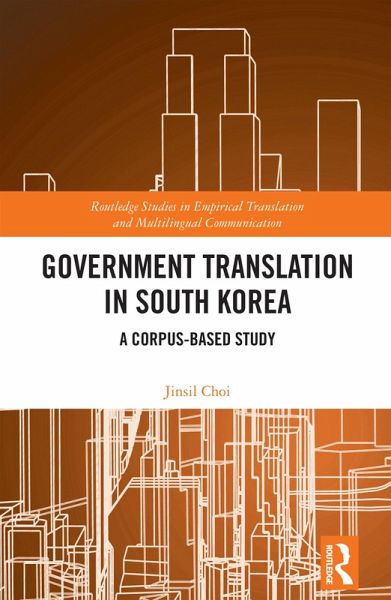
Government Translation in South Korea: A Corpus-based Study is the first book to investigate and discuss translation processes and translation products in South Korean government institutions, employing a parallel corpus-based approach. Choi identifies different agents and procedures involved in institutional translation practices, discusses linguistic and genre features of translations, and investigates changes made in translations compared to the original documents, during the two Korean presidencies of Lee Myung-bak (2008-2013) and Park Geun-hye (2013-2017).
Choi's book explores important facets of Korean government translation in the belief that practices associated with the normative meaning and concept of government translation have to be displaced into the wider understanding of the concept of translation as a social construct. Drawing on the theoretical frameworks of institutional translation and critical discourse analysis-informed corpus-based translation studies, the chapters discuss the practice, process and products of Korean government translation. The Korean-English parallel corpus methodology used introduces a systemic way to analyse changes in Korean government translations, based on a personally built sentence-level tagged corpus, both qualitatively and quantitatively. This volume will be of great interest to scholars and students of translation studies as well as Korean studies.
Choi's book explores important facets of Korean government translation in the belief that practices associated with the normative meaning and concept of government translation have to be displaced into the wider understanding of the concept of translation as a social construct. Drawing on the theoretical frameworks of institutional translation and critical discourse analysis-informed corpus-based translation studies, the chapters discuss the practice, process and products of Korean government translation. The Korean-English parallel corpus methodology used introduces a systemic way to analyse changes in Korean government translations, based on a personally built sentence-level tagged corpus, both qualitatively and quantitatively. This volume will be of great interest to scholars and students of translation studies as well as Korean studies.
Dieser Download kann aus rechtlichen Gründen nur mit Rechnungsadresse in A, B, BG, CY, CZ, D, DK, EW, E, FIN, F, GR, HR, H, IRL, I, LT, L, LR, M, NL, PL, P, R, S, SLO, SK ausgeliefert werden.
"This book provides unprecedented insights into the production and selection for translation of texts issued by South Korean government institutions, adding important detail to our understanding of institutional translation. In so doing, it also illustrates the advantages of the corpus based methodology applied in terms both of process and product analysis in translation studies."-Kirsten Malmkjær, Professor Emeritus of Translation Studies, the University of Leicester, UK
"This book makes an important and timely contribution to our understanding of institutional translation, exploring a rare topic of government translation and analyzing hitherto neglected genres, such as web-magazines, press briefings or speeches. This impressive and inspiring study offers a comprehensive, systematic and critical account of the translation process and products, supported by a wealth of parallel corpus data."-Lucja Biel, University of Warsaw, Poland
"This book makes an important and timely contribution to our understanding of institutional translation, exploring a rare topic of government translation and analyzing hitherto neglected genres, such as web-magazines, press briefings or speeches. This impressive and inspiring study offers a comprehensive, systematic and critical account of the translation process and products, supported by a wealth of parallel corpus data."-Lucja Biel, University of Warsaw, Poland
"This book provides unprecedented insights into the production and selection for translation of texts issued by South Korean government institutions, adding important detail to our understanding of institutional translation. In so doing, it also illustrates the advantages of the corpus based methodology applied in terms both of process and product analysis in translation studies."-Kirsten Malmkjær, Professor Emeritus of Translation Studies, the University of Leicester, UK
"This book makes an important and timely contribution to our understanding of institutional translation, exploring a rare topic of government translation and analyzing hitherto neglected genres, such as web-magazines, press briefings or speeches. This impressive and inspiring study offers a comprehensive, systematic and critical account of the translation process and products, supported by a wealth of parallel corpus data."-Lucja Biel, University of Warsaw, Poland
"This book makes an important and timely contribution to our understanding of institutional translation, exploring a rare topic of government translation and analyzing hitherto neglected genres, such as web-magazines, press briefings or speeches. This impressive and inspiring study offers a comprehensive, systematic and critical account of the translation process and products, supported by a wealth of parallel corpus data."-Lucja Biel, University of Warsaw, Poland