Sie sind bereits eingeloggt. Klicken Sie auf 2. tolino select Abo, um fortzufahren.
Bitte loggen Sie sich zunächst in Ihr Kundenkonto ein oder registrieren Sie sich bei bücher.de, um das eBook-Abo tolino select nutzen zu können.
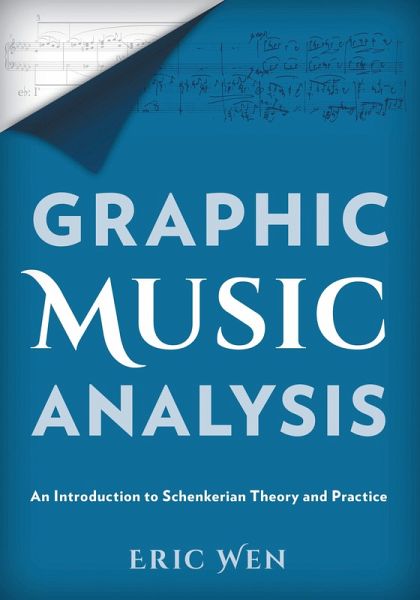
Graphic Music Analysis presents Schenkerian analysis in a practical and engaging manner that will resonate with musicology, theory, and composition students, as well as performing musicians. With over 650 musical examples, Eric Wen guides students through the step-by-step process of creating graphic representations of music and reveals how Schenkerian ideas evolve out of analytical issues in the works encountered. Rather than promoting an analytic method for its own sake, Wen derives structural techniques from their particular musical situations to help students engage directly with the music.…mehr
Graphic Music Analysis presents Schenkerian analysis in a practical and engaging manner that will resonate with musicology, theory, and composition students, as well as performing musicians. With over 650 musical examples, Eric Wen guides students through the step-by-step process of creating graphic representations of music and reveals how Schenkerian ideas evolve out of analytical issues in the works encountered. Rather than promoting an analytic method for its own sake, Wen derives structural techniques from their particular musical situations to help students engage directly with the music. The textbook has an online companion website (textbooks.rowman.com/wen) featuring: Full scores and recordings of the works discussed in the bookDownloadable workbook of additional pieces to analyzeDetailed commentary on Schenker's own analysis of J. S. Bach's Prelude in C from Book 1 of The Well-Tempered Clavier An instructor's manual with a step-by-step guide to analyzing the supplementary workbook examples is also available. Please email textbooks@rowman.com for more information.
Die Herstellerinformationen sind derzeit nicht verfügbar.
Autorenporträt
Eric Wen is recognized as one of today's preeminent experts in Schenkerian analysis. He has published numerous academic articles, and presented papers at many universities and conferences, including all five International Schenker Symposiums. A member of the faculty at The Curtis Institute of Music in Philadelphia since 1999, Wen has also taught in the doctoral program at The Graduate Center (CUNY), as well as at the Juilliard School and Mannes College of Music in New York. Before then he taught at the University of London, as well as the Guildhall School and Royal Academy of Music in London, where he also served as editor of The Strad magazine and The Musical Times.
Inhaltsangabe
Section 1 - Graphic Music Analysis Chapter 1: Highlighting Notes and Making Connections between Them Chapter 2: Figuration Chapter 3: The Linear Progression Chapter 4: The 5-6 succession Chapter 5: Structural Levels Chapter 6: The Introduction to Mozart's "Dissonance" Quartet Section 2 - Semper idem, sed non eodem modo Chapter 7: The Fundamental Structure (Ursatz) Chapter 8: Urlinie Descents from 3 Chapter 9: Urlinie Descents from 5 Section 3 - Techniques of Elaborating the Ursatz Chapter 10: Substitution Chapter 11: Delaying the Initial Tone of the Urlinie Chapter 12: Boundary Play and the Obligatory Register Chapter 13: Sequences Chapter 14: Non-Structural Harmonies Chapter 15: Implied Tones Chapter 16: Mixture Chapter 17: Relocating the Urlinie Chapter 18: The Phrygian 2 Chapter 19: The Auxiliary Cadence Chapter 20: Non-Tonic Expansions Section 4 - Tonal Structure and Musical Form Chapter 21: The Parallel Period (A A¿) Chapter 22: Variants of the Parallel Period Chapter 23: A B A Form Chapter 24: A B A' Form (with simple A) Chapter 25: A B A' Form (with compound A) Chapter 26: Sonata Form in the Major Mode Chapter 27: Sonata Form in the Minor Mode Epilogue
Es gelten unsere Allgemeinen Geschäftsbedingungen: www.buecher.de/agb
Impressum
www.buecher.de ist ein Internetauftritt der buecher.de internetstores GmbH
Geschäftsführung: Monica Sawhney | Roland Kölbl | Günter Hilger
Sitz der Gesellschaft: Batheyer Straße 115 - 117, 58099 Hagen
Postanschrift: Bürgermeister-Wegele-Str. 12, 86167 Augsburg
Amtsgericht Hagen HRB 13257
Steuernummer: 321/5800/1497
USt-IdNr: DE450055826