Sie sind bereits eingeloggt. Klicken Sie auf 2. tolino select Abo, um fortzufahren.
Bitte loggen Sie sich zunächst in Ihr Kundenkonto ein oder registrieren Sie sich bei bücher.de, um das eBook-Abo tolino select nutzen zu können.
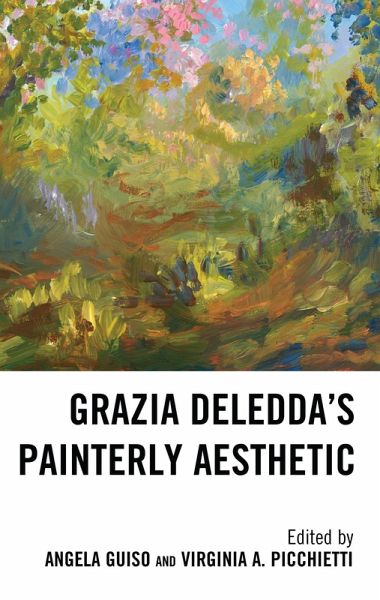
Central to Grazia Deledda's narrative worlds are the relationships between her characters and the vast landscapes in which they move and act. The writer translates and represents her characters, her characters' emotions, and her natural and urban landscapes with a vocabulary that is often related to the visual arts. However, although her descriptions contain the gradations of Modernist painting, beginning with Impressionism, no book-length study, and with diverse perspectives, has thus far investigated Deledda's relationship with the visual arts and the resulting painterly aesthetic of her…mehr
Central to Grazia Deledda's narrative worlds are the relationships between her characters and the vast landscapes in which they move and act. The writer translates and represents her characters, her characters' emotions, and her natural and urban landscapes with a vocabulary that is often related to the visual arts. However, although her descriptions contain the gradations of Modernist painting, beginning with Impressionism, no book-length study, and with diverse perspectives, has thus far investigated Deledda's relationship with the visual arts and the resulting painterly aesthetic of her multicolored narratives. In this sense, Grazia Deledda's Painterly Aesthetic provides an articulated literary panorama of Deledda's novels and short stories through a discourse that is situated between literature and pictorial art. Inspired by these two cardinal points, the analyses are undertaken by contributors who have a profound awareness of an epochal change and work in different disciplines. One year from the centenary of her receipt of the Nobel Prize, the contributors investigate the connections, consonances, and differences between Grazia Deledda's oeuvre and other works inside this panorama to verify a possible unity of purpose. At the same time, they seek to ascertain whether these connections can corroborate and exalt the choices that the Sardinian writer made to free herself from the constraints of a hostile environment.
Die Herstellerinformationen sind derzeit nicht verfügbar.
Autorenporträt
Angela Guiso is an established literary critic, author of numerous studies on modern and contemporary Italian literature, and authoritative voice in Deledda studies. Virginia A. Picchietti is professor of Italian and women's and gender studies at the University of Scranton.
Inhaltsangabe
Section I: From the Language of the Painters of the Secessione Romana to Ignacio Zuloaga's Chromatism Chapter 1: From the "Anticlassical" Barbagia to the "Gerusalemme dell'arte": The Representation of the Island in the Works of Grazia Deledda. Between Primitivism and the Aesthetics of the Secessions Dino Manca Chapter 2: Deledda, Modernism, Primitivism, and Contemporary Art Giuliana Altea Chapter 3: Grazia Deledda's Landscape Writings: Ignacio Zuloaga's Pictorial Suggestions in "L'uomo nuovo" and "Lasciare o prendere?" Ombretta Frau Section II: The Long Journey of Deledda's Narratives from Impressionism to Art Déco Chapter 4: Impressionist Style in Deledda's Landscapes Clara Incani Carta Chapter 5: An Explorer's "Soul [.] Enlightened by the Shining Art": Grazia Deledda's Epistemology as a Traveller Through Observation, Discourse, and Image Tania Manca Section III: The Chiaroscuro of Deledda's Short Stories Chapter 6: The Space Between: Deledda's Doors as Frames for Visual and Symbolic Landscapes Marella Feltrin-Morris Chapter 7: "The Feast of Christ" and the Practice of Forgiveness According to Grazia Deledda Stefania Lucamante Section IV: Artistic Connections across Continents: Deledda and Mansfield, Morisot, Cather, Wharton Chapter 8: Between Affinity and Sisterhood: Nature and Art in Grazia Deledda's Visual Writing Angela Guiso Chapter 9: Landscapes of Desolation: Philosophical Pessimism in Grazia Deledda's Canne al vento (1913) and Edith Wharton's Ethan Frome (1911) Maria Novella Mercuri Chapter 10: Marianna Sirca, Alexandra Bergson, and Marie Tovesky Shabata: Understanding Grazia Deledda and Willa Cather's Female Protagonists through Berthe Morisot's Impressionist Paintings Virginia A. Picchietti
Es gelten unsere Allgemeinen Geschäftsbedingungen: www.buecher.de/agb
Impressum
www.buecher.de ist ein Internetauftritt der buecher.de internetstores GmbH
Geschäftsführung: Monica Sawhney | Roland Kölbl | Günter Hilger
Sitz der Gesellschaft: Batheyer Straße 115 - 117, 58099 Hagen
Postanschrift: Bürgermeister-Wegele-Str. 12, 86167 Augsburg
Amtsgericht Hagen HRB 13257
Steuernummer: 321/5800/1497
USt-IdNr: DE450055826