31,95 €
31,95 €
inkl. MwSt.
Sofort per Download lieferbar

16 °P sammeln
31,95 €
Als Download kaufen
31,95 €
inkl. MwSt.
Sofort per Download lieferbar
16 °P sammeln
Jetzt verschenken
Alle Infos zum eBook verschenken
31,95 €
inkl. MwSt.
Sofort per Download lieferbar
Alle Infos zum eBook verschenken
16 °P sammeln

Andere Kunden interessierten sich auch für
") Great War Modernisms and 'The New Age' Magazine (eBook, PDF)31,95 €
Great War Modernisms and 'The New Age' Magazine (eBook, PDF)31,95 €") Gerard Manley Hopkins (eBook, ePUB)39,95 €
Gerard Manley Hopkins (eBook, ePUB)39,95 €") Blake, Deleuzian Aesthetics, and the Digital (eBook, ePUB)31,95 €
Blake, Deleuzian Aesthetics, and the Digital (eBook, ePUB)31,95 €") The Constitution of English Literature (eBook, ePUB)28,95 €
The Constitution of English Literature (eBook, ePUB)28,95 €") Angela Carter: New Critical Readings (eBook, ePUB)31,95 €
Angela Carter: New Critical Readings (eBook, ePUB)31,95 €") Jeanette Winterson (eBook, ePUB)19,95 €
Jeanette Winterson (eBook, ePUB)19,95 €") Reading Zadie Smith (eBook, ePUB)22,95 €
Reading Zadie Smith (eBook, ePUB)22,95 €

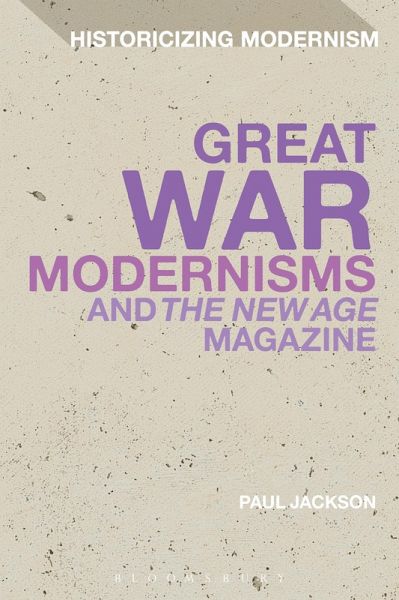
The literary magazine The New Age brought together a diverse set of intellectuals. Against the backdrop of the First World War, they chose to write about more than modernist art and aesthetics. By closely reading and contextualizing their contributions, Paul Jackson's study engages with the political and philosophical responses of literary artists to modernity. Jackson demonstrates the need to interpret modernism not merely as an aesthetic phenomenon,but inherently linked to politics and philosophy.
By placing the writing of a canonical modernist, Wyndham Lewis, against a figure usually excluded from the modernist canon, H.G. Wells, Jackson examines further a wartime modernism that embraced socialist and political views. This reinterpretation of modernism provides a historicised understanding of the politicised hopes of artists promoting revolutionary forms of cultural renewal. Considering modernist writers' relationship between politics,philosophy and aesthetics in the context of total war Jackson encourages new cultural-historical definitions of modernism. In addition this study provides the first close analysis of cultural contributions from a leading wartime Little Magazine, tracing the radical modernist debates that developed in its pages.