Sie sind bereits eingeloggt. Klicken Sie auf 2. tolino select Abo, um fortzufahren.
Bitte loggen Sie sich zunächst in Ihr Kundenkonto ein oder registrieren Sie sich bei bücher.de, um das eBook-Abo tolino select nutzen zu können.
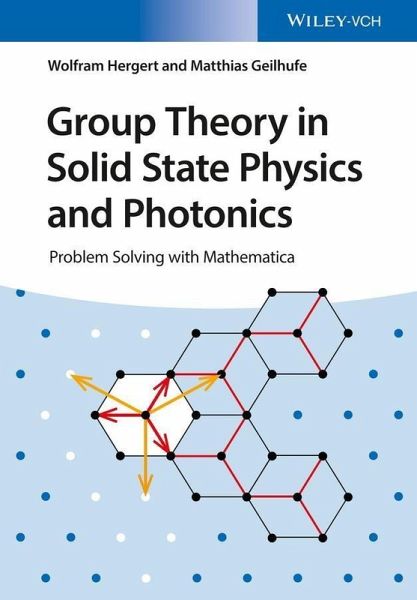
Das Prinzip der Gruppentheorie ist gut einführt. Dennoch werden in diesem Lehrbuch zwei komplett neue Aspekte vorgestellt: besseres Verständnis durch die Konzentration auf Problemlösungsstrategien und der weitreichende Einsatz von Mathematica sowie die Einführung eines neuen Tools für die Photonik durch die Anwendung von Konzepten auf photonische Fasern und Kristalle.
Das Prinzip der Gruppentheorie ist gut einführt. Dennoch werden in diesem Lehrbuch zwei komplett neue Aspekte vorgestellt: besseres Verständnis durch die Konzentration auf Problemlösungsstrategien und der weitreichende Einsatz von Mathematica sowie die Einführung eines neuen Tools für die Photonik durch die Anwendung von Konzepten auf photonische Fasern und Kristalle.
Dieser Download kann aus rechtlichen Gründen nur mit Rechnungsadresse in D ausgeliefert werden.
Die Herstellerinformationen sind derzeit nicht verfügbar.
Autorenporträt
Wolfram Hergert, extraordinary professor in Computational Physics, is member of the Theoretical Physics group at University Halle-Wittenberg, Germany. Main subjects of his work are solid state theory, electronic and magnetic structure of nanostructures and photonics. Prof. Hergert has experience in teaching group theory and in applying Mathematica to physical problems. He has published in renowned journals, like Nature and Physical Review Letters, and edited a books on Computational Materials Science and Mie Theory. He is also coauthor of a book on Quantum Theory. R. Matthias Geilhufe is currently a post-doctoral researcher at the Nordic Institute for Theoretical Physics (Nordita) in Stockholm (Sweden). He completed his undergraduate and postgraduate studies at the Martin Luther University Halle-Wittenberg (Germany) with specialization in theoretical and computational physics and did his PhD in connection with the Max Planck Institute of Microstructure Physics in Halle. His main research interests are in condensed matter theory, in particular functional organic materials, Dirac materials, superconductivity, and topological band theory.
Inhaltsangabe
1 Preface 2 Introduction
I Basics of group theory 3 Symmetry operations and transformations of fields 4 Basic abstract group theory 5 Discrete symmetry groups for solid state physics and photonics 6 Representation theory 7 Symmetry in k-space
II Applications in electronic structure theory 8 Solution of the Schroedinger equation 9 Generalization to include the spin 10 Electronic energy bands
III Applications in photonics 11 Solution of Maxwell's equations 12 Twodimensional photonic crystals 13 Threedimensional photonic crystals 14 Other Applications
A Mathematica Package Reference B Connection of the group theory package to MPB and MEEP
I Basics of group theory 3 Symmetry operations and transformations of fields 4 Basic abstract group theory 5 Discrete symmetry groups for solid state physics and photonics 6 Representation theory 7 Symmetry in k-space
II Applications in electronic structure theory 8 Solution of the Schroedinger equation 9 Generalization to include the spin 10 Electronic energy bands
III Applications in photonics 11 Solution of Maxwell's equations 12 Twodimensional photonic crystals 13 Threedimensional photonic crystals 14 Other Applications
A Mathematica Package Reference B Connection of the group theory package to MPB and MEEP
Es gelten unsere Allgemeinen Geschäftsbedingungen: www.buecher.de/agb
Impressum
www.buecher.de ist ein Internetauftritt der buecher.de internetstores GmbH
Geschäftsführung: Monica Sawhney | Roland Kölbl | Günter Hilger
Sitz der Gesellschaft: Batheyer Straße 115 - 117, 58099 Hagen
Postanschrift: Bürgermeister-Wegele-Str. 12, 86167 Augsburg
Amtsgericht Hagen HRB 13257
Steuernummer: 321/5800/1497
USt-IdNr: DE450055826