0,49 €
inkl. MwSt.
Sofort per Download lieferbar
0 °P sammeln

Andere Kunden interessierten sich auch für
 (eBook, ePUB)") Hadrian the Seventh (Summarized Edition) (eBook, ePUB)0,49 €
Hadrian the Seventh (Summarized Edition) (eBook, ePUB)0,49 €") Hadrian the Seventh (eBook, ePUB)1,99 €
Hadrian the Seventh (eBook, ePUB)1,99 € (eBook, ePUB)") Hadrian the Seventh (Historical Novel) (eBook, ePUB)1,99 €
Hadrian the Seventh (Historical Novel) (eBook, ePUB)1,99 €") Hadrian the Seventh (eBook, ePUB)1,99 €
Hadrian the Seventh (eBook, ePUB)1,99 €") Hadrian the Seventh (eBook, ePUB)1,99 €
Hadrian the Seventh (eBook, ePUB)1,99 € (eBook, ePUB)") Hadrian the Seventh (Historical Novel) (eBook, ePUB)0,49 €
Hadrian the Seventh (Historical Novel) (eBook, ePUB)0,49 €") Hadrian the Seventh (eBook, ePUB)1,99 €
Hadrian the Seventh (eBook, ePUB)1,99 €

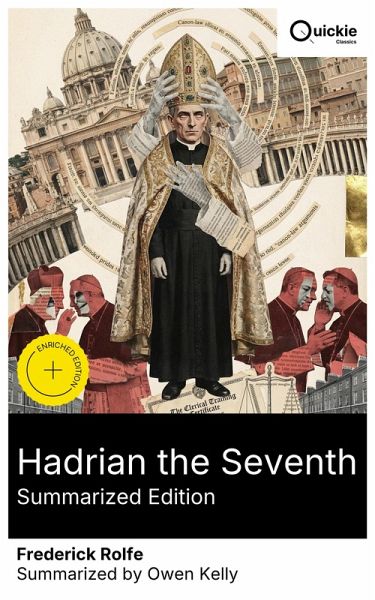
First published in 1904, Hadrian the Seventh imagines the thwarted Englishman George Arthur Rose unexpectedly elected pope and, as Hadrian VII, reforming Church and world with dazzling audacity. Rolfe's baroque, liturgy-saturated prose fuses satire, revenge fantasy, and punctilious canon-law detail. The novel stands between fin-de-siècle decadence and early modernism, anticipating autofiction and camp ecclesial comedy. Frederick Rolfe-self-styled Baron Corvo-was a Catholic convert repeatedly thwarted in clerical training, quarrelsome with patrons, and chronically poor. His wounded vocation and ferocious self-mythologizing shape the book: George Arthur Rose is an unmistakable alter ego, endowed with Rolfe's fastidious Latinity, exacting aesthetic tastes, and desire to discipline a world that had humiliated him. Hadrian the Seventh deserves readers of ecclesiastical history, satire, and decadent letters alike. Come for glittering sentences and procedural verisimilitude; stay for an unnervingly intimate study of charisma, ressentiment, and reforming zeal. Few novels clarify so crisply why authority enthralls-and corrodes-the souls that crave it, or make grievance so disturbingly entertaining. Quickie Classics summarizes timeless works with precision, preserving the author's voice and keeping the prose clear, fast, and readable-distilled, never diluted. Enriched Edition extras: Introduction · Synopsis · Historical Context · Brief Analysis · 4 Reflection Q&As · Editorial Footnotes.
Dieser Download kann aus rechtlichen Gründen nur mit Rechnungsadresse in A, B, BG, CY, CZ, D, DK, EW, E, FIN, F, GR, H, IRL, I, LT, L, LR, M, NL, PL, P, R, S, SLO, SK ausgeliefert werden.