Sie sind bereits eingeloggt. Klicken Sie auf 2. tolino select Abo, um fortzufahren.
Bitte loggen Sie sich zunächst in Ihr Kundenkonto ein oder registrieren Sie sich bei bücher.de, um das eBook-Abo tolino select nutzen zu können.
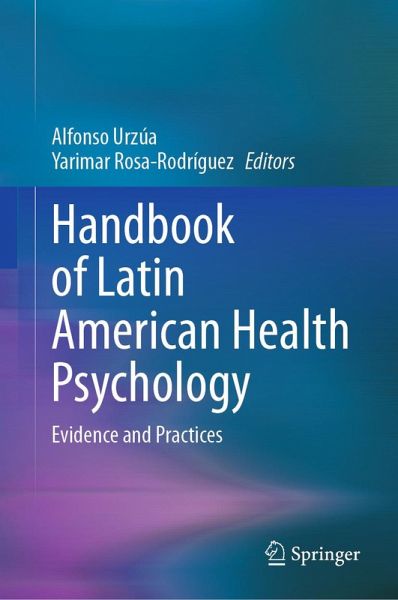
This handbook presents a comprehensive overview of a tradition of psychological research and practice little known in the English-speaking world: the Latin American school of health psychology. Even though health psychology as a field of research and practice was born in Latin America with the creation of the National Group of Health Psychology within the Cuban Ministry of Public Health in 1969, this genesis is seldom acknowledged in the international literature. And even less is known on an international level about the original contributions that Latin American health psychologists have made…mehr
This handbook presents a comprehensive overview of a tradition of psychological research and practice little known in the English-speaking world: the Latin American school of health psychology. Even though health psychology as a field of research and practice was born in Latin America with the creation of the National Group of Health Psychology within the Cuban Ministry of Public Health in 1969, this genesis is seldom acknowledged in the international literature. And even less is known on an international level about the original contributions that Latin American health psychologists have made and still make to the development of the discipline.
This volume aims to fill this gap by presenting to the international community a comprehensive account of the particular trajectory of health psychology in Latin America and the original contributions made by a field of research and practice that has always tried to integrate a socio-culturally sensitive approach to develop studies and interventions in health promotion and disease prevention. This is done by bringing together chapters written by leading experts from the region that explain the specific social, political and cultural contexts in which health psychology developed in Latin America; present the original theoretical and methodological approaches developed by Latin American health psychologists; and provide an overview of current research done in the region about the contribution of psychology to the management of various health conditions.
The Handbook of Latin American Health Psychology will be of interest to researchers, practitioners and students interested in the internationalization and cross-cultural generalizability of health psychology, as a tool for building a truly global and culturally sensitive discipline.
Some chapters of this handbook were originally written in Spanish and translated into English with the help of artificial intelligence. A subsequent human revision was done primarily in terms of content.
Dieser Download kann aus rechtlichen Gründen nur mit Rechnungsadresse in A, B, BG, CY, CZ, D, DK, EW, E, FIN, F, GR, HR, H, IRL, I, LT, L, LR, M, NL, PL, P, R, S, SLO, SK ausgeliefert werden.
Die Herstellerinformationen sind derzeit nicht verfügbar.
Autorenporträt
Alfonso Urzúa is full Professor and researcher at the School of Psychology from Universidad Católica del Norte, Chile. Psychologist and Licentiate in Psychology from the Universidad de Tarapacá, Master in Public Health from the Universidad de Chile and Doctor in Clinical and Health Psychology from the Universitat de Barcelona. He has presented multiple reports and conferences nationally and on several continents. He has published over 200 articles in WoS and Scopus journals on well-being, quality of life and health, as well as books and book chapters. Past editor of Terapia Psicológica, member of editorial and/or scientific committees of Scientific Journals in Psychology in several countries. Past President of the Interamerican Society of Psychology [SIP], has been part of the board of the Latin American Association of Health Psychology [ALAPSA], the Chilean Society of Scientific Psychology, the Chilean Society of Clinical Psychology and Psychotherapy, the Chilean Society of Health Psychology and Behavioral Medicine. Honorary Member of the College of Psychologists of Peru and the Cuban Society of Health Psychology. He is currently the director of the Doctoral Program taught by the School of Psychology at the Universidad Católica del Norte. Among other distinctions, he has been distinguished with the award for current contribution to psychological research by the Scientific Society of Psychology of Chile and 2021, 2022 and 2023 for being in the top 2% of most cited researchers in the world in his specialty in SCOPUS. Since 2013 he is the principal investigator, with funding from the government of Chile through the National Fund for Scientific and Technological Development [FONDECYT], currently on health and migration issues. Yarimar Rosa-Rodríguez has a doctorate in philosophy specialized in clinical psychology from the University of Puerto Rico (UPR) and a diploma in Gender and Feminist Movements from the University of Buenos Aires. She is researcher at the Institute for Psychological Research, currently Director of the Educational Research Center, of the College of Education at the Río Piedras campus of the UPR. She has offered courses in research methods and practice, sexuality, gender, and health psychology at the undergraduate and graduate levels in the Departments of Psychology, Social Work, and the Women and Gender Studies Program at the UPR. She is co-director of the SIEMPRE VIVAS Metro project, dedicated to intervention, prevention, activism and research on gender violence on university campuses. She is also a visiting professor at the Universidad Católica del Norte de Chile, where she offers an annual seminar on qualitative and mixed methods research. She combines her research tasks with teaching and training undergraduate and graduate students in a variety of research methods. Her research work is aimed at evaluating the intersections of gender and sex in women health, sexual harassment of women and diverse gender and sex communities, from a feminist perspective. She is a certified Trauma Sensitive Yoga facilitator through the Justice Resource Institute's Trauma Center and Embodiment. She has collaborated in the design and evaluation of direct service programs for vulnerable communities on the island. She is editor of the Salud & Sociedad Journal, member of the Latin American Psychological Association of Health Psychology (ALAPSA) and Vice President for the Central America and Caribbean region of the Interamerican Society of Psychology.
Inhaltsangabe
Introduction.- Section 1. The context of health psychology in Latin America.- Chapter 1. Contextual elements for the development of psychology in the region.- Chapter 2. History and development of health psychology in Latin America - Jorge Grau + 1 or 2 authors.- Chapter 3. Insertion of psychology in health systems- Olga Infante + 1 or 2 authors.- Chapter 4. Psychology in hospital settings in Latin American context - Eduardo Remor + 1 or 2 authors.- Section 2. Conceptual Elements.- Chapter 5. Perspectives on Health Behavior Change in Latin America: Examining Key Models and Evidence - María José Baeza Rivera, Camila Salazar Fernández & Natalia Salinas Oñate.- Chapter 6. Health promotion and disease prevention in Latin America - María Teresa Varela Arévalo, Ana Marcela Uribe Figueroa & Diana Carolina Rubio León.- Chapter 7. Gender and Health: Rethinking Gender in Healthcare, Beyond the Binarism - Tania Rocha + 1 or 2 authors.- Chapter 8. Well-being and Health - Alfonso Urzúa & Alejandra Caqueo.- Chapter 9. Community Participation in the Promotion of Health in Latin America- Blanca Ortiz-Torres & Julio Santana-Mariño.- Section 3. Health and disease topics.- Chapter 10. Diabetes - Manuel Ortiz + 1 or 2 authors.- Chapter 11. Cardiovascular Health - Leonell Torres + 1 or 2 authors.- Chapter 12. Respiratory system - Japcy Quiceno, Andrea Hernández Pérez & Ireri Thirión Romero.- Chapter 13. Cancer - Ma. del Carmen Llantá, Jennifer Morales-Cruz, Olimpia Petzold, Marilyn Toledo & Oscar Galindo.- Chapter 15. Reproductive and Sexual Health - Yarimar Rosa-Rodríguez + 1 or 2 authors.- Chapter 16. Musculoskeletal system - Stefano Vinaccia, Lorena Cudris-Torres & Álvaro Barrios-Núñez.- Chapter 17. Stress - Tomás Caycho-Rodríguez, Jonatan Baños-Chaparro & Julio Torales.- Chapter 18. Sexually transmitted diseases and infections - Carlos Pineda, Adalberto Campo-Arias & Mayra Gómez-Lugo.- Chapter 19. Sleep Disorders - Daniel Yupanqui + 1 or 2 authors.- Chapter 20. Eating behavior - Camila Oda + 1 or 2 authors.- Chapter 21. Pain - Alberto Cobian + 1 or 2 authors.- Chapter 22. Drug consumption - Claudio Rojas-Jara, Rodrigo Moreta-Herrera & Rodrigo Gutiérrez.- Chapter 23. Adherence and medication consumption - Andrés Pérez-Acosta & Adriana Urbina.- Chapter 24. Health Psychology interventions in Children and Adolescents - Maricela Osorio Guzmán & Carlos Prado Romero.- Chapter 25. Olders: Psychology of health interventions with elderly - Rosa Meda, Antonio Kobayashi & Jason Aragón.- Chapter 26 . Psychological interventions in emergent situations.- Conclusions.
Introduction.- Section 1. The context of health psychology in Latin America.- Chapter 1. Contextual elements for the development of psychology in the region.- Chapter 2. History and development of health psychology in Latin America - Jorge Grau + 1 or 2 authors.- Chapter 3. Insertion of psychology in health systems- Olga Infante + 1 or 2 authors.- Chapter 4. Psychology in hospital settings in Latin American context - Eduardo Remor + 1 or 2 authors.- Section 2. Conceptual Elements.- Chapter 5. Perspectives on Health Behavior Change in Latin America: Examining Key Models and Evidence - María José Baeza Rivera, Camila Salazar Fernández & Natalia Salinas Oñate.- Chapter 6. Health promotion and disease prevention in Latin America - María Teresa Varela Arévalo, Ana Marcela Uribe Figueroa & Diana Carolina Rubio León.- Chapter 7. Gender and Health: Rethinking Gender in Healthcare, Beyond the Binarism - Tania Rocha + 1 or 2 authors.- Chapter 8. Well-being and Health - Alfonso Urzúa & Alejandra Caqueo.- Chapter 9. Community Participation in the Promotion of Health in Latin America- Blanca Ortiz-Torres & Julio Santana-Mariño.- Section 3. Health and disease topics.- Chapter 10. Diabetes - Manuel Ortiz + 1 or 2 authors.- Chapter 11. Cardiovascular Health - Leonell Torres + 1 or 2 authors.- Chapter 12. Respiratory system - Japcy Quiceno, Andrea Hernández Pérez & Ireri Thirión Romero.- Chapter 13. Cancer - Ma. del Carmen Llantá, Jennifer Morales-Cruz, Olimpia Petzold, Marilyn Toledo & Oscar Galindo.- Chapter 15. Reproductive and Sexual Health - Yarimar Rosa-Rodríguez + 1 or 2 authors.- Chapter 16. Musculoskeletal system - Stefano Vinaccia, Lorena Cudris-Torres & Álvaro Barrios-Núñez.- Chapter 17. Stress - Tomás Caycho-Rodríguez, Jonatan Baños-Chaparro & Julio Torales.- Chapter 18. Sexually transmitted diseases and infections - Carlos Pineda, Adalberto Campo-Arias & Mayra Gómez-Lugo.- Chapter 19. Sleep Disorders - Daniel Yupanqui + 1 or 2 authors.- Chapter 20. Eating behavior - Camila Oda + 1 or 2 authors.- Chapter 21. Pain - Alberto Cobian + 1 or 2 authors.- Chapter 22. Drug consumption - Claudio Rojas-Jara, Rodrigo Moreta-Herrera & Rodrigo Gutiérrez.- Chapter 23. Adherence and medication consumption - Andrés Pérez-Acosta & Adriana Urbina.- Chapter 24. Health Psychology interventions in Children and Adolescents - Maricela Osorio Guzmán & Carlos Prado Romero.- Chapter 25. Olders: Psychology of health interventions with elderly - Rosa Meda, Antonio Kobayashi & Jason Aragón.- Chapter 26 . Psychological interventions in emergent situations.- Conclusions.
Es gelten unsere Allgemeinen Geschäftsbedingungen: www.buecher.de/agb
Impressum
www.buecher.de ist ein Internetauftritt der buecher.de internetstores GmbH
Geschäftsführung: Monica Sawhney | Roland Kölbl | Günter Hilger
Sitz der Gesellschaft: Batheyer Straße 115 - 117, 58099 Hagen
Postanschrift: Bürgermeister-Wegele-Str. 12, 86167 Augsburg
Amtsgericht Hagen HRB 13257
Steuernummer: 321/5800/1497
USt-IdNr: DE450055826