46,95 €
46,95 €
inkl. MwSt.
Sofort per Download lieferbar

23 °P sammeln
46,95 €
Als Download kaufen
46,95 €
inkl. MwSt.
Sofort per Download lieferbar
23 °P sammeln
Jetzt verschenken
Alle Infos zum eBook verschenken
46,95 €
inkl. MwSt.
Sofort per Download lieferbar
Alle Infos zum eBook verschenken
23 °P sammeln

Andere Kunden interessierten sich auch für
") Handbook of Urban Mobilities (eBook, PDF)46,95 €
Handbook of Urban Mobilities (eBook, PDF)46,95 €") Justice and Cities (eBook, ePUB)36,95 €
Justice and Cities (eBook, ePUB)36,95 €") David Harvey (eBook, ePUB)21,95 €
David Harvey (eBook, ePUB)21,95 €") Inside Smart Cities (eBook, ePUB)39,95 €
Inside Smart Cities (eBook, ePUB)39,95 €") Sharing Mobilities (eBook, ePUB)39,95 €
Sharing Mobilities (eBook, ePUB)39,95 €") Ethical Cities (eBook, ePUB)37,95 €
Ethical Cities (eBook, ePUB)37,95 €") Justice and Cities (eBook, PDF)36,95 €
Justice and Cities (eBook, PDF)36,95 €

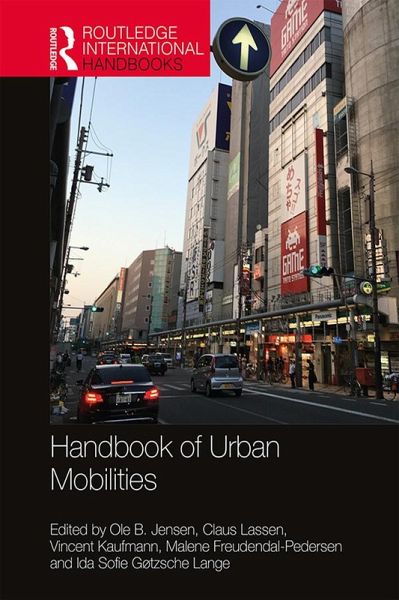
This book offers the reader a comprehensive understanding and the multitude of methods utilized in the research of urban mobilities with cities and 'the urban' as its pivotal axis. It covers theories and concepts for scholars and researchers to understand, observe and analyse the world of urban mobilities.
The Handbook of Urban Mobilities facilitates the understanding of urban mobilities within a historic conscience of societal transformation. It explores key concepts and theories within the 'mobilities turn' with a particular urban framework, as well as the methods and tools at play when empirical, urban mobilities research is undertaken. This book also explores the urban mobilities practices related to commutes; particular modes of moving; the exploration of everyday life and embodied practices as they manifest themselves within urban mobilities; and the themes of power, conflict, and social exclusion. A discussion of urban planning, public control, and governance is also undertaken in the book, wherein the themes of infrastructures, technologies and design are duly considered.
With chapters written in an accessible style, this handbook carries timely contributions within the contemporary state of the art of urban mobilities research. It will thus be useful for academics and students of graduate programmes and post-graduate studies within disciplines such as urban geography, political science, sociology, anthropology, urban planning, traffic and transportation planning, and architecture and urban design.
The Handbook of Urban Mobilities facilitates the understanding of urban mobilities within a historic conscience of societal transformation. It explores key concepts and theories within the 'mobilities turn' with a particular urban framework, as well as the methods and tools at play when empirical, urban mobilities research is undertaken. This book also explores the urban mobilities practices related to commutes; particular modes of moving; the exploration of everyday life and embodied practices as they manifest themselves within urban mobilities; and the themes of power, conflict, and social exclusion. A discussion of urban planning, public control, and governance is also undertaken in the book, wherein the themes of infrastructures, technologies and design are duly considered.
With chapters written in an accessible style, this handbook carries timely contributions within the contemporary state of the art of urban mobilities research. It will thus be useful for academics and students of graduate programmes and post-graduate studies within disciplines such as urban geography, political science, sociology, anthropology, urban planning, traffic and transportation planning, and architecture and urban design.
Dieser Download kann aus rechtlichen Gründen nur mit Rechnungsadresse in A, B, BG, CY, CZ, D, DK, EW, E, FIN, F, GR, HR, H, IRL, I, LT, L, LR, M, NL, PL, P, R, S, SLO, SK ausgeliefert werden.
"Featuring the most prominent scholars in the field, the Handbook of Urban Mobilities is a must have for all those interested in the intersection of mobilities studies and urban spaces. The essays in the handbook focus on the ways in which mobilities provides a framework to study the urban, and all its related networks, such as people, technologies, geographies, and culture. As such, the authors constantly remind us that mobilities is not only about increased speed, but also about immobilities, moorings, and differential mobilities. Focusing on the the histories, theories, practices, infrastructures and methods to study the interdependence between cities and mobilities, the essays in this handbook constantly ask, "What is urban in mobilities?"
- Adriana de Souza e Silva, Professor, Department of Communication, NC State University, USA
"The social sciences, humanities and design disciplines have become preoccupied with mobilities in the past two decades - and for good reason: the challenges and crises of our cities and our world are utterly linked to how people, things and flows move across the world.
In this superb collection, for the first time, readers can gain a state-of-the-art overview of this crucial 'mobilities turn'. Through fully 44 chapters from many of the leading lights in the movement, insightful reviews address all of its key dimensions. Justice, climate change, disability and gender; walking, cycling, driving and public transport; digitisation, 'smart' cities and 'Big Data'; questions of class, ethnicity, (dis)ability and the bodym, issues of design, planning, governance and architecture; the challenges of doing mobility research itself -- all receive expert treatment. The result is a truly definitive collection"
- Stephen Graham, Professor of Cities and Society, Newcastle University
"Cities pulse to the rhythms of mobilities. This expertly curated handbook is an essential reference guide for navigating the heady swirl of mobile technologies, infrastructures, practices and materialities that make cities what they are."
- David Bissell, The University of Melbourne
- Adriana de Souza e Silva, Professor, Department of Communication, NC State University, USA
"The social sciences, humanities and design disciplines have become preoccupied with mobilities in the past two decades - and for good reason: the challenges and crises of our cities and our world are utterly linked to how people, things and flows move across the world.
In this superb collection, for the first time, readers can gain a state-of-the-art overview of this crucial 'mobilities turn'. Through fully 44 chapters from many of the leading lights in the movement, insightful reviews address all of its key dimensions. Justice, climate change, disability and gender; walking, cycling, driving and public transport; digitisation, 'smart' cities and 'Big Data'; questions of class, ethnicity, (dis)ability and the bodym, issues of design, planning, governance and architecture; the challenges of doing mobility research itself -- all receive expert treatment. The result is a truly definitive collection"
- Stephen Graham, Professor of Cities and Society, Newcastle University
"Cities pulse to the rhythms of mobilities. This expertly curated handbook is an essential reference guide for navigating the heady swirl of mobile technologies, infrastructures, practices and materialities that make cities what they are."
- David Bissell, The University of Melbourne