42,95 €
inkl. MwSt.
Sofort per Download lieferbar
21 °P sammeln

Andere Kunden interessierten sich auch für
") Health, Housing, and Homelessness (eBook, PDF)42,95 €
Health, Housing, and Homelessness (eBook, PDF)42,95 €") Illicit Medicines in the Global South (eBook, ePUB)39,95 €
Illicit Medicines in the Global South (eBook, ePUB)39,95 €") Health, Disability and the Capability Approach (eBook, ePUB)39,95 €
Health, Disability and the Capability Approach (eBook, ePUB)39,95 €") New Directions in Health Education (eBook, ePUB)26,95 €
New Directions in Health Education (eBook, ePUB)26,95 €") Health Care Systems in Europe and Asia (eBook, ePUB)45,95 €
Health Care Systems in Europe and Asia (eBook, ePUB)45,95 €") Managing Projects in Health and Social Care (eBook, ePUB)54,95 €
Managing Projects in Health and Social Care (eBook, ePUB)54,95 €") Critical Reflection in Context (eBook, ePUB)41,95 €
Critical Reflection in Context (eBook, ePUB)41,95 €
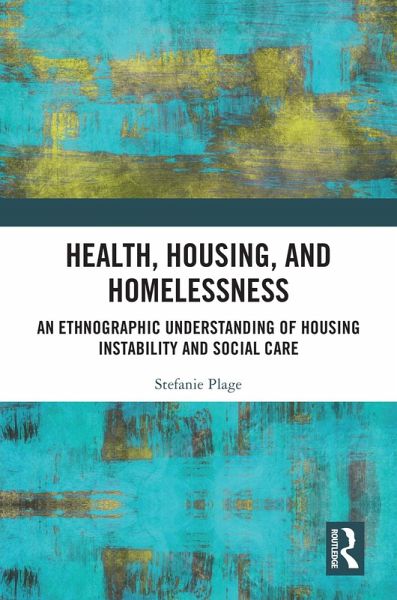
Examining the fundamental relationship between housing and health, this perceptive volume illuminates how the health of those living with housing instability is affected by the day-to-day issues they face.
Based on a series of interviews with both those affected by this issue and health and social care practitioners, as well as ethnographic observations at multiple sites of a health care centre, this book examines how housing instability shapes both the health services that people are able to access and their own approach to self-care. It highlights how housing instability is inextricably linked to poorer health outcomes, and suggests how individual, collective, and institutional practices can be reimagined to address the disparity between those with and without a stable home.
This book will interest scholars and students across the Sociology of Health and Illness, Social Work, Public Health, and Social Policy, as well as practitioners in this field.
Based on a series of interviews with both those affected by this issue and health and social care practitioners, as well as ethnographic observations at multiple sites of a health care centre, this book examines how housing instability shapes both the health services that people are able to access and their own approach to self-care. It highlights how housing instability is inextricably linked to poorer health outcomes, and suggests how individual, collective, and institutional practices can be reimagined to address the disparity between those with and without a stable home.
This book will interest scholars and students across the Sociology of Health and Illness, Social Work, Public Health, and Social Policy, as well as practitioners in this field.
Dieser Download kann aus rechtlichen Gründen nur mit Rechnungsadresse in A, B, BG, CY, CZ, D, DK, EW, E, FIN, F, GR, HR, H, IRL, I, LT, L, LR, M, NL, PL, P, R, S, SLO, SK ausgeliefert werden.
"Part short-stories, part scholarship and part policy critique, Plage takes readers along on her moving research journey into health and housing instability in one Australian city. Artfully drawing on fieldwork, she tells the stories of people experiencing homelessness and housing instability, tempering these stories of care, trying, and reframed hope with concepts from relevant contemporary social theorists. The result: a timely, affectively intense and academically powerful re-imagination of the intersections between health, housing and care that leaves readers wanting more for participants and from policy."
Prof Rebecca Olson, School of Social Science, The University of Queensland, Australia
"This groundbreaking book offers a powerful and deeply insightful exploration of the intersection between housing instability and health. With rich empirical research and a bold theoretical approach, it challenges conventional ideas about healthcare access, self-care, and often overly simplistic 'social determinants' paradigms. By centering lived experiences of people who are marginalised and drawing on affect theory and feminist scholarship, Plage reveals the plethora of systemic barriers that persistently undermine health equity while illuminating the day-to-day resilience and relational care practices of those navigating housing instability. A vital and urgent contribution, this book is essential reading for scholars, practitioners, and policymakers committed to reimagining care and justice in our health and social systems."
Prof Alex Broom, Director, Sydney Centre for Healthy Societies, The University of Sydney, Australia
Prof Rebecca Olson, School of Social Science, The University of Queensland, Australia
"This groundbreaking book offers a powerful and deeply insightful exploration of the intersection between housing instability and health. With rich empirical research and a bold theoretical approach, it challenges conventional ideas about healthcare access, self-care, and often overly simplistic 'social determinants' paradigms. By centering lived experiences of people who are marginalised and drawing on affect theory and feminist scholarship, Plage reveals the plethora of systemic barriers that persistently undermine health equity while illuminating the day-to-day resilience and relational care practices of those navigating housing instability. A vital and urgent contribution, this book is essential reading for scholars, practitioners, and policymakers committed to reimagining care and justice in our health and social systems."
Prof Alex Broom, Director, Sydney Centre for Healthy Societies, The University of Sydney, Australia