52,95 €
52,95 €
inkl. MwSt.
Sofort per Download lieferbar

26 °P sammeln
52,95 €
Als Download kaufen
52,95 €
inkl. MwSt.
Sofort per Download lieferbar
26 °P sammeln
Jetzt verschenken
Alle Infos zum eBook verschenken
52,95 €
inkl. MwSt.
Sofort per Download lieferbar
Alle Infos zum eBook verschenken
26 °P sammeln

Andere Kunden interessierten sich auch für
") Hegel and the State (eBook, ePUB)52,95 €
Hegel and the State (eBook, ePUB)52,95 €") Reason and Revolution (eBook, PDF)19,95 €
Reason and Revolution (eBook, PDF)19,95 €") The Berlin Antisemitism Controversy (eBook, PDF)35,95 €
The Berlin Antisemitism Controversy (eBook, PDF)35,95 €") German Philosophy in the Twentieth Century (eBook, PDF)37,95 €
German Philosophy in the Twentieth Century (eBook, PDF)37,95 €") The Philosophy of Georg Simmel (eBook, PDF)39,95 €
The Philosophy of Georg Simmel (eBook, PDF)39,95 €") Break-Out from the Crystal Palace (eBook, PDF)45,95 €
Break-Out from the Crystal Palace (eBook, PDF)45,95 €") Indian Philosophy and Yoga in Germany (eBook, PDF)0,00 €
Indian Philosophy and Yoga in Germany (eBook, PDF)0,00 €




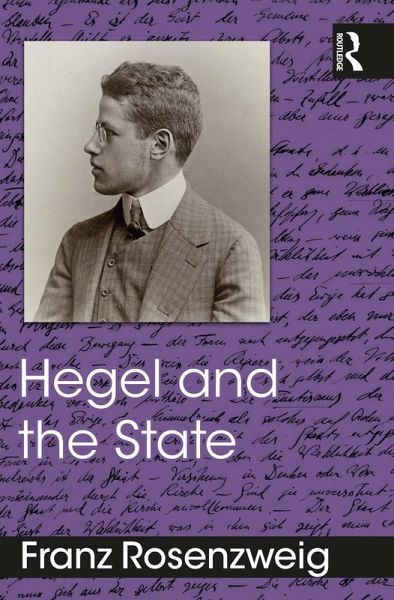
Franz Rosenzweig (1886-1929) is one of the most significant German Jewish philosophers of the twentieth century. Published in German in 1920 and now finally available in English for the first time, Hegel and the State is a major contribution to the understanding of Hegel's political and social thought and a profound analysis of the intellectual currents that shaped the German state in the late nineteenth and early twentieth centuries.
Through careful readings of Hegel's early handwritten manuscripts, Rosenzweig shows that Hegel was wrestling with the problem of how to reconcile the subjectivity and freedom of the individual within a community and ultimately the political state. According to Rosenzweig, the route out of this conundrum chosen by Hegel shaped his mature political philosophy, where he saw the relationship between the individual and the state as reciprocal. At a deeper level, the significance of Hegel and the State lies in the way that Rosenzweig explains the failure of Hegel's quasi-communitarian view of the state to emerge, due to the authoritarian direction of the newly unified German state under Bismarck. Anticipating the political and moral disaster that was to follow, Rosenzweig concludes by questioning the very viability of any theory of the state that relies on the pillars of bureaucratic militarism and a government-supported capitalist business culture.
With the inclusion of a Foreword by Myriam Bienenstock and a substantial Afterword by Axel Honneth, Hegel and the State is a ground-breaking work of early twentieth-century philosophical and political thought. It is essential reading for students of Hegel, German Idealism, Jewish philosophy, and the origins of critical theory. It will also be of interest to those in related subjects such as the history of sociology, and German and intellectual history.
Through careful readings of Hegel's early handwritten manuscripts, Rosenzweig shows that Hegel was wrestling with the problem of how to reconcile the subjectivity and freedom of the individual within a community and ultimately the political state. According to Rosenzweig, the route out of this conundrum chosen by Hegel shaped his mature political philosophy, where he saw the relationship between the individual and the state as reciprocal. At a deeper level, the significance of Hegel and the State lies in the way that Rosenzweig explains the failure of Hegel's quasi-communitarian view of the state to emerge, due to the authoritarian direction of the newly unified German state under Bismarck. Anticipating the political and moral disaster that was to follow, Rosenzweig concludes by questioning the very viability of any theory of the state that relies on the pillars of bureaucratic militarism and a government-supported capitalist business culture.
With the inclusion of a Foreword by Myriam Bienenstock and a substantial Afterword by Axel Honneth, Hegel and the State is a ground-breaking work of early twentieth-century philosophical and political thought. It is essential reading for students of Hegel, German Idealism, Jewish philosophy, and the origins of critical theory. It will also be of interest to those in related subjects such as the history of sociology, and German and intellectual history.
Dieser Download kann aus rechtlichen Gründen nur mit Rechnungsadresse in A, B, BG, CY, CZ, D, DK, EW, E, FIN, F, GR, HR, H, IRL, I, LT, L, LR, M, NL, PL, P, R, S, SLO, SK ausgeliefert werden.
'This remarkable book by one of the twentieth century's leading philosophers and religious thinkers, available for the first time in English translation, is essential reading for anyone who wants to understand how the relationship between political and religious thought has shaped our world. For those who are interested in Hegel's political philosophy, Rosenzweig's book is an illuminating account of the development and political context of a way of thinking that remains relevant today. For those who are interested in Rosenzweig's own religiously inflected thought, this volume shows both the great promise and the crushing disappointment of the German political project that is the prelude to his masterwork, The Star of Redemption.' - Paul Franks, Yale University, USA
'The best book on Hegel's political philosophy is Franz Rosenzweig's Hegel und der Staat, which first appeared in 1920. It is the most thorough in its research, the most extensive in its coverage, and the most rigorous in exposition and argument. Despite these merits, the book has not been translated into English-until now. It appears here in a reliable and accurate translation by Josiah and Jules Simon. This is a major event in Hegel scholarship, and a major contribution to the study of Hegel in the English-speaking world.' - Frederick Beiser, Syracuse University, USA
'The best book on Hegel's political philosophy is Franz Rosenzweig's Hegel und der Staat, which first appeared in 1920. It is the most thorough in its research, the most extensive in its coverage, and the most rigorous in exposition and argument. Despite these merits, the book has not been translated into English-until now. It appears here in a reliable and accurate translation by Josiah and Jules Simon. This is a major event in Hegel scholarship, and a major contribution to the study of Hegel in the English-speaking world.' - Frederick Beiser, Syracuse University, USA