Sie sind bereits eingeloggt. Klicken Sie auf 2. tolino select Abo, um fortzufahren.
Bitte loggen Sie sich zunächst in Ihr Kundenkonto ein oder registrieren Sie sich bei bücher.de, um das eBook-Abo tolino select nutzen zu können.
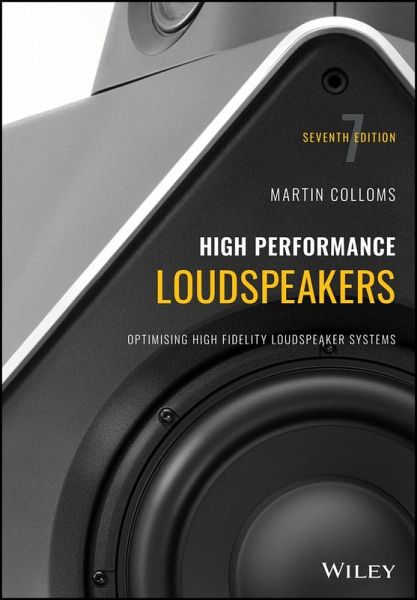
Provides a technology overview of what goes into a high performance loudspeaker and covers all the latest advances in the field The design of high performance loudspeakers requires a mix of developed skills in electroacoustics, high fidelity sound reproduction and subjective evaluation. Taking a designer's view of the subject, this new edition of High Performance Loudspeakers, Seventh Edition provides a comprehensive, timely and practical knowledge base to aid the design of superior loudspeaker systems fit for purpose. It is updated throughout with the latest progress in research and…mehr
Provides a technology overview of what goes into a high performance loudspeaker and covers all the latest advances in the field The design of high performance loudspeakers requires a mix of developed skills in electroacoustics, high fidelity sound reproduction and subjective evaluation. Taking a designer's view of the subject, this new edition of High Performance Loudspeakers, Seventh Edition provides a comprehensive, timely and practical knowledge base to aid the design of superior loudspeaker systems fit for purpose. It is updated throughout with the latest progress in research and technology, synthesis and analysis, digital signal processing incorporated products, automated production test systems and wireless compact designs. This Seventh Edition of the highly successful guide to the design and specifications of high quality loudspeakers and loudspeaker systems addresses the issue of where higher performance and sound quality is required and shows how the numerous considerations -- including application, target price, size, aspiration and particular market -- lead to a complex mix of design and engineering decisions. The book has also been substantially revised to reflect the many changes in the technology of loudspeakers and includes two brand new chapters -- one covering ultra-compact systems and DSP integration, and the second providing details of a worked example of the loudspeaker systems design process. * Offers a complete overview of the technology * Thoroughly updated with new content to reflect the latest advances in the field while retaining the firm theoretical foundation of previous editions * Presents a designer's point of view of the field, helping to equip both amateur enthusiasts and academically trained graduates with industry practice * Covers all the newest developments in the field of high performance loudspeakers * Offers a critical and objective approach to all subjects covered, rather than a simple spelling out of theory and facts * Appeals to both amateur speaker builders as a source of ideas, and to professional speaker designers with an overview of competitive products and features Acknowledged industry-wide as the definitive work on speaker design and analysis, High Performance Loudspeakers, Seventh Edition is essential reading for audio engineers, speaker designers, equipment designers and students of acoustic engineering, electronics and electro-acoustics. It will also prove invaluable to students of electronics, broadcasting and recording techniques, but will also be of interest to authors and journalists in audio, and not least, amateur loudspeaker builders and enthusiasts.
Dieser Download kann aus rechtlichen Gründen nur mit Rechnungsadresse in D ausgeliefert werden.
Die Herstellerinformationen sind derzeit nicht verfügbar.
Autorenporträt
Martin Colloms is an independent electroacoustics engineer in the UK who has seen over 200 of his high fidelity audio and speaker designs put into mass production. Martin has worked as a loudspeaker critic-publishing over 1,500 high fidelity speaker reviews-and is the technical editor of HIFICRITIC.
Inhaltsangabe
Preface to the First Edition xix Preface to the Fifth Edition xxi Preface to the Sixth Edition xxiii Preface to the Seventh Edition xxv Acknowledgements xxvii 1 General Review 1 1.1 Early Loudspeakers 1 1.2 Audible Frequency Range and Wavelength 4 1.3 The BBC Contribution 12 1.4 Emerging Standards 13 1.5 Influence of Improved Low Frequency Analysis 17 1.6 Changes in UK Lifestyle are Affecting Domestic Audio Systems 22 1.7 High End Stereo Audio 23 1.8 Sound Docks 23 1.9 Headphones 27 1.10 Advances in Pro Audio 27 2 Developments in Loudspeaker System Design 31 2.1 Developments in Loudspeaker System Design 31 2.2 Limits to Performance 37 2.3 The Stereo Illusion: '3D Sound' 38 2.4 Sensitivity and Impedance 40 2.5 Enclosures 41 2.6 Drive Units 44 2.7 The Room 47 3 Theoretical Aspects of Diaphragm Radiators 51 3.1 Radiation From Simple Sources 51 3.2 Electromechanics of a Hypothetical Moving Coil Loudspeaker 57 3.3 Radiated Pressure 67 3.4 Relating the TwoPort Model to Low Frequency Analogous Circuits 74 3.5 Higher Modes of the Loudspeaker Diaphragm 77 4 Transducers Diaphragms and Loudspeaker Technologies 87 4.1 Dome Radiators 87 4.2 Velocity of Sound In a Diaphragm 93 4.3 Compensation of Dome Characteristics 95 4.4 Cone Behaviour 95 4.5 Cone Parameters 96 4.6 Cone Shape 104 4.7 Motor Systems 112 4.8 Moving Coil Motor Linearity 115 4.9 Effect of Magnetic Field Strength Variation on Loudspeaker Pressure Response 119 4.10 Magnet Systems 120 4.11 Film Transducers, Magnetic and Electrostatic 126 4.12 Bending Radiators, DML, Distributed Mode and BMR: The Balanced Mode Radiator 144 5 Low Frequency System Analysis: Room Environments and 2 Half Space Radiation 157 5.1 General Considerations 157 5.2 Room Interaction, The Broader Picture 165 5.3 Optimum System Design for Low Subjective Colouration 167 5.4 LF System Analysis 181 5.5 Viewpoint-What Is an Optimal Low Frequency Q Factor for a System? 195 5.6 Closed Box System 198 5.7 Reflex or Vented Enclosures 207 5.8 Band Pass Designs and LF Equalization 224 5.9 Longevity, Reliability, Tolerances, Climate 237 5.10 Transmission Line Enclosures 243 5.11 Sub Woofers and Extended Low Frequency Design 249 6 Horn and Other Loading Variations 261 6.1 Introduction 261 6.2 Line Source Loudspeakers 269 6.3 The Moving Coil Spaced Dipole 275 6.4 Bi Polar Speakers 276 7 Moving Coil Direct Radiator Drivers 279 7.1 Moving Coil Motor System 279 7.2 Low Frequencies, Bass Units 283 7.3 LF/MF Units 306 7.4 MF, Mid Frequency Units 309 7.5 High Frequency Units 317 7.6 Full Range Units 326 7.7 Dynamics and Engineering 333 8 Systems and Crossovers 339 8.1 Passive Loudspeaker System Design 342 8.2 'Two and äHalf Way' System Design 348 8.3 The Crossover Network and Target Function 349 8.4 Crossover Component Considerations 380 8.5 General Design Considerations, Voicing and Balancing 392 8.6 The Amplifier-Loudspeaker Interface 407 8.7 Active Loudspeakers 416 8.8 Current Drive 436 8.9 Digital Loudspeakers 440 8.10 Digital Active System Details 450 8.11 DSP Crossover Filter Order 450 9 The Enclosure 457 9.1 Enclosure Materials 458 9.2 Enclosure Resonances 463 9.3 Magnitude of Undamped Panel Output 465 9.4 Audibility of Resonances 469 9.5 Resonance Control, Damping Materials and Bracing 470 9.6 Internal Enclosure Modes 476 9.7 Driver Cone, Transmission of Internal Resonances 480 9.8 Cabinet Construction 483 9.9 Diffraction and Cabinet Shape 493 9.10 Loudspeaker Design Software 499 9.11 Importance of Effective Driver Mounting Methods 501 9.12 Drive Unit Mounting: Clamped or Decoupled? 505 9.13 Open Baffles: Dipoles 506 9.14 Loudspeaker Supports and Placement 507 10 Loudspeaker Assessment 513 10.1 Loudspeaker Specifications Standards and Distortions 515 10.2 FM: Frequency Modulation Distortion 532 10.3 Measurement and Evaluation: Introduction 545 10.4 Objective Measurements: Amplitude/Frequency Responses (4 , Full Anechoic) 554 10.5 Random Noise Excitation 558 10.6 Subjective Evaluation 600 Index 635
Es gelten unsere Allgemeinen Geschäftsbedingungen: www.buecher.de/agb
Impressum
www.buecher.de ist ein Internetauftritt der buecher.de internetstores GmbH
Geschäftsführung: Monica Sawhney | Roland Kölbl | Günter Hilger
Sitz der Gesellschaft: Batheyer Straße 115 - 117, 58099 Hagen
Postanschrift: Bürgermeister-Wegele-Str. 12, 86167 Augsburg
Amtsgericht Hagen HRB 13257
Steuernummer: 321/5800/1497
USt-IdNr: DE450055826