2,99 €
2,99 €
inkl. MwSt.
Sofort per Download lieferbar

0 °P sammeln
2,99 €
Als Download kaufen
2,99 €
inkl. MwSt.
Sofort per Download lieferbar
0 °P sammeln
Jetzt verschenken
Alle Infos zum eBook verschenken
2,99 €
inkl. MwSt.
Sofort per Download lieferbar
Alle Infos zum eBook verschenken
0 °P sammeln

Andere Kunden interessierten sich auch für
") Inferno! (eBook, ePUB)4,99 €
Inferno! (eBook, ePUB)4,99 €") Zeppelin Inferno (eBook, ePUB)24,60 €
Zeppelin Inferno (eBook, ePUB)24,60 €") The History of the Thirty Years' War (eBook, ePUB)1,99 €
The History of the Thirty Years' War (eBook, ePUB)1,99 €") The Palatine Family and the Thirty Years' War (eBook, ePUB)56,95 €
The Palatine Family and the Thirty Years' War (eBook, ePUB)56,95 €") The Thirty Years War (eBook, ePUB)37,95 €
The Thirty Years War (eBook, ePUB)37,95 €") The Thirty Years War (eBook, ePUB)0,91 €
The Thirty Years War (eBook, ePUB)0,91 €") The Schneider Trophy Air Races (eBook, ePUB)19,25 €
The Schneider Trophy Air Races (eBook, ePUB)19,25 €







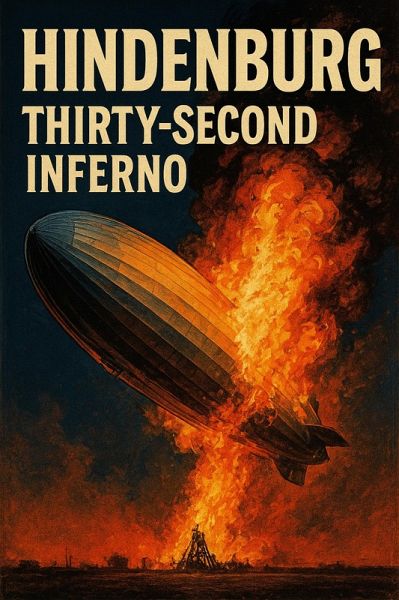
Hindenburg: Thirty-Second Inferno is a clear, human-centered chronicle of the most famous airship in history and the half-minute of fire that ended an era. Spanning twenty immersive chapters, it traces the zeppelin dream from its hopeful beginnings through the Hindenburg's majestic construction, serene ocean crossings, and refined life aboardpromenades of glass, piano in the lounge, disciplined crews, and a floating world of quiet elegance. With steady, simple prose, it opens the doors of the hangars at Friedrichshafen, walks the reader along duralumin ribs and gas cells, and reveals the teamwork, rituals, and pride that held a giant ship safely in the sky.
The narrative narrows to May 6, 1937: the gray New Jersey evening, the slow turn over Lakehurst, the dropped mooring lines, and then the sudden bloom of flame that raced the length of the hull. The book stays close to witnesses and survivorsrescuers running into heat and smoke, passengers finding seconds of courage, and the trembling voice of the famous broadcast that carried grief into homes around the world. It follows the night's rescue efforts, the solemn roll of names, and the first careful questions asked among wreckage still warm with rain and ash.
Beyond the shock, the book examines investigations and debates with calm clarity: hydrogen's lift against its peril, helium's safety against its scarcity, static and weather, leak and spark, and the humble truth that complex failures are chains, not single breaks. It shows how the disaster reshaped trust and practicelonger checklists, better materials, clearer cockpit authorityand how airplanes quietly inherited the future as airships slipped into memory.
Equally, this is a study of remembrance. It explores how film frames and a shaken voice forged collective memory; how museums, small artifacts, and simple ceremonies keep dignity intact; and how myths grow where certainty ends. The closing chapters look at the end of the zeppelin age without bitterness, honoring its beauty while preserving its lessons, and noting the careful, modern afterlives of lighter-than-air craft in modest, useful roles.
For readers of history and aviation, and for anyone drawn to stories where wonder and caution meet, Hindenburg: Thirty-Second Inferno offers a complete, compassionate portraitof ambition and risk, of loss and learning, and of how the world becomes wiser when thirty seconds change it forever.
The narrative narrows to May 6, 1937: the gray New Jersey evening, the slow turn over Lakehurst, the dropped mooring lines, and then the sudden bloom of flame that raced the length of the hull. The book stays close to witnesses and survivorsrescuers running into heat and smoke, passengers finding seconds of courage, and the trembling voice of the famous broadcast that carried grief into homes around the world. It follows the night's rescue efforts, the solemn roll of names, and the first careful questions asked among wreckage still warm with rain and ash.
Beyond the shock, the book examines investigations and debates with calm clarity: hydrogen's lift against its peril, helium's safety against its scarcity, static and weather, leak and spark, and the humble truth that complex failures are chains, not single breaks. It shows how the disaster reshaped trust and practicelonger checklists, better materials, clearer cockpit authorityand how airplanes quietly inherited the future as airships slipped into memory.
Equally, this is a study of remembrance. It explores how film frames and a shaken voice forged collective memory; how museums, small artifacts, and simple ceremonies keep dignity intact; and how myths grow where certainty ends. The closing chapters look at the end of the zeppelin age without bitterness, honoring its beauty while preserving its lessons, and noting the careful, modern afterlives of lighter-than-air craft in modest, useful roles.
For readers of history and aviation, and for anyone drawn to stories where wonder and caution meet, Hindenburg: Thirty-Second Inferno offers a complete, compassionate portraitof ambition and risk, of loss and learning, and of how the world becomes wiser when thirty seconds change it forever.
Dieser Download kann aus rechtlichen Gründen nur mit Rechnungsadresse in A, B, CY, CZ, D, DK, EW, E, FIN, F, GR, H, IRL, I, LT, L, LR, M, NL, PL, P, R, S, SLO, SK ausgeliefert werden.