39,95 €
inkl. MwSt.
Sofort per Download lieferbar
20 °P sammeln

Andere Kunden interessierten sich auch für
") Homes at Work (eBook, ePUB)39,95 €
Homes at Work (eBook, ePUB)39,95 €") Membership Based Organizations of the Poor (eBook, PDF)15,95 €
Membership Based Organizations of the Poor (eBook, PDF)15,95 €") Beyond Market-Driven Development (eBook, PDF)51,95 €
Beyond Market-Driven Development (eBook, PDF)51,95 €") Territorial Development in Latin America (eBook, PDF)45,95 €
Territorial Development in Latin America (eBook, PDF)45,95 €") The Institutional Approach to Labour and Development (eBook, PDF)56,95 €
The Institutional Approach to Labour and Development (eBook, PDF)56,95 €") Smart Cities in Europe and Asia (eBook, PDF)45,95 €
Smart Cities in Europe and Asia (eBook, PDF)45,95 €") Economics of Planning Policies in China (eBook, PDF)41,95 €
Economics of Planning Policies in China (eBook, PDF)41,95 €




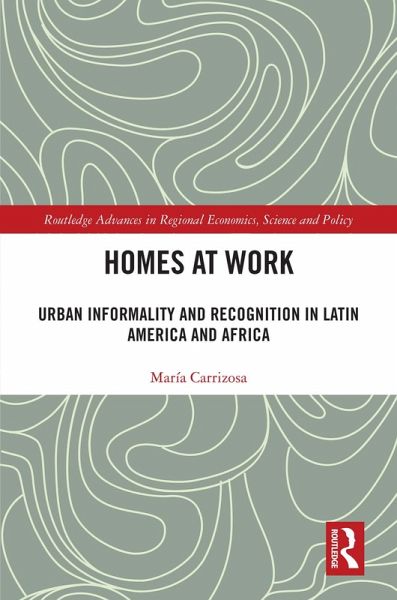
Following the outbreak of the COVID-19 pandemic, working from home became a global phenomenon, yet before 2020, it was a relatively understudied practice. But in informal settlements, the definition of "home" and "employment" is completely intertwined, which is why there is so much to learn from them. For over half a century, mainstream theoretical approaches to urban informality, dominated by development economics, often fail to see this economic and spatial phenomenon jointly. Labor studies tend to be space-blind and spatial studies often disregard informal employment. Profoundly interdisciplinary, this work connects scholarship in development, public policy, labor studies, and feminist economics, with that in urban studies, planning, housing, architecture, and visual studies.
The book walks the reader behind the closed doors of working homes that make the fabric, both social and economic, of most cities. It applies a visual methodology to reveal their "space-use intensity" and quantify the extent to which houses in informal settlements fill their inner pores with economic activity and community services. The research also revisits urban formalization policies in Latin America and Africa, to uncover a fallacious politics of recognition. It ultimately argues for a recognition continuum: an approach to urban informality that is more practical and fairer.
The book is of interest to development economists, urban scholars, public policy specialists, time-use researchers, and architects working on housing, employment generation, urban livelihoods, gender studies, and related topics.
The book walks the reader behind the closed doors of working homes that make the fabric, both social and economic, of most cities. It applies a visual methodology to reveal their "space-use intensity" and quantify the extent to which houses in informal settlements fill their inner pores with economic activity and community services. The research also revisits urban formalization policies in Latin America and Africa, to uncover a fallacious politics of recognition. It ultimately argues for a recognition continuum: an approach to urban informality that is more practical and fairer.
The book is of interest to development economists, urban scholars, public policy specialists, time-use researchers, and architects working on housing, employment generation, urban livelihoods, gender studies, and related topics.
Dieser Download kann aus rechtlichen Gründen nur mit Rechnungsadresse in A, B, BG, CY, CZ, D, DK, EW, E, FIN, F, GR, HR, H, IRL, I, LT, L, LR, M, NL, PL, P, R, S, SLO, SK ausgeliefert werden.