19,95 €
19,95 €
inkl. MwSt.
Sofort per Download lieferbar

10 °P sammeln
19,95 €
Als Download kaufen
19,95 €
inkl. MwSt.
Sofort per Download lieferbar
10 °P sammeln
Jetzt verschenken
Alle Infos zum eBook verschenken
19,95 €
inkl. MwSt.
Sofort per Download lieferbar
Alle Infos zum eBook verschenken
10 °P sammeln

Andere Kunden interessierten sich auch für
") How Disinformation Ruins Public Diplomacy (eBook, ePUB)19,95 €
How Disinformation Ruins Public Diplomacy (eBook, ePUB)19,95 €") Risk Communication and COVID-19 (eBook, PDF)36,95 €
Risk Communication and COVID-19 (eBook, PDF)36,95 €") Political Communication and COVID-19 (eBook, PDF)0,00 €
Political Communication and COVID-19 (eBook, PDF)0,00 €") The Frontiers of Public Diplomacy (eBook, PDF)41,95 €
The Frontiers of Public Diplomacy (eBook, PDF)41,95 €") Shortening the Distance between Government and Public in China I (eBook, PDF)41,95 €
Shortening the Distance between Government and Public in China I (eBook, PDF)41,95 €") Strategic Narratives (eBook, PDF)39,95 €
Strategic Narratives (eBook, PDF)39,95 €") Local Governments in Multilevel Governance (eBook, PDF)32,95 €
Local Governments in Multilevel Governance (eBook, PDF)32,95 €



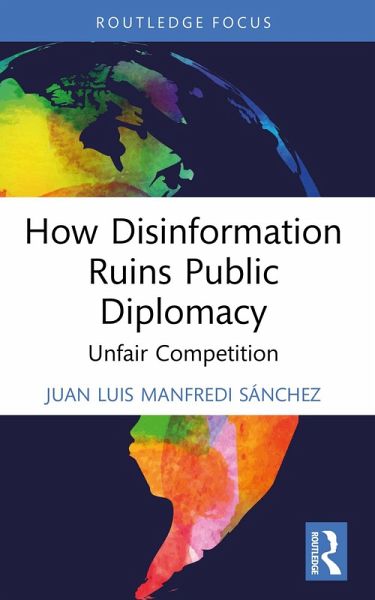
How Disinformation Ruins Public Diplomacy evaluates and analyzes how Chinese and Russian public diplomacy strategies differ from the existing academic literature and debates, specifically in the context of the new disinformation era.
In the context of mediatized public diplomacy, disinformation, and deglobalization, this book asks: do China, Russia, and new emerging powers take advantage by employing values and techniques attributed to public diplomacy? What if goals (dialogue and cooperation) are settled on an unfair basis (false content, meddling, and institutional erosion)? Can their repertoire of actions be considered public diplomacy? And if their initiatives are not public diplomacy, what impact do their actions have on the theoretical construction of the discipline? While using China and Russia as the two main case studies in order to develop a new theory, this book covers other relevant cases on the management of public diplomacy for other purposes. The case of Turkey provides a model of transformation and adaptation of public diplomacy, with Erdogan's hyper-leadership built on anti-Western rhetoric and the emergence of a new Ottomanism. The case of India explores Modi's creation of an ethnically-branded democracy which places Hinduism at the heart of political decisions. In the case of Morocco, its positioning in religious dialogue, the establishment of relations and political normalization with Israel, and territorial unity (Western Sahara) are explored.
Exploring how authoritarian powers abuse the global disinformation order to achieve their public diplomacy goals, this book will be of great interest to students and scholars of international relations, politics, public diplomacy, communication studies, and social theory. In the professional sphere it will also appeal to politicians, diplomats, foreign policy makers, think-tanks, journalists, and foreign correspondents.
In the context of mediatized public diplomacy, disinformation, and deglobalization, this book asks: do China, Russia, and new emerging powers take advantage by employing values and techniques attributed to public diplomacy? What if goals (dialogue and cooperation) are settled on an unfair basis (false content, meddling, and institutional erosion)? Can their repertoire of actions be considered public diplomacy? And if their initiatives are not public diplomacy, what impact do their actions have on the theoretical construction of the discipline? While using China and Russia as the two main case studies in order to develop a new theory, this book covers other relevant cases on the management of public diplomacy for other purposes. The case of Turkey provides a model of transformation and adaptation of public diplomacy, with Erdogan's hyper-leadership built on anti-Western rhetoric and the emergence of a new Ottomanism. The case of India explores Modi's creation of an ethnically-branded democracy which places Hinduism at the heart of political decisions. In the case of Morocco, its positioning in religious dialogue, the establishment of relations and political normalization with Israel, and territorial unity (Western Sahara) are explored.
Exploring how authoritarian powers abuse the global disinformation order to achieve their public diplomacy goals, this book will be of great interest to students and scholars of international relations, politics, public diplomacy, communication studies, and social theory. In the professional sphere it will also appeal to politicians, diplomats, foreign policy makers, think-tanks, journalists, and foreign correspondents.
Dieser Download kann aus rechtlichen Gründen nur mit Rechnungsadresse in A, B, BG, CY, CZ, D, DK, EW, E, FIN, F, GR, HR, H, IRL, I, LT, L, LR, M, NL, PL, P, R, S, SLO, SK ausgeliefert werden.