Sie sind bereits eingeloggt. Klicken Sie auf 2. tolino select Abo, um fortzufahren.
Bitte loggen Sie sich zunächst in Ihr Kundenkonto ein oder registrieren Sie sich bei bücher.de, um das eBook-Abo tolino select nutzen zu können.
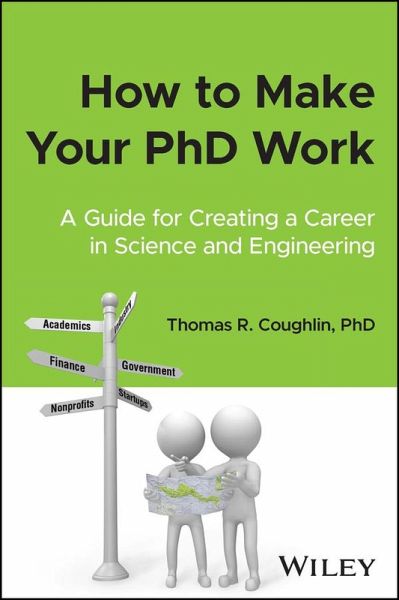
How to Make Your PhD Work A modern guide for a challenging modern PhD market The job market for PhDs in science and engineering has become immensely more challenging in the last decade. As of 2022, less than 5% of PhDs attain permanent academic positions, yet books about navigating PhD programs continue to treat permanent academic employment as the assumed norm. Today's PhDs need tools not only for completing their programs successfully, but for positioning themselves in a varied and competitive job market. How to Make Your PhD Work meets this need, with concrete, empowering advice that takes…mehr
How to Make Your PhD Work A modern guide for a challenging modern PhD market The job market for PhDs in science and engineering has become immensely more challenging in the last decade. As of 2022, less than 5% of PhDs attain permanent academic positions, yet books about navigating PhD programs continue to treat permanent academic employment as the assumed norm. Today's PhDs need tools not only for completing their programs successfully, but for positioning themselves in a varied and competitive job market. How to Make Your PhD Work meets this need, with concrete, empowering advice that takes account of modern job market challenges and opportunities. It cuts through widespread misconceptions about STEM careers and funding, offers tips for navigating difficult degree programs, and supplies current or prospective PhDs with the tools to radically transform their post-degree career prospects. How to Make Your PhD Work readers will also find: * Detailed discussion of topics including postdoctoral fellowships, nonacademic careers, success in industry, and more * Twelve stories from PhD students who talk about their relationship with their advisor, their success with their project, and their transition into their careers * Worksheets and case studies designed to help PhDs map out potential career paths * An author with extensive experience of the nonacademic job market and a real understanding of the challenges STEM PhDs face How to Make Your PhD Work is ideal for any STEM PhD student, prospective student, or early career researcher looking to improve their positions in the job market.
Dieser Download kann aus rechtlichen Gründen nur mit Rechnungsadresse in D ausgeliefert werden.
Die Herstellerinformationen sind derzeit nicht verfügbar.
Autorenporträt
Thomas R. Coughlin, PhD, is founder of the company PhD Source, which advises PhDs on their career prospects. He is also Founder and CEO of Core Merchants LLC, providing consulting and technology to startups and small businesses, and holds numerous positions in the biopharmaceutical industry. He has extensive experience in research, biotech start-ups, and medical communications, and has taught entrepreneurship academically and held industrial positions of many kinds.
Inhaltsangabe
Preface xv
Part I You Are Here 1
1 The Twenty-First Century PhD 3
1.1 A Realistic Perspective 3
1.2 The Current PhD Landscape Has Changed 3
1.2.1 Factor #1: A Steady Rise in PhDs 4
1.2.2 Variable #2: The Funding Rates 5
1.2.3 Variable #3: An Unchanged Academic Job Market 7
1.3 The PhD Job Market is Vast 8
1.4 Conclusions 9
References 9
2 The Real PhD Career Landscape 11
2.1 Your Advisor Cannot Be Your Only Guide 11
2.2 PhDs in Nonacademic Careers 11
2.3 PhDs in Specific Careers 12
2.3.1 How Many PhDs are Going In to These Jobs? 12
2.3.2 A PhD, Unemployed? 13
2.4 Self-assessment and Research 14
2.5 Real PhD Career Transition Stories 14
2.5.1 PhDs With Widely Different Experiences 14
2.5.2 Diagnosis of Their PhD 15
2.5.3 Stories Span Many Career Endpoints 15
2.6 Conclusion 16
References 16
3 The PhD Career Feedback Loop 18
3.1 Deciding Your Own Story 18
3.2 An Iterative Process 18
3.3 PhD Career Feedback Loop 18
3.4 Sense and Respond 19
3.5 Commit 100% 20
3.6 Conclusion 20
Reference 21
4 An Objective Assessment of Your PhD or Postdoc 22
4.1 Same Three Letters With Very Different Experiences 22
4.2 Taking the First Step 22
4.3 The PhD and Postdoc House 23
4.4 Advisor, Environment, and Project, in That Order 23
4.5 Afraid of What You Might Find? 25
4.6 Checking How Things Are Going 25
4.6.1 What Do With the Results From the Test 25
4.7 Factor #1: Your Advisor 26
4.7.1 The Importance of Your Advisor 27
4.7.2 Hallmarks of a Good Advisor 27
4.7.3 Hallmarks of a Bad Advisor 27
4.7.4 Advisors Who Lose Tenure 28
4.8 Factor #2: Your Environment 28
4.8.1 Impact of Your Institution and Advisor on the Environment 29
4.8.2 Primary Research Institutions or Medical Institutions 29
4.8.3 Research and Teaching Institutions 29
4.8.4 Research Group Members 29
4.8.5 Nontenured Advisors 30
4.9 Factor #3: Your Project 31
4.9.1 Determinants of a Good Project 31
4.9.2 An Inherited Project 31
4.10 PhD and Postdoctoral Self-Assessment Diagnostic Tests 31
4.10.1 Interpreting Your Scores 33
4.10.2 What Does a Good Rating of 0-1 Mean? 33
4.10.3 What Does an Intermediate Rating of 2-3 Mean? 33
4.10.4 What Does a Poor Rating of 4-5 Mean? 33
4.10.5 What About a Terrible Rating of 6? 34
4.11 Conclusion 34
Reference 35
Transition Story: Vineeta Sharma, PhD 36
Transition Story: Sreemoyee Acharya, PhD 40
Transition Story: Jesminara Khatun, PhD 44
Part II Your Academic Path 47
5 Overcoming Academic Obstacles 49
5.1 Proactive Steps 49
5.2 Personal Leadership 49
5.3 The Importance of Your Advisor 50
5.3.1 Importance of a Good Relationship 50
5.3.2 Working With Aloof Advisors 50
5.3.3 Advisors Under Pressure Can Be Difficult 50
5.3.4 Managing Up With Your Advisor 51
5.3.5 Improving the Relationship With Your Advisor 53
5.4 Navigating Challenging Environments 53
5.4.1 Overcoming Toxic Environments 55
5.4.2 A Lack of Funding 55
5.5 Overcoming Challenging or Uninteresting Projects 56