Sie sind bereits eingeloggt. Klicken Sie auf 2. tolino select Abo, um fortzufahren.
Bitte loggen Sie sich zunächst in Ihr Kundenkonto ein oder registrieren Sie sich bei bücher.de, um das eBook-Abo tolino select nutzen zu können.
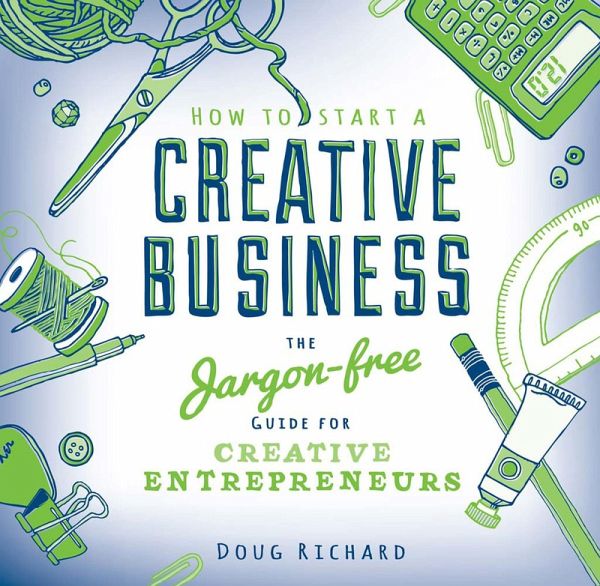
A guide to starting and sustaining creativity-based businesses-from culinary to crafting to film to fashion and beyond. Many "creative types" don't think they're cut out for business-but Doug Richard, founder of School for Creative Startups, believes entrepreneurs are made, not born. In this user-friendly guide he shows how artists, chefs, designers, musicians, and others can turn their hobbies and passions into sustainable lifestyle businesses. Based on a unique ten-question formula, the book provides comprehensive start-up business advice in jargon-free style, brought to life with real-life…mehr
A guide to starting and sustaining creativity-based businesses-from culinary to crafting to film to fashion and beyond. Many "creative types" don't think they're cut out for business-but Doug Richard, founder of School for Creative Startups, believes entrepreneurs are made, not born. In this user-friendly guide he shows how artists, chefs, designers, musicians, and others can turn their hobbies and passions into sustainable lifestyle businesses. Based on a unique ten-question formula, the book provides comprehensive start-up business advice in jargon-free style, brought to life with real-life case studies from a range of creative start-ups-and online resources that help you to develop your own business goals and plans. "This book helps debunk the myth that creative people and business don't mix." -James Boardwell, cofounder, Folksy
Die Herstellerinformationen sind derzeit nicht verfügbar.
Autorenporträt
Doug Richard is a UK based Californian serial entrepreneur and angel investor. Richard came to public prominence as a result of the BBC TV programme Dragons' Den, where he appeared as a 'dragon', or investor in the first two series. He subsequently became known for the Richard Report, the Entrepreneur's Manifesto and several other initiatives directed at improving UK support for startups and small businesses. He is regularly invited to appear on business initiatives and economic development pieces with some frequency on the BBC and financial news networks. Doug has received a host of honours and awards during his career and was the first American to receive The Queen's Award for Enterprise Promotion. Amongst others, he became a fellow of the RSA and received an Honorary Doctorate of the University of Essex for his contribution to entrepreneurship education. In 2008 Doug started School for Startups through which he has educated nearly 20,000 startups on the skills required to be successful. In 2010 Doug started School for Creative Startups with the sole remit of teaching creative people how to turn their creative hobbies into sustainable lifestyle businesses.
Inhaltsangabe
1. What do we do that people need or want? This will look at the business proposition. 2. Who is our customer? This will look at markets and segments. 3. How do customers find out about our products? This will look at marketing channels. 4. What distribution channels should we consider? This will look at distribution and support. 5. How much is it worth to the customer? This will look at revenue models. 6. What pricing model should we choose? This will look at pricing models.v 7. What kind of relationship do we want with our customers? This will look at customer service. 8. Who are we up against? This will look at the competition. 9. What do we have in common with our industry? This will look at the industry. 10. What must we be good at? This will look at key assets and resources.
1. What do we do that people need or want? This will look at the business proposition. 2. Who is our customer? This will look at markets and segments. 3. How do customers find out about our products? This will look at marketing channels. 4. What distribution channels should we consider? This will look at distribution and support. 5. How much is it worth to the customer? This will look at revenue models. 6. What pricing model should we choose? This will look at pricing models.v 7. What kind of relationship do we want with our customers? This will look at customer service. 8. Who are we up against? This will look at the competition. 9. What do we have in common with our industry? This will look at the industry. 10. What must we be good at? This will look at key assets and resources.
Es gelten unsere Allgemeinen Geschäftsbedingungen: www.buecher.de/agb
Impressum
www.buecher.de ist ein Internetauftritt der buecher.de internetstores GmbH
Geschäftsführung: Monica Sawhney | Roland Kölbl | Günter Hilger
Sitz der Gesellschaft: Batheyer Straße 115 - 117, 58099 Hagen
Postanschrift: Bürgermeister-Wegele-Str. 12, 86167 Augsburg
Amtsgericht Hagen HRB 13257
Steuernummer: 321/5800/1497
USt-IdNr: DE450055826