Sie sind bereits eingeloggt. Klicken Sie auf 2. tolino select Abo, um fortzufahren.
Bitte loggen Sie sich zunächst in Ihr Kundenkonto ein oder registrieren Sie sich bei bücher.de, um das eBook-Abo tolino select nutzen zu können.
In recent years human rights have assumed a central position in the discourse surrounding international development, while human rights agencies have begun to more systematically address economic and social rights. This edited volume brings together distinguished scholars to explore the merging of human rights and development agendas at local, national and international levels. They examine how this merging affects organisational change, operational change and the role of relevant actors in bringing about change. With a focus on practice and policy rather than pure theory, the volume also…mehr
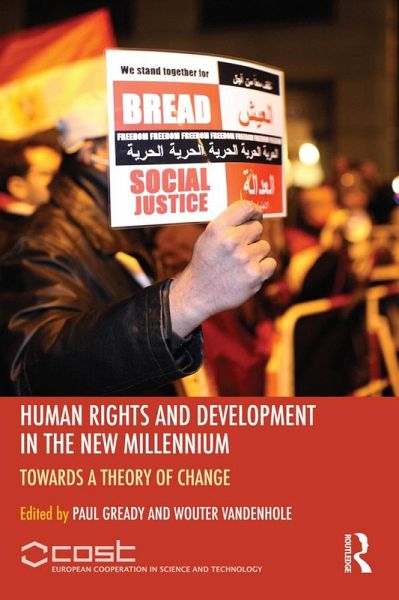
In recent years human rights have assumed a central position in the discourse surrounding international development, while human rights agencies have begun to more systematically address economic and social rights. This edited volume brings together distinguished scholars to explore the merging of human rights and development agendas at local, national and international levels. They examine how this merging affects organisational change, operational change and the role of relevant actors in bringing about change. With a focus on practice and policy rather than pure theory, the volume also addresses broader questions such as what human rights and development can learn from one another, and whether the connections between the two fields are increasing or declining.
The book is structured in three sections:
Part I looks at approaches that combine human rights and development, including chapters on drivers of change; indicators; donor; and legal empowerment of the poor.
Part II focuses on organisational contexts and includes chapters on the UN at the country level; EU development cooperation; PLAN's children's rights-based approach; and ActionAid's human rights-based approach.
Part III examines country contexts, including chapters on the ILO in various settings; the Congo; Ethiopia; and South Africa.
Human Rights and Development in the new Millennium: Towards a Theory of Change will be of strong interest to students and scholars of human rights, development studies, political science and economics.
Dieser Download kann aus rechtlichen Gründen nur mit Rechnungsadresse in A, B, BG, CY, CZ, D, DK, EW, E, FIN, F, GR, HR, H, IRL, I, LT, L, LR, M, NL, PL, P, R, S, SLO, SK ausgeliefert werden.
Die Herstellerinformationen sind derzeit nicht verfügbar.
Autorenporträt
Paul Gready is Professor of Applied Human Rights and Director of the Centre for Applied Human Rights at the University of York, UK. Wouter Vandenhole teaches human rights law and holds the UNICEF Chair in Children's Rights at the University of Antwerp, Belgium.
Inhaltsangabe
Chapter 1: P Gready with W Vandenhole, Introduction - What are we Trying to Change? Theories of Change in Development and Human Rights Approaches Chapter 2: H-O Sano, The drivers of human rights change in development Chapter 3: G de Beco, Human rights indicators and MDG indicators: Building a common language for human rights and development organizations Chapter 4: A Tostensen, H Stokke and S Trygged, Means, Modes and Methods: Donor Support Strategies for Child Rights in Kenya Chapter 5: B Andreassen, Legal empowerment of the poor - A strategy for social change? Organisational Contexts Chapter 6: Wouter Vandenhole, Overcoming the Protection Promotion Dichotomy Human Rights Based Approaches to Development and Organisational Change within the UN at Country Level Chapter 7: M van Reisen and D Mekonnen, EU Development Cooperation: The Contours of Global and National Engagement Chapter 8: K Arts, Countering Violence against Children in the Philippines: Positive RBA Practice Examples from PLAN Chapter 9: P Gready, ActionAid's Human Rights-based Approach and its Impact on Organisational and Operational Change Country Contexts Chapter 10: H Stokke, Standardised practice - From international labour standards to development practice Chapter 11: K De Feyter and R Lumbika Nlandu, Skimming the Surface: Human Rights-Related Donor Interventions in the Bas-Congo Chapter 12: S Porter, A Change of Road for the Rights-Based Approach? A Reflection on Piloting a Health-Enabling Mobile Technology Programme in KwaZulu-Natal, South Africa Chapter 13: S Yeshanew, The Ethiopian Law Governing Civil Society Organizations: Divorcing Human Rights and Development? Chapter 14: W Vandenhole, C Lennox, P Gready and H Stokke, In Lieu of a Conclusion: Some Cross-cutting Issues and their Policy Implications
Es gelten unsere Allgemeinen Geschäftsbedingungen: www.buecher.de/agb
Impressum
www.buecher.de ist ein Internetauftritt der buecher.de internetstores GmbH
Geschäftsführung: Monica Sawhney | Roland Kölbl | Günter Hilger
Sitz der Gesellschaft: Batheyer Straße 115 - 117, 58099 Hagen
Postanschrift: Bürgermeister-Wegele-Str. 12, 86167 Augsburg
Amtsgericht Hagen HRB 13257
Steuernummer: 321/5800/1497
USt-IdNr: DE450055826