Sie sind bereits eingeloggt. Klicken Sie auf 2. tolino select Abo, um fortzufahren.
Bitte loggen Sie sich zunächst in Ihr Kundenkonto ein oder registrieren Sie sich bei bücher.de, um das eBook-Abo tolino select nutzen zu können.
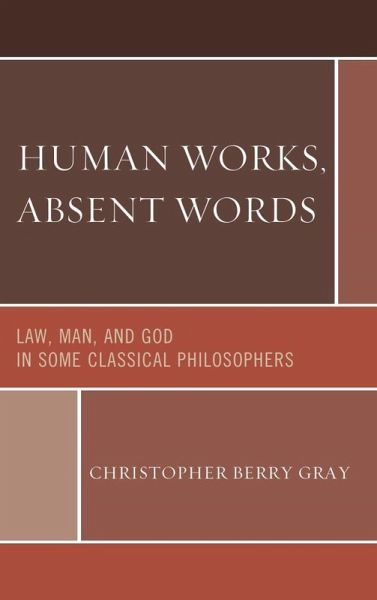
What is said can be understood only when seen in the context of what is not said. Many ancient and medieval philosophers use this dynamic of presence and absence. Plato always recognizes that his expressions are energized by being set before other people. Aristotle's dialectic between different sorts of public activity does the same. Anselm sees his writing as a test case for what it says. Bonaventure approximates his distance from trinity by finding its images at large. Aquinas makes legal norms approach the flexibility of facts. Ockham's solution to holding goods without owning them…mehr
What is said can be understood only when seen in the context of what is not said. Many ancient and medieval philosophers use this dynamic of presence and absence. Plato always recognizes that his expressions are energized by being set before other people. Aristotle's dialectic between different sorts of public activity does the same. Anselm sees his writing as a test case for what it says. Bonaventure approximates his distance from trinity by finding its images at large. Aquinas makes legal norms approach the flexibility of facts. Ockham's solution to holding goods without owning them impresses English jural doctrine. Las Casas' refusal to fix first nations' identity in deviant past activities hints at how to rectify contacts with first peoples today. This book shows how each author amplifies meaning in the distance between what he puts into his work and what he leaves unsaid.
Die Herstellerinformationen sind derzeit nicht verfügbar.
Autorenporträt
Christopher Berry Gray has taught philosophy at Concordia University in Montreal since 1967. He was born in Paterson, New Jersey, in 1941 and received his BA in 1963 from St. Bonaventure University. Gray earned his MA in 1965 and his PhD in 1970, both from The Catholic University of America. He received his BCL in 1978 and his LLB in 1979, both from McGill University Law School. In addition to articles, chapters, and other books on philosophy and law, he has also published The Philosophy of Law: An Encyclopedia and The Methodology of Maurice Hauriou: Legal, Sociological, Philosophical.
Inhaltsangabe
Preface Acknowledgements 1 Phaedo's Trivia 2 Paideia, Schole, Paidia: Then and Now 3 Finality's Flameout 4 External Goods and Contemplation in Aristotle 5 Aristotle's Text on Justice 6 Freedom and Necessity in St. Anselm's Cur Deus Homo 7 Bonaventure's Proof of Trinity 8 Civil Obligation in Bonaventure and 20th Century Anarchists 9 Specification of Norm in the Jurisprudences of Aquinas, Austin and Kelsen 10 Ockham on Trusts 11 Las Casas' Medieval Ideology
Es gelten unsere Allgemeinen Geschäftsbedingungen: www.buecher.de/agb
Impressum
www.buecher.de ist ein Internetauftritt der buecher.de internetstores GmbH
Geschäftsführung: Monica Sawhney | Roland Kölbl | Günter Hilger
Sitz der Gesellschaft: Batheyer Straße 115 - 117, 58099 Hagen
Postanschrift: Bürgermeister-Wegele-Str. 12, 86167 Augsburg
Amtsgericht Hagen HRB 13257
Steuernummer: 321/5800/1497
USt-IdNr: DE450055826