41,95 €
41,95 €
inkl. MwSt.
Sofort per Download lieferbar

21 °P sammeln
41,95 €
Als Download kaufen
41,95 €
inkl. MwSt.
Sofort per Download lieferbar
21 °P sammeln
Jetzt verschenken
Alle Infos zum eBook verschenken
41,95 €
inkl. MwSt.
Sofort per Download lieferbar
Alle Infos zum eBook verschenken
21 °P sammeln

Andere Kunden interessierten sich auch für
") Husserl and Spatiality (eBook, ePUB)41,95 €
Husserl and Spatiality (eBook, ePUB)41,95 €") Architecture and Silence (eBook, PDF)43,95 €
Architecture and Silence (eBook, PDF)43,95 €") Hans van der Laan's Instruments of Thought (eBook, PDF)38,95 €
Hans van der Laan's Instruments of Thought (eBook, PDF)38,95 €") Julien-David Leroy and the Making of Architectural History (eBook, PDF)47,95 €
Julien-David Leroy and the Making of Architectural History (eBook, PDF)47,95 €") The Philadelphia School and the Future of Architecture (eBook, PDF)39,95 €
The Philadelphia School and the Future of Architecture (eBook, PDF)39,95 €") Architectural Technicities (eBook, PDF)41,95 €
Architectural Technicities (eBook, PDF)41,95 €") The Classical Orders of Architecture (eBook, PDF)56,95 €
The Classical Orders of Architecture (eBook, PDF)56,95 €






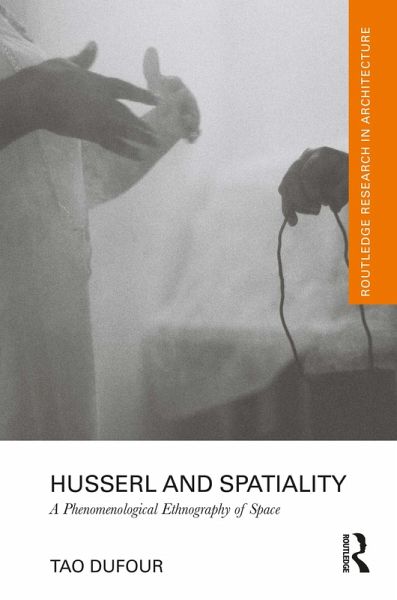
Husserl and Spatiality is an exploration of the phenomenology of space and embodiment, based on the work of Edmund Husserl. Little known in architecture, Husserl's phenomenology of embodied spatiality established the foundations for the works of later phenomenologists, including Maurice Merleau-Ponty's well-known phenomenology of perception. Through a detailed study of his posthumously published and unpublished manuscripts on space, DuFour examines the depth and scope of Husserl's phenomenology of space. The book investigates his analyses of corporeity and the "lived body," extending to questions of intersubjective, intergenerational, and geo-historical spatial experience, what DuFour terms the "environmentality" of space.
Combining in-depth architectural philosophical investigations of spatiality with a rich and intimate ethnography, Husserl and Spatiality speaks to themes in social and cultural anthropology, from a theoretical perspective that addresses spatial practice and experience. Drawing on fieldwork in Brazil, DuFour develops his analyses of Husserl's phenomenology through spatial accounts of ritual in the Afro-Brazilian religion of Candomblé. The result is a methodological innovation and unique mode of spatial description that DuFour terms a "phenomenological ethnography of space." The book's profoundly interdisciplinary approach makes an incisive contribution relevant to academics and students of architecture and architectural theory, anthropology and material culture, and philosophy and environmental aesthetics.
Combining in-depth architectural philosophical investigations of spatiality with a rich and intimate ethnography, Husserl and Spatiality speaks to themes in social and cultural anthropology, from a theoretical perspective that addresses spatial practice and experience. Drawing on fieldwork in Brazil, DuFour develops his analyses of Husserl's phenomenology through spatial accounts of ritual in the Afro-Brazilian religion of Candomblé. The result is a methodological innovation and unique mode of spatial description that DuFour terms a "phenomenological ethnography of space." The book's profoundly interdisciplinary approach makes an incisive contribution relevant to academics and students of architecture and architectural theory, anthropology and material culture, and philosophy and environmental aesthetics.
Dieser Download kann aus rechtlichen Gründen nur mit Rechnungsadresse in A, B, BG, CY, CZ, D, DK, EW, E, FIN, F, GR, HR, H, IRL, I, LT, L, LR, M, NL, PL, P, R, S, SLO, SK ausgeliefert werden.
Husserl and Spatiality is a whirlwind expedition through central Husserlian concepts in relation to the central problem of what constitutes a space. As I read about DuFour's childhood memories, and his descriptions from his rich ethnographic study of the spaces and practices of the Brazilian religion Candomblé, his writing seemed to linger and cling to the walls of my room, building tangible horizons and creating ripples of effect in my understanding also of my own surrounding environment. This book will inspire interpretations of the world that favour empathy over power, bodily engagement over subjective self-centeredness, and historical meaningfulness over relational flatness. It is a much-needed call to reinterpret spatial relationships in ways that allow the past to gently touch the future.
- Henriette Steiner, Associate Professor, Section for Landscape Architecture and Planning, University of Copenhagen
Part radical re-reading of Husserl, part phenomenology of Afro-Brazilian ritual, DuFour's is an astoundingly original take on space as the constitutive ground of all lived experience. The ethnography of ritual here becomes the litmus test of the deepest stakes of human experience-both condition of possibility and the generative source of human relationships, replete with embodied history and affective significance. This is what DuFour calls environmentality-a tour de force of life-driven conceptual creativity.
- Martin Holbraad, Professor of Social Anthropology and Head of the Department of Anthropology, University College London
- Henriette Steiner, Associate Professor, Section for Landscape Architecture and Planning, University of Copenhagen
Part radical re-reading of Husserl, part phenomenology of Afro-Brazilian ritual, DuFour's is an astoundingly original take on space as the constitutive ground of all lived experience. The ethnography of ritual here becomes the litmus test of the deepest stakes of human experience-both condition of possibility and the generative source of human relationships, replete with embodied history and affective significance. This is what DuFour calls environmentality-a tour de force of life-driven conceptual creativity.
- Martin Holbraad, Professor of Social Anthropology and Head of the Department of Anthropology, University College London