Sie sind bereits eingeloggt. Klicken Sie auf 2. tolino select Abo, um fortzufahren.
Bitte loggen Sie sich zunächst in Ihr Kundenkonto ein oder registrieren Sie sich bei bücher.de, um das eBook-Abo tolino select nutzen zu können.
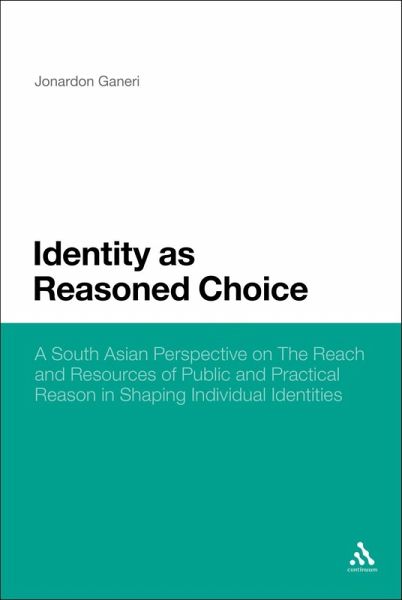
In an increasingly multi-religious and multi-ethnic world, identity has become something actively chosen rather than merely acquired at birth. This book essentially analyzes the resources available to make such a choice. Looking into the world of intellectual India, this unique comparative survey focuses on the identity resources offered by India's traditions of reasoning and public debate. Arguing that identity is a formation of reason, it draws on Indian theory to claim that identities are constructed from exercises of reason as derivation from exemplary cases. The book demonstrates that…mehr
In an increasingly multi-religious and multi-ethnic world, identity has become something actively chosen rather than merely acquired at birth. This book essentially analyzes the resources available to make such a choice. Looking into the world of intellectual India, this unique comparative survey focuses on the identity resources offered by India's traditions of reasoning and public debate. Arguing that identity is a formation of reason, it draws on Indian theory to claim that identities are constructed from exercises of reason as derivation from exemplary cases. The book demonstrates that contemporary debates on global governance and cosmopolitan identities can benefit from these Indian resources, which were developed within an intercultural pluralism context with an emphasis on consensual resolution of conflict. This groundbreaking work builds on themes developed by Amartya Sen to provide a creative pursuit of Indian reasoning that will appeal to anyone studying politics, philosophy, and Asian political thought.
Die Herstellerinformationen sind derzeit nicht verfügbar.
Autorenporträt
Jonardon Ganeri is Professor of Philosophy at the University of Sussex, UK. His research draws upon analytical, Indian and European traditions of philosophical thought. He has published four books, including The Lost Age of Reason: Philosophy in Early Modern India 1450-1700 (Clarendon Press, 2010). He was a visiting professor at the University of Chicago, and a research fellow at King's College London and at Jawaharlal Nehru University in New Delhi.
Inhaltsangabe
Preface Introduction: The Reach and Resources of Reason PART I: PUBLIC REASON PROMOTED 1. An Ideal of Public Reason Public reason in the Questions of Milinda An ideal of public reason in the Nyaya-sutra 2. Ancient Indian Logic as a Theory of Case-Based Reasoning A model of reasoning in the Nyaya-sutra The theory transformed Retrieving the ancient case-based model 3. Neutrality: a Theory From the Time of Asoka A Buddhist treatise on public reason: the Elements of Dialogue Eight stances in a dialogue The 'way forward' and the 'way back' 4. Local Norms: the Priority of the Particular Rules versus cases Three models of particulars as standards Particulars as paradigms in the Nyaya-sutra Particulars as prototypes in the Ritual Sutras PART II: PRACTICAL REASON RESOURCED 5. The Critic Within Multiple Hinduisms A dissenting voice Meeting reason with reason Evidence, expertise and assent Religion and reason 6. Adapt and Substitute The hermeneutics of ritual Ethics in the Hindu canon The reason of sages Adaptive reasoning from paradigms 7. Model Humans and Moral Instincts Persons as paradigms of exemplary conduct Ethical dilemmas: the 'case' The heart's approval: moral instinct PART III: DISSENT 8. Implied Voices of Dissent The paradox of inquiry Inquiry as adjudication The challenge reformulated in Sa?kara 9. Can One Seek to Answer any Question? Srihar?a On questioning: the pragmatics of interrogative dialogue The prior knowledge argument Against aiming The longing for knowledge PART IV: IDENTITY, FOUND OR FASHIONED? 10. On the Formation of Self Spiritual exercises and the aesthetic analogy Philosophy as medicine Plutarch and the Buddhists: returning oneself to the present A life complete at every moment Taming the self Philosophy and the ends of life 11. Problems of Self and Identity Reincarnation and personal identity Higher and lower selves Bad thoughts and conscience No self? Being true to your individual self 12. Identity and Illusions about the Self Speaking about the self Polestar and compass: two modes of practical reason The ethics of self-deception and the reach of reason Cognitive stories 13. "What You Are You Do Not See, What You See is Your Shadow" The philosophical double The double in Mauni's fiction Self to self Inhabiting an identity PART V: IDENTITY & THE MODERN INTELLECTUAL 14. Interpreting Intellectual India Questions of method Objectivity Immersion 15. An Exemplary Indian Intellectual Bimal Krishna Matilal A conversation among equals A common ground? 16. India and the Shaping of Global Intellectual Culture Covert borrowings Other routes of influence Concluding Summary Bibliography
Preface Introduction: The Reach and Resources of Reason PART I: PUBLIC REASON PROMOTED 1. An Ideal of Public Reason Public reason in the Questions of Milinda An ideal of public reason in the Nyaya-sutra 2. Ancient Indian Logic as a Theory of Case-Based Reasoning A model of reasoning in the Nyaya-sutra The theory transformed Retrieving the ancient case-based model 3. Neutrality: a Theory From the Time of Asoka A Buddhist treatise on public reason: the Elements of Dialogue Eight stances in a dialogue The 'way forward' and the 'way back' 4. Local Norms: the Priority of the Particular Rules versus cases Three models of particulars as standards Particulars as paradigms in the Nyaya-sutra Particulars as prototypes in the Ritual Sutras PART II: PRACTICAL REASON RESOURCED 5. The Critic Within Multiple Hinduisms A dissenting voice Meeting reason with reason Evidence, expertise and assent Religion and reason 6. Adapt and Substitute The hermeneutics of ritual Ethics in the Hindu canon The reason of sages Adaptive reasoning from paradigms 7. Model Humans and Moral Instincts Persons as paradigms of exemplary conduct Ethical dilemmas: the 'case' The heart's approval: moral instinct PART III: DISSENT 8. Implied Voices of Dissent The paradox of inquiry Inquiry as adjudication The challenge reformulated in Sa?kara 9. Can One Seek to Answer any Question? Srihar?a On questioning: the pragmatics of interrogative dialogue The prior knowledge argument Against aiming The longing for knowledge PART IV: IDENTITY, FOUND OR FASHIONED? 10. On the Formation of Self Spiritual exercises and the aesthetic analogy Philosophy as medicine Plutarch and the Buddhists: returning oneself to the present A life complete at every moment Taming the self Philosophy and the ends of life 11. Problems of Self and Identity Reincarnation and personal identity Higher and lower selves Bad thoughts and conscience No self? Being true to your individual self 12. Identity and Illusions about the Self Speaking about the self Polestar and compass: two modes of practical reason The ethics of self-deception and the reach of reason Cognitive stories 13. "What You Are You Do Not See, What You See is Your Shadow" The philosophical double The double in Mauni's fiction Self to self Inhabiting an identity PART V: IDENTITY & THE MODERN INTELLECTUAL 14. Interpreting Intellectual India Questions of method Objectivity Immersion 15. An Exemplary Indian Intellectual Bimal Krishna Matilal A conversation among equals A common ground? 16. India and the Shaping of Global Intellectual Culture Covert borrowings Other routes of influence Concluding Summary Bibliography
Es gelten unsere Allgemeinen Geschäftsbedingungen: www.buecher.de/agb
Impressum
www.buecher.de ist ein Internetauftritt der buecher.de internetstores GmbH
Geschäftsführung: Monica Sawhney | Roland Kölbl | Günter Hilger
Sitz der Gesellschaft: Batheyer Straße 115 - 117, 58099 Hagen
Postanschrift: Bürgermeister-Wegele-Str. 12, 86167 Augsburg
Amtsgericht Hagen HRB 13257
Steuernummer: 321/5800/1497
USt-IdNr: DE450055826