43,95 €
inkl. MwSt.
Sofort per Download lieferbar
22 °P sammeln

Andere Kunden interessierten sich auch für
") Indigenous Rights to the City (eBook, PDF)43,95 €
Indigenous Rights to the City (eBook, PDF)43,95 €") Bureaucracy, Belonging, and the City in North India (eBook, ePUB)41,95 €
Bureaucracy, Belonging, and the City in North India (eBook, ePUB)41,95 €") City Branding in Chinese Megacity Regions (eBook, ePUB)42,95 €
City Branding in Chinese Megacity Regions (eBook, ePUB)42,95 €") Internal Migration in the Developed World (eBook, ePUB)41,95 €
Internal Migration in the Developed World (eBook, ePUB)41,95 €") Migration Landing Spaces (eBook, ePUB)21,95 €
Migration Landing Spaces (eBook, ePUB)21,95 €") The Postcolonial Age of Migration (eBook, ePUB)38,95 €
The Postcolonial Age of Migration (eBook, ePUB)38,95 €") The Cities of the Poor (eBook, ePUB)32,95 €
The Cities of the Poor (eBook, ePUB)32,95 €
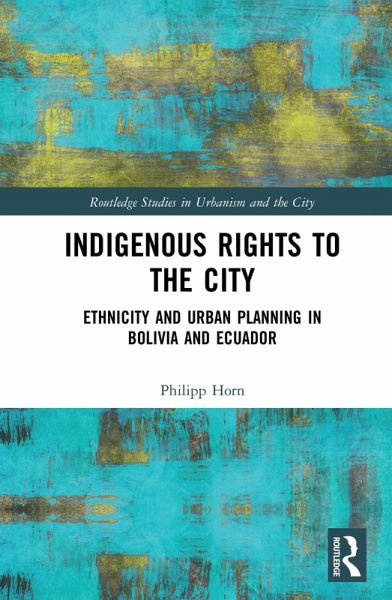
This book breaks new ground in understanding urban indigeneity in policy and planning practice. It is the first comprehensive and comparative study that foregrounds the complex interplay of multiple organisations involved in translating indigenous rights to the city in Latin America, focussing on the cities of La Paz and Quito.
The book establishes how planning for urban indigeneity looks in practice, even in seemingly progressive settings, such as Bolivia and Ecuador, where indigenous rights to the city are recognised within constitutions. It demonstrates that the translation of indigenous rights to the city is a process involving different actor groups operating within state institutions and indigenous communities, which often hold conflicting interests and needs. The book also establishes a set of theoretical, methodological, and practical foundations for envisaging how urban indigenous planning in Latin America and elsewhere should be understood, studied, and undertaken: As a process which embraces conflict and challenges power relations within indigenous communities and between these communities and the state.
This book will appeal to practitioners, researchers, and students working within the fields of urban planning, urban development, and indigenous rights.
The book establishes how planning for urban indigeneity looks in practice, even in seemingly progressive settings, such as Bolivia and Ecuador, where indigenous rights to the city are recognised within constitutions. It demonstrates that the translation of indigenous rights to the city is a process involving different actor groups operating within state institutions and indigenous communities, which often hold conflicting interests and needs. The book also establishes a set of theoretical, methodological, and practical foundations for envisaging how urban indigenous planning in Latin America and elsewhere should be understood, studied, and undertaken: As a process which embraces conflict and challenges power relations within indigenous communities and between these communities and the state.
This book will appeal to practitioners, researchers, and students working within the fields of urban planning, urban development, and indigenous rights.
Dieser Download kann aus rechtlichen Gründen nur mit Rechnungsadresse in A, B, BG, CY, CZ, D, DK, EW, E, FIN, F, GR, HR, H, IRL, I, LT, L, LR, M, NL, PL, P, R, S, SLO, SK ausgeliefert werden.