Sie sind bereits eingeloggt. Klicken Sie auf 2. tolino select Abo, um fortzufahren.
Bitte loggen Sie sich zunächst in Ihr Kundenkonto ein oder registrieren Sie sich bei bücher.de, um das eBook-Abo tolino select nutzen zu können.
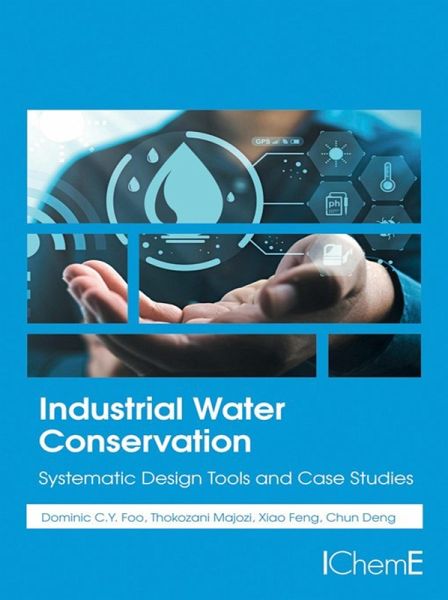
Industrial Water Conservation: Systematic Design Tools and Case Studies offers fundamental knowledge of various established process integration tools for water conservation, including water pinch analysis and mathematical programming techniques. The book provides a demonstration of water conservation tools on various industrial case studies, enabling readers to learn how these methods can be implemented in actual industrial settings. Part A provides various systematic methods on water recovery system design based on process integration techniques, whereas Part B provides various industrial…mehr
Industrial Water Conservation: Systematic Design Tools and Case Studies offers fundamental knowledge of various established process integration tools for water conservation, including water pinch analysis and mathematical programming techniques. The book provides a demonstration of water conservation tools on various industrial case studies, enabling readers to learn how these methods can be implemented in actual industrial settings. Part A provides various systematic methods on water recovery system design based on process integration techniques, whereas Part B provides various industrial case studies covering the success stories of the implementation of the methods covered in Part A.This is an indispensable resource for practitioners in various industrial sectors - chemicals and petrochemicals, pulp and paper, food and beverage, textile, etc., consultants in water-related industries, as well as (post)-graduate students in chemical engineering. - Written by world-renowned scholars on industrial water conservation - Consists of state-of-the-art methods based on process integration techniques such as water pinch analysis and mathematical programming methods - Includes industrial case studies on various successful implementation
Dieser Download kann aus rechtlichen Gründen nur mit Rechnungsadresse in A, B, BG, CY, CZ, D, DK, EW, E, FIN, F, GR, HR, H, IRL, I, LT, L, LR, M, NL, PL, P, R, S, SLO, SK ausgeliefert werden.
Die Herstellerinformationen sind derzeit nicht verfügbar.
Autorenporträt
Dominic Foo is a Professor of Process Design and Integration at the University of Nottingham Malaysia and is the Founding Director for the Centre of Excellence for Green Technologies. He is a Fellow of the Institution of Chemical Engineers (IChemE), Fellow of the Academy of Sciences Malaysia (ASM), Fellow of the Institution of Engineers Malaysia (IEM), Chartered Engineer (CEng) with the Engineering Council UK, Professional Engineer (PEng) with the Board of Engineer Malaysia (BEM), ASEAN Chartered Professional Engineers (ACPE), as well as the President for the Asia Pacific Confederation of Chemical Engineering (APCChE). He is top 1% world-renowned scientist according to Stanford List, working in process integration for resource conservation and CO2 reduction. Professor Foo is an active author, with eight books, more than 190 journal papers and made more than 240 conference presentations, with more than 30 keynote/plenary speeches. Professor Foo is the Editor-in-Chief for Process Integration and Optimization for Sustainability (Springer Nature), Subject Editor for Process Safety & Environmental Protection (Elsevier), and editorial board members for several other renowned journals. He is the winners of the Innovator of the Year Award 2009 of IChemE, Young Engineer Award 2010 of IEM, Outstanding Young Malaysian Award 2012 of Junior Chamber International (JCI), Outstanding Asian Researcher and Engineer 2013 (Society of Chemical Engineers, Japan), and Top Research Scientist Malaysia 2016 (ASM).Thokozani Majozi is a full professor in the School of Chemical and Metallurgical Engineering, Wits University, where he also holds an NRF/DST Chair in Sustainable Process Engineering. He is also the Executive Dean of the Faculty of Engineering and the Built Environment. Prior to joining Wits in 2013, he was a professor at the University of Pretoria, where he spent nearly 10 years, and an associate professor in computer science at the University of Pannonia in Hungary from 2005 to 2009. A chemical engineer by profession, Majozi completed his PhD in Process Integration at the University of Manchester Institute of Science and Technology (UMIST) in the United Kingdom (UK). He is a member of various international scientific committees and a Fellow for the Institute of Chemical Engineering (UK), Academy of Sciences of South Africa (ASSAf), Academy of Engineering of SA, Water Institute of Southern Africa and African Academy of Sciences (AAS). He spent the early years of his career in the industrial sector, working for Unilever, Dow AgroSciences and Sasol Technology. Majozi is author and co-author of more than 200 scientific publications, including a book entitled Batch Chemical Process Integration published by Springer in January 2010, a book entitled Synthesis, Design and Resources Optimization, published by CRC Press/Taylor and Francis in 2015 and a book entitled Understanding Batch Chemical Processes, also published by CRC Press/Taylor and Francis in 2017.Xiao Feng is a Professor of Chemical Engineering at Xi'an Jiaotong University. She is the Vice-Chair of Thermodynamics and Engineering Application Committee, China Energy Research Society, Standing Director of Chinese industrial Ecology Economics and Technology Society, and Standing Director of Water Treatment and Reuse Committee, Chinese Society of Environment Science. She is working in process integration. Professor Feng is an active author, with three books, more than 150 international journal papers. Professor Feng is editorial board members for Process Integration and Optimization for Sustainability, Processes, Energy Conversion and Storage, and several Chinese journals.
Inhaltsangabe
Part A Fundamentals of water recovery system design 1. Water pinch analysis for concentration base (e.g. COD, suspended solid) and property base (e.g. pH, acidity) water recovery (Deng) 2. Pinch based optimisation methods for water recovery (Foo) 3. Mathematical programming for concentration based (e.g. COD, suspended solid) and property base (e.g. pH, acidity) water recovery (Feng) 4. Water recovery for batch processes (Majozi) Part B Industrial case studies 5. Case study 1 catalyst plant (Feng) 6. Case study 2 viscose fiber plant (Feng) 7. Case study 3 printing and dyeing plant (Feng) 8. Case study 4 synthetic rubber production (Foo) 9. Case study 5 gas to liquid plant (Foo) 10. Case study 6 wastewater interception and recovery system of a refinery plant (Deng) 11. Case study 7 large scale water network of a refinery plant (Deng) 12. Case study 8 electric power plant (Majozi) 13. Case study 9 pharmaceutical plant (Majozi) 14. Case study 10 dairy facility (Majozi)
Part A Fundamentals of water recovery system design 1. Water pinch analysis for concentration base (e.g. COD, suspended solid) and property base (e.g. pH, acidity) water recovery (Deng) 2. Pinch based optimisation methods for water recovery (Foo) 3. Mathematical programming for concentration based (e.g. COD, suspended solid) and property base (e.g. pH, acidity) water recovery (Feng) 4. Water recovery for batch processes (Majozi) Part B Industrial case studies 5. Case study 1 catalyst plant (Feng) 6. Case study 2 viscose fiber plant (Feng) 7. Case study 3 printing and dyeing plant (Feng) 8. Case study 4 synthetic rubber production (Foo) 9. Case study 5 gas to liquid plant (Foo) 10. Case study 6 wastewater interception and recovery system of a refinery plant (Deng) 11. Case study 7 large scale water network of a refinery plant (Deng) 12. Case study 8 electric power plant (Majozi) 13. Case study 9 pharmaceutical plant (Majozi) 14. Case study 10 dairy facility (Majozi)
Es gelten unsere Allgemeinen Geschäftsbedingungen: www.buecher.de/agb
Impressum
www.buecher.de ist ein Internetauftritt der buecher.de internetstores GmbH
Geschäftsführung: Monica Sawhney | Roland Kölbl | Günter Hilger
Sitz der Gesellschaft: Batheyer Straße 115 - 117, 58099 Hagen
Postanschrift: Bürgermeister-Wegele-Str. 12, 86167 Augsburg
Amtsgericht Hagen HRB 13257
Steuernummer: 321/5800/1497
USt-IdNr: DE450055826