43,95 €
43,95 €
inkl. MwSt.
Sofort per Download lieferbar

22 °P sammeln
43,95 €
Als Download kaufen
43,95 €
inkl. MwSt.
Sofort per Download lieferbar
22 °P sammeln
Jetzt verschenken
Alle Infos zum eBook verschenken
43,95 €
inkl. MwSt.
Sofort per Download lieferbar
Alle Infos zum eBook verschenken
22 °P sammeln

Andere Kunden interessierten sich auch für
") Financial Inclusion for Poverty Alleviation (eBook, ePUB)49,95 €
Financial Inclusion for Poverty Alleviation (eBook, ePUB)49,95 €") Aid and Technical Cooperation as a Foreign Policy Tool for Emerging Donors (eBook, ePUB)43,95 €
Aid and Technical Cooperation as a Foreign Policy Tool for Emerging Donors (eBook, ePUB)43,95 €") Multinationals, Poverty Alleviation and UK Aid (eBook, ePUB)39,95 €
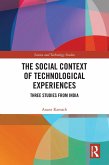
Multinationals, Poverty Alleviation and UK Aid (eBook, ePUB)39,95 €") The Social Context of Technological Experiences (eBook, ePUB)41,95 €
The Social Context of Technological Experiences (eBook, ePUB)41,95 €") Neoextractivism and Capitalist Development (eBook, ePUB)43,95 €
Neoextractivism and Capitalist Development (eBook, ePUB)43,95 €") Communication in International Development (eBook, ePUB)39,95 €
Communication in International Development (eBook, ePUB)39,95 €") The Routledge Handbook of Latin American Development (eBook, ePUB)45,95 €
The Routledge Handbook of Latin American Development (eBook, ePUB)45,95 €


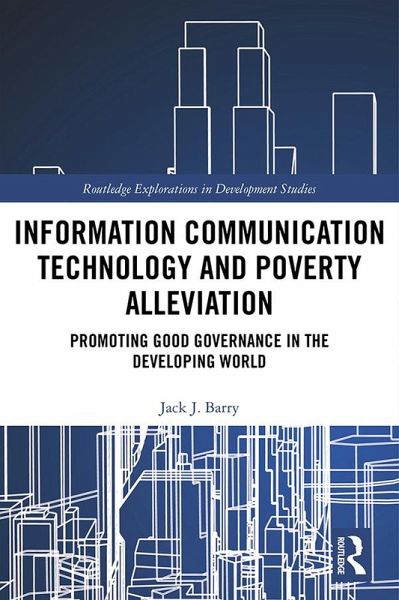
Despite global economic disparities, recent years have seen rapid technological changes in developing countries, as it is now common to see people across all levels of society with smartphones in their hands and computers in their homes. However, does access to Information Communication Technologies (ICTs) actually improve the day-to-day lives of low-income citizens? This book argues that access to the internet can help alleviate poverty, improve development outcomes, and is now vital for realizing many human rights.
This book posits that good governance is essential to the realization of inclusive pro-poor development goals, and puts forward policy recommendations that aim to mitigate the complex digital divide by employing governance as the primary actor. In making his argument, the author provides a quantitative analysis of developing countries, conjoined with a targeted in-depth study of Mexico. This mixed method approach provides an intriguing case for how improvements in the quality of governance impacts both ICT penetration, and poverty alleviation. Overall, the book challenges the neoliberal deterministic perspective that the open market will "solve" technology diffusion, and argues instead that good governance is the lynchpin that creates conducive conditions for ICTs to make an impact on poverty alleviation. In fact, the digital divide should not be considered binary, rather it is a multifaceted problem where income, education, and language all need to be considered to address it effectively.
This book will be useful for researchers/students of development, communication technologies, and comparative politics as well as for development practitioners and policy makers with an interest in how modern technology is impacting the poor in the developing world.
This book posits that good governance is essential to the realization of inclusive pro-poor development goals, and puts forward policy recommendations that aim to mitigate the complex digital divide by employing governance as the primary actor. In making his argument, the author provides a quantitative analysis of developing countries, conjoined with a targeted in-depth study of Mexico. This mixed method approach provides an intriguing case for how improvements in the quality of governance impacts both ICT penetration, and poverty alleviation. Overall, the book challenges the neoliberal deterministic perspective that the open market will "solve" technology diffusion, and argues instead that good governance is the lynchpin that creates conducive conditions for ICTs to make an impact on poverty alleviation. In fact, the digital divide should not be considered binary, rather it is a multifaceted problem where income, education, and language all need to be considered to address it effectively.
This book will be useful for researchers/students of development, communication technologies, and comparative politics as well as for development practitioners and policy makers with an interest in how modern technology is impacting the poor in the developing world.
Dieser Download kann aus rechtlichen Gründen nur mit Rechnungsadresse in A, B, BG, CY, CZ, D, DK, EW, E, FIN, F, GR, HR, H, IRL, I, LT, L, LR, M, NL, PL, P, R, S, SLO, SK ausgeliefert werden.