36,95 €
36,95 €
inkl. MwSt.
Sofort per Download lieferbar

18 °P sammeln
36,95 €
Als Download kaufen
36,95 €
inkl. MwSt.
Sofort per Download lieferbar
18 °P sammeln
Jetzt verschenken
Alle Infos zum eBook verschenken
36,95 €
inkl. MwSt.
Sofort per Download lieferbar
Alle Infos zum eBook verschenken
18 °P sammeln

Andere Kunden interessierten sich auch für
") Networked Graphics (eBook, ePUB)43,95 €
Networked Graphics (eBook, ePUB)43,95 €") Spatial Augmented Reality (eBook, ePUB)133,95 €
Spatial Augmented Reality (eBook, ePUB)133,95 €") NURBS for Curve & Surface Design (eBook, ePUB)78,95 €
NURBS for Curve & Surface Design (eBook, ePUB)78,95 €") Light and Skin Interactions (eBook, ePUB)30,95 €
Light and Skin Interactions (eBook, ePUB)30,95 €") Augmented Reality (eBook, ePUB)72,95 €
Augmented Reality (eBook, ePUB)72,95 €") Computer Graphics (eBook, ePUB)97,95 €
Computer Graphics (eBook, ePUB)97,95 €") The Essentials of CAGD (eBook, ePUB)58,95 €
The Essentials of CAGD (eBook, ePUB)58,95 €




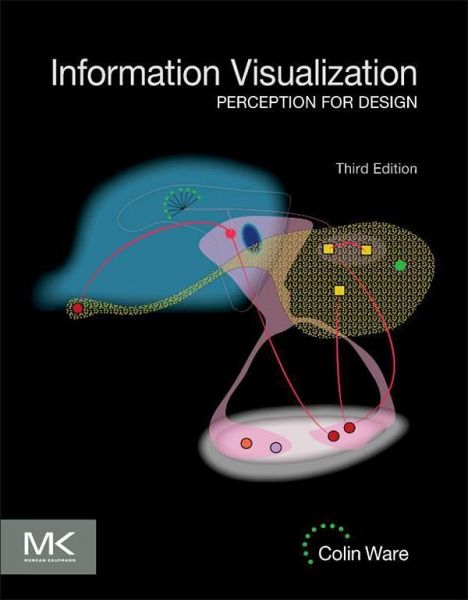
Most designers know that yellow text presented against a blue background reads clearly and easily, but how many can explain why, and what really are the best ways to help others and ourselves clearly see key patterns in a bunch of data? When we use software, access a website, or view business or scientific graphics, our understanding is greatly enhanced or impeded by the way the information is presented. This book explores the art and science of why we see objects the way we do. Based on the science of perception and vision, the author presents the key principles at work for a wide range of applications--resulting in visualization of improved clarity, utility, and persuasiveness. The book offers practical guidelines that can be applied by anyone: interaction designers, graphic designers of all kinds (including web designers), data miners, and financial analysts. - Complete update of the recognized source in industry, research, and academic for applicable guidance on information visualizing - Includes the latest research and state of the art information on multimedia presentation - More than 160 explicit design guidelines based on vision science - A new final chapter that explains the process of visual thinking and how visualizations help us to think about problems - Packed with over 400 informative full color illustrations, which are key to understanding of the subject
Dieser Download kann aus rechtlichen Gründen nur mit Rechnungsadresse in A, B, BG, CY, CZ, D, DK, EW, E, FIN, F, GR, HR, H, IRL, I, LT, L, LR, M, NL, PL, P, R, S, SLO, SK ausgeliefert werden.
"Oh my God, the Bible just got better. There is no book that I rely on more in my work than Information Visualization: Perception for Design, and with this third edition Colin Ware has made it more indispensible and easier to apply than ever." --Stephen Few, Principal, Perceptual Edge
"Drawing on his background in both computer science and the psychology of perception, Ware (coastal and ocean mapping, U. of New Hampshire) has become a leader in three-dimensional visualization systems, such as ocean currents and the movement of whales. For this third edition of his reference on what the science of perception reveals about visualization, he has clarified the design implications of research in perception, and increased the emphasis on the process of visual thinking. The topics include foundations for an applied science of data visualization, color, static and moving pictures, visual objects and data objects, and interacting with visualization." --Reference and Research Book News, August 2012
"Drawing on his background in both computer science and the psychology of perception, Ware (coastal and ocean mapping, U. of New Hampshire) has become a leader in three-dimensional visualization systems, such as ocean currents and the movement of whales. For this third edition of his reference on what the science of perception reveals about visualization, he has clarified the design implications of research in perception, and increased the emphasis on the process of visual thinking. The topics include foundations for an applied science of data visualization, color, static and moving pictures, visual objects and data objects, and interacting with visualization." --Reference and Research Book News, August 2012