84,95 €
84,95 €
inkl. MwSt.
Sofort per Download lieferbar

42 °P sammeln
84,95 €
Als Download kaufen
84,95 €
inkl. MwSt.
Sofort per Download lieferbar
42 °P sammeln
Jetzt verschenken
Alle Infos zum eBook verschenken
84,95 €
inkl. MwSt.
Sofort per Download lieferbar
Alle Infos zum eBook verschenken
42 °P sammeln

Andere Kunden interessierten sich auch für
") Making a Scientific Case for Conscious Agency and Free Will (eBook, ePUB)26,95 €
Making a Scientific Case for Conscious Agency and Free Will (eBook, ePUB)26,95 €") Consumer Neuroscience (eBook, ePUB)95,95 €
Consumer Neuroscience (eBook, ePUB)95,95 €") Designing and Managing Complex Systems (eBook, ePUB)95,95 €
Designing and Managing Complex Systems (eBook, ePUB)95,95 €") Neuroeconomics of Prosocial Behavior (eBook, ePUB)26,95 €
Neuroeconomics of Prosocial Behavior (eBook, ePUB)26,95 €") Advances in Experimental Social Psychology (eBook, ePUB)73,95 €
Advances in Experimental Social Psychology (eBook, ePUB)73,95 €") The Elements of Choice (eBook, ePUB)12,90 €
The Elements of Choice (eBook, ePUB)12,90 €") Creativity and the Wandering Mind (eBook, ePUB)67,95 €
Creativity and the Wandering Mind (eBook, ePUB)67,95 €




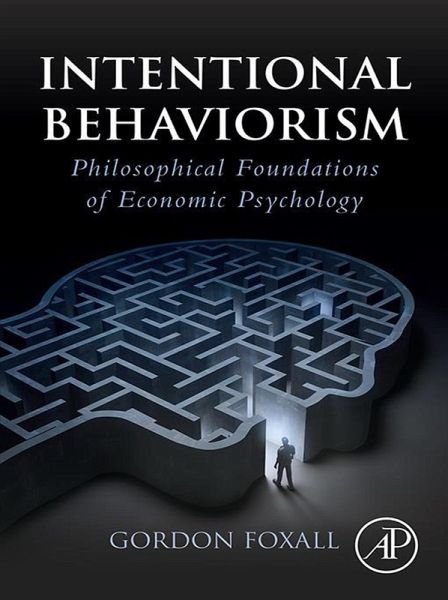
Intentional behaviorism is a philosophy of psychology that seeks to ascertain the place and nature of cognitive explanation of behavior by empirically determining the scope of an extensional account of behavior based on the limitations of a behavioral approach to explanation. This book draws on an empirical program of research in economic psychology to establish a route to a reliable and justifiable intentional explanation of behavior. Since the cognitive revolution in psychology, intentional explanations of behavior have become the norm, and as the methodology that provides the normal science component of psychology, cognitivism is sometimes accepted relatively uncritically. However, there is a lack of understanding of the role of psychological research in determining the place and shape of intentionality. This book explicates the philosophy of psychology that the author has devised and applied in his work on economic psychology and behavioral economics. Given the provenance of intentional behaviorism, economic and consumer psychology forms the primary application basis for the book. This book provides a theoretical background to understanding how and why consumers make the choices they do. The book integrates behavioral economics, consumer psychology, and decision-making research to explore intentional behaviorism, which is proposed as a philosophical framework for consumer psychology, viewing economic behavior in the contexts of modern human consumers in affluent marketing-oriented societies. - Integrates research in behavioral economics, decision-making, cognitive psychology, and consumer psychology. - Offers readers an interdisciplinary look at intentionality and intentional explanations. - Proposes a theory of intentional behaviorism to explain economic behavior, consumer choice, and other decision-making. - Examines the methodologies of philosophers of mind such as Dennett and Searle.
Dieser Download kann aus rechtlichen Gründen nur mit Rechnungsadresse in A, B, BG, CY, CZ, D, DK, EW, E, FIN, F, GR, HR, H, IRL, I, LT, L, LR, M, NL, PL, P, R, S, SLO, SK ausgeliefert werden.
"No one discipline can solely account for the complexities that determine consumer choice. In his new book,?Intentional Behaviorism: Philosophical Foundations of Economic Psychology, Gordon Foxall masterfully bridges the gap between different disciplinary subjects and schools of thoughts to offer a multidisciplinary perspective and philosophical analysis on the complexities of economic and social behaviour. Both comprehensive and illuminating, this book significantly advances the field and is essential reading for professionals in the area." --Mirella Yani-de-Soriano, Reader, Cardiff University, UK.
"Gordon Foxall has been conducting an empirical research programme into consumer behavioural and economic psychology and consumer decision-making and choice for over three decades. In his current and most innovative approach to the psychological explanation of action, Foxall introduces the concept of?Janus-variables?as a means of linking extensional and intentional variables whilst maintaining their individual spheres of applicability: an ingenious device which will repay the serious attention of behavioral scientists and philosophers. He demonstrates a vast range of knowledge and successfully brings together a truly interdisciplinary piece of scholarship, employing admirable use of philosophical reasoning to proffer an explanation of economic behaviour and much more." --Paul M. W. Hackett, Honorary Fellow, Department of Philosophy, University of Durham, Durham, UK and Professor of Ethnography, School of Communication, EMERSON COLLEGE, Boston, USA
"Gordon Foxall begins his carefully-argued and compelling work by observing that economic activity-"the allocation of limited resources among competing ends" (p.7)-is applicable to all sorts of activity not typically considered economic. He notes that social, political, and even romantic behavior (and let s add much non-human animal activity) can be usefully viewed within this broad economic perspective. And indeed "useful" is the operative word here as Foxall constructs a research framework for economic behavior that rests upon two philosophies of psychology that are conventionally deemed incompatible. But, Radical Behaviorism, Foxall holds, has not been superseded by Cognitivism (specifically Intentional Stance Cognitivism) in a Kuhnian paradigm war. Rather the clash between these two can be one of productive innovation-a scientific consilience, not a destructive competition. Employing just this interplay between these two mighty foundations, Foxall derives an original methodology for a branch of empirical behavioral science designed to render economic behavior more intelligible. This book is a worthy effort toward this unarguably important task." --Linda A.W. Brakel, M.D., Associate Professor (Adjunct), Dept. of Psychiatry, University of Michigan
"Gordon Foxall has been conducting an empirical research programme into consumer behavioural and economic psychology and consumer decision-making and choice for over three decades. In his current and most innovative approach to the psychological explanation of action, Foxall introduces the concept of?Janus-variables?as a means of linking extensional and intentional variables whilst maintaining their individual spheres of applicability: an ingenious device which will repay the serious attention of behavioral scientists and philosophers. He demonstrates a vast range of knowledge and successfully brings together a truly interdisciplinary piece of scholarship, employing admirable use of philosophical reasoning to proffer an explanation of economic behaviour and much more." --Paul M. W. Hackett, Honorary Fellow, Department of Philosophy, University of Durham, Durham, UK and Professor of Ethnography, School of Communication, EMERSON COLLEGE, Boston, USA
"Gordon Foxall begins his carefully-argued and compelling work by observing that economic activity-"the allocation of limited resources among competing ends" (p.7)-is applicable to all sorts of activity not typically considered economic. He notes that social, political, and even romantic behavior (and let s add much non-human animal activity) can be usefully viewed within this broad economic perspective. And indeed "useful" is the operative word here as Foxall constructs a research framework for economic behavior that rests upon two philosophies of psychology that are conventionally deemed incompatible. But, Radical Behaviorism, Foxall holds, has not been superseded by Cognitivism (specifically Intentional Stance Cognitivism) in a Kuhnian paradigm war. Rather the clash between these two can be one of productive innovation-a scientific consilience, not a destructive competition. Employing just this interplay between these two mighty foundations, Foxall derives an original methodology for a branch of empirical behavioral science designed to render economic behavior more intelligible. This book is a worthy effort toward this unarguably important task." --Linda A.W. Brakel, M.D., Associate Professor (Adjunct), Dept. of Psychiatry, University of Michigan