44,95 €
inkl. MwSt.
Sofort per Download lieferbar
22 °P sammeln

Andere Kunden interessierten sich auch für
") Civil Disobedience from Nepal to Norway (eBook, ePUB)38,95 €
Civil Disobedience from Nepal to Norway (eBook, ePUB)38,95 €") Wittgenstein and the Nature of Violence (eBook, ePUB)35,95 €
Wittgenstein and the Nature of Violence (eBook, ePUB)35,95 €") Justice and the Just War Tradition (eBook, ePUB)42,95 €
Justice and the Just War Tradition (eBook, ePUB)42,95 €") The Concept of Violence (eBook, ePUB)44,95 €
The Concept of Violence (eBook, ePUB)44,95 €") Understanding Peace (eBook, ePUB)46,95 €
Understanding Peace (eBook, ePUB)46,95 €") Mobilities and Foucault (eBook, ePUB)45,95 €
Mobilities and Foucault (eBook, ePUB)45,95 €") Just War in Religion and Politics (eBook, ePUB)35,95 €
Just War in Religion and Politics (eBook, ePUB)35,95 €







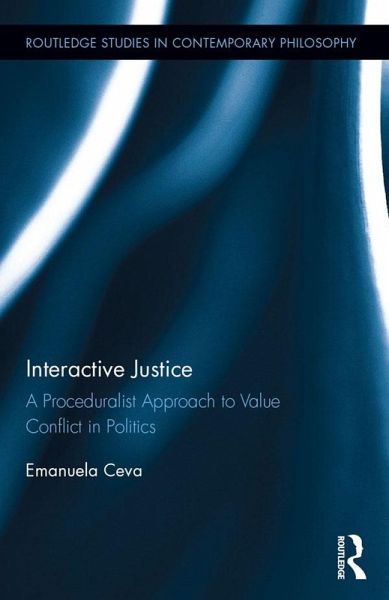
Contemporary societies are riddled with moral disputes caused by conflicts between value claims competing for the regulation of matters of public concern. This familiar state of affairs is relevant for one of the most important debates within liberal political thought: should institutions seek to realize justice or peace? Justice-driven philosophers characterize the normative conditions for the resolution of value conflicts through the establishment of a moral consensus on an order of priority between competing value claims. Peace-driven philosophers have concentrated, perhaps more modestly, on the characterization of the ways in which competing value claims should be balanced, with a view to establishing a modus vivendi aimed at containing the conflict.
Interactive Justice addresses an important question related to this debate: on what terms should the parties interact during their conflict for their interaction to be morally acceptable to them? Although largely unexplored by political philosophers, this is a main area of concern in conflict management. Building on a proceduralist interpretation of "relational" concerns of justice, the author develops a liberal normative theory of interactive justice for the management of value conflict in politics grounded in the fundamental values of fair hearing and procedural equality. This book innovatively builds a bridge between works in political philosophy and peace studies to propose a fresh lens through which to view the normative responses liberal institutions ought to give to value conflict in politics, and moves beyond the apparent dichotomy between pursuing end-state justice through conflict resolution or peace through conflict containment.
Interactive Justice addresses an important question related to this debate: on what terms should the parties interact during their conflict for their interaction to be morally acceptable to them? Although largely unexplored by political philosophers, this is a main area of concern in conflict management. Building on a proceduralist interpretation of "relational" concerns of justice, the author develops a liberal normative theory of interactive justice for the management of value conflict in politics grounded in the fundamental values of fair hearing and procedural equality. This book innovatively builds a bridge between works in political philosophy and peace studies to propose a fresh lens through which to view the normative responses liberal institutions ought to give to value conflict in politics, and moves beyond the apparent dichotomy between pursuing end-state justice through conflict resolution or peace through conflict containment.
Dieser Download kann aus rechtlichen Gründen nur mit Rechnungsadresse in A, B, BG, CY, CZ, D, DK, EW, E, FIN, F, GR, HR, H, IRL, I, LT, L, LR, M, NL, PL, P, R, S, SLO, SK ausgeliefert werden.