66,95 €
inkl. MwSt.
Sofort per Download lieferbar
33 °P sammeln

Andere Kunden interessierten sich auch für
") Interest Groups in American Politics (eBook, ePUB)66,95 €
Interest Groups in American Politics (eBook, ePUB)66,95 €") Interest Groups and Lobbying (eBook, PDF)34,95 €
Interest Groups and Lobbying (eBook, PDF)34,95 €") Interest Groups and Lobbying (eBook, ePUB)34,95 €
Interest Groups and Lobbying (eBook, ePUB)34,95 €") Campaigns and Elections American Style (eBook, PDF)38,95 €
Campaigns and Elections American Style (eBook, PDF)38,95 €") Inside the Bubble (eBook, PDF)34,95 €
Inside the Bubble (eBook, PDF)34,95 €") The Organization of Political Interest Groups (eBook, PDF)43,95 €
The Organization of Political Interest Groups (eBook, PDF)43,95 €") Interest Groups and Political Representation in Portugal and Beyond (eBook, PDF)96,95 €
Interest Groups and Political Representation in Portugal and Beyond (eBook, PDF)96,95 €





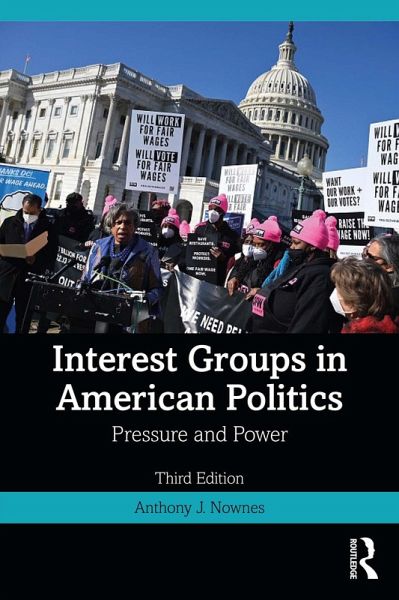
Americans regularly rail against so-called "special interests." Yet, many members of society are themselves represented in one form or another by organized groups trying to affect government decisions. Interest Groups in American Politics, Third Edition, is grounded by the role of information in interest group activity, a theme that runs through the book. This concise, thorough text demonstrates that interest groups are involved in the political system at all levels of government-federal, state, and local-and in all aspects of political activity, from election campaigns to agenda setting to lawmaking and policy implementation. Rather than an anomaly or distortion of the political system, interest group activity is a normal and healthy function of a pluralist society and democratic governance. Nonetheless, Nownes warns of the dangers of unwatched interest group activity, especially in the realms of the electoral process and issue advocacy.
This much-anticipated third edition of Nownes's text retains a student-friendly tone. It thoroughly updates the references to interest group research, social media activity, new foreign actors in American politics, and political action committee (PAC) and party connections. Numerous figures and tables throughout the book help students visualize significant trends and information.
New to the Third Edition
This much-anticipated third edition of Nownes's text retains a student-friendly tone. It thoroughly updates the references to interest group research, social media activity, new foreign actors in American politics, and political action committee (PAC) and party connections. Numerous figures and tables throughout the book help students visualize significant trends and information.
New to the Third Edition
- A new section in Chapter 1 (Interest Groups in the United States) on social movements in the US.
- A new section in Chapter 4 (The Non-Lobbying Activities of Interest Groups) on how interest groups use social media to recruit members and burnish their image.
- A new section in Chapter 5 (Direct Lobbying) about lobbying regulation, how it affects group behavior, and "shadow interests."
- New data in Chapter 6 (Electoral Lobbying) on how and how much groups spend on PACs, super PACs, and other vehicles for election spending.
- A new section in Chapter 7 (Indirect Lobbying) on how interest groups use social media and new technology to affect political outcomes.
- A new section in Chapter 8 (Interest Groups and Political Parties) on interest groups, the Republican Party, and President Donald Trump.
- New information in Chapter 9 (The Influence of Interest Groups) on the latest research on interest group power and influence. The new section will cite the latest literature on the growing power of business.
Dieser Download kann aus rechtlichen Gründen nur mit Rechnungsadresse in A, B, BG, CY, CZ, D, DK, EW, E, FIN, F, GR, HR, H, IRL, I, LT, L, LR, M, NL, PL, P, R, S, SLO, SK ausgeliefert werden.
Praise for Interest Groups in American Politics: Pressure and Power, Third Edition
Personally engaging and relevant to modern times, this book explains the who, what, when, and where of lobbying in America. Even better: it explains why some interests are represented while others are not, why some lobbyists are more influential than others, and why interest groups sometimes use tactics (e.g., sponsoring advertisements, organizing protests) other than lobbying to affect government policy. Nownes draws from interviews with advocates to enliven core concepts in the study of interest groups. This book is rich both empirically and theoretically and is sure to become a common text assigned in undergraduate courses.
--James Strickland, Arizona State University
Personally engaging and relevant to modern times, this book explains the who, what, when, and where of lobbying in America. Even better: it explains why some interests are represented while others are not, why some lobbyists are more influential than others, and why interest groups sometimes use tactics (e.g., sponsoring advertisements, organizing protests) other than lobbying to affect government policy. Nownes draws from interviews with advocates to enliven core concepts in the study of interest groups. This book is rich both empirically and theoretically and is sure to become a common text assigned in undergraduate courses.
--James Strickland, Arizona State University