52,95 €
inkl. MwSt.
Sofort per Download lieferbar
26 °P sammeln

Andere Kunden interessierten sich auch für
") Intersectional Italy (eBook, PDF)52,95 €
Intersectional Italy (eBook, PDF)52,95 €") The Allegory of Love in the Early Renaissance (eBook, ePUB)41,95 €
The Allegory of Love in the Early Renaissance (eBook, ePUB)41,95 €") Industrial Literature and Authors (eBook, ePUB)42,95 €
Industrial Literature and Authors (eBook, ePUB)42,95 €") Primo Levi's Narratives of Embodiment (eBook, ePUB)49,95 €
Primo Levi's Narratives of Embodiment (eBook, ePUB)49,95 €") Women, Rhetoric, and Drama in Early Modern Italy (eBook, ePUB)45,95 €
Women, Rhetoric, and Drama in Early Modern Italy (eBook, ePUB)45,95 €") Petrarch and the Making of Gender in Renaissance Italy (eBook, ePUB)42,95 €
Petrarch and the Making of Gender in Renaissance Italy (eBook, ePUB)42,95 €") Revisiting Italy (eBook, ePUB)44,95 €
Revisiting Italy (eBook, ePUB)44,95 €





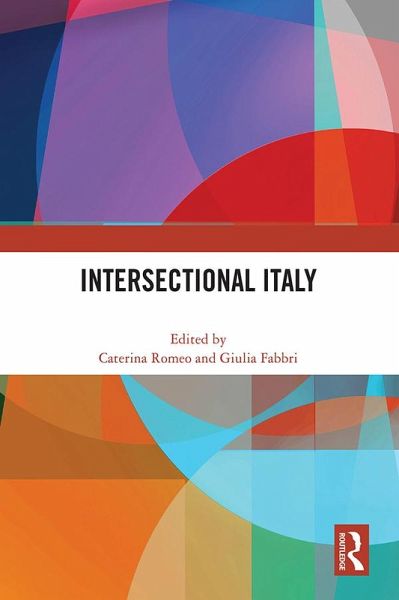
This book questions Italian "white innocence" and examines the specificity of Italian racial discourse through the analysis of different kinds of texts and representations.
Intersectionality - a theoretical and methodological approach focusing on the multidimensional discrimination that individuals and groups experience based on their race, color, gender, and other axes of oppression - has only recently been embraced as an effective methodology in Italy, whose national identity is structured around the "chromatic norm" of whiteness. The categories of race and color have been almost absent in post-war public debate as well as in scholarly discourse. Feminist movements and theoreticians have mostly placed gender at the core of their analyses, leaving white privilege unchallenged and undertheorized. Colonial and postcolonial studies have linked present-day racism to Italian colonialism, thus shedding light on contemporary incarnations of Empire. In this volume, the authors adopt an intersectional methodology to question Italian "white innocence" and to examine the specificity of Italian racial discourse through the analysis of different kinds of texts and representations. The volume also includes two interviews with writers and intellectuals Djarah Kan and Leaticia Ouedraogo, who discuss how they articulate concepts of intersectionality, Blackness, white privilege, and structural racism in Italian contemporary culture and society.
The book will be of great significance to students, researchers and scholars of Migration and Postcolonial Studies interested in gender, class, and racial identity. The chapters in this book were originally published as a special issue of the Journal of Postcolonial Writing.
Intersectionality - a theoretical and methodological approach focusing on the multidimensional discrimination that individuals and groups experience based on their race, color, gender, and other axes of oppression - has only recently been embraced as an effective methodology in Italy, whose national identity is structured around the "chromatic norm" of whiteness. The categories of race and color have been almost absent in post-war public debate as well as in scholarly discourse. Feminist movements and theoreticians have mostly placed gender at the core of their analyses, leaving white privilege unchallenged and undertheorized. Colonial and postcolonial studies have linked present-day racism to Italian colonialism, thus shedding light on contemporary incarnations of Empire. In this volume, the authors adopt an intersectional methodology to question Italian "white innocence" and to examine the specificity of Italian racial discourse through the analysis of different kinds of texts and representations. The volume also includes two interviews with writers and intellectuals Djarah Kan and Leaticia Ouedraogo, who discuss how they articulate concepts of intersectionality, Blackness, white privilege, and structural racism in Italian contemporary culture and society.
The book will be of great significance to students, researchers and scholars of Migration and Postcolonial Studies interested in gender, class, and racial identity. The chapters in this book were originally published as a special issue of the Journal of Postcolonial Writing.
Dieser Download kann aus rechtlichen Gründen nur mit Rechnungsadresse in A, B, BG, CY, CZ, D, DK, EW, E, FIN, F, GR, HR, H, IRL, I, LT, L, LR, M, NL, PL, P, R, S, SLO, SK ausgeliefert werden.