43,95 €
43,95 €
inkl. MwSt.
Sofort per Download lieferbar

22 °P sammeln
43,95 €
Als Download kaufen
43,95 €
inkl. MwSt.
Sofort per Download lieferbar
22 °P sammeln
Jetzt verschenken
Alle Infos zum eBook verschenken
43,95 €
inkl. MwSt.
Sofort per Download lieferbar
Alle Infos zum eBook verschenken
22 °P sammeln

Andere Kunden interessierten sich auch für
") Intersexualization (eBook, PDF)43,95 €
Intersexualization (eBook, PDF)43,95 €") Critical Intersex (eBook, ePUB)41,95 €
Critical Intersex (eBook, ePUB)41,95 €") Routledge International Handbook of Diversity Studies (eBook, ePUB)47,95 €
Routledge International Handbook of Diversity Studies (eBook, ePUB)47,95 €") Queer Word- and World-Making in South Africa (eBook, ePUB)39,95 €
Queer Word- and World-Making in South Africa (eBook, ePUB)39,95 €") Sexuality, Gender and Power (eBook, ePUB)37,95 €
Sexuality, Gender and Power (eBook, ePUB)37,95 €") Sex in Marriage (eBook, ePUB)26,95 €
Sex in Marriage (eBook, ePUB)26,95 €") Doing Gender in Media, Art and Culture (eBook, ePUB)42,95 €
Doing Gender in Media, Art and Culture (eBook, ePUB)42,95 €





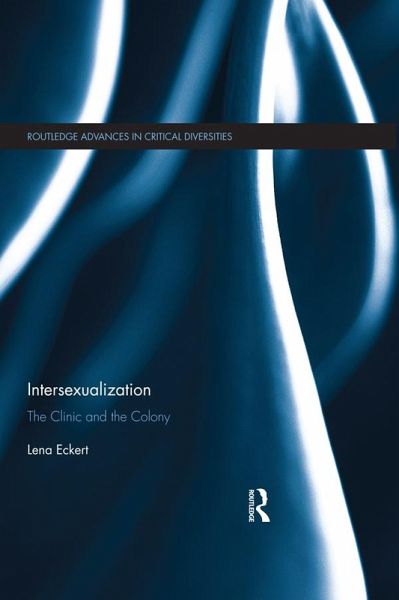
Since the 1970s, research into 'Intersex' has been a central fascination for feminist theorists seeking to make arguments about how men and women are created as social/gender categories. Intersexualization: The Clinic and the Colony takes the case of Olympic runner Caster Semenya as a starting point to explore the issue of determining sex, and the ways in which intersexuality is a 'threat' to the distinction between men/women, homosexuality/heterosexuality and white/black.
By focusing on the 1950s and the 40 years after, Eckert shows how what she calls intersexualization began in psycho-medical research at the Johns Hopkins Hospital in Baltimore and UCLA, and has from there spread into cross-cultural anthropological accounts conducted in Papua New Guinea and the Dominican Republic. With cross-cultural intersexualization having been largely neglected in recent literature on intersex, this timely volume describes how such intersexualization derives from the combination of medicalization and pathologization through two crucial parts. The first part, "The Clinic," describes historical psycho-medical material engaging with hermaphroditism ranging from Greek Mythology up to today. This is followed by "The Colony," which analyzes, in several close-readings, cross-cultural anthropological, sexological and psychoanalytical accounts contributing to cross-cultural intersexualization.
Enclosing a wide range of inter- and transdisciplinary approaches to heteronormative and dichotomously organized frames of knowledge and organization, this volume is essential reading for upper-undergraduate and post-graduate students within the fields of gender studies, social studies of medicine, anthropology,science and technology studies, cultural studies, sociology, and history of medicine.
By focusing on the 1950s and the 40 years after, Eckert shows how what she calls intersexualization began in psycho-medical research at the Johns Hopkins Hospital in Baltimore and UCLA, and has from there spread into cross-cultural anthropological accounts conducted in Papua New Guinea and the Dominican Republic. With cross-cultural intersexualization having been largely neglected in recent literature on intersex, this timely volume describes how such intersexualization derives from the combination of medicalization and pathologization through two crucial parts. The first part, "The Clinic," describes historical psycho-medical material engaging with hermaphroditism ranging from Greek Mythology up to today. This is followed by "The Colony," which analyzes, in several close-readings, cross-cultural anthropological, sexological and psychoanalytical accounts contributing to cross-cultural intersexualization.
Enclosing a wide range of inter- and transdisciplinary approaches to heteronormative and dichotomously organized frames of knowledge and organization, this volume is essential reading for upper-undergraduate and post-graduate students within the fields of gender studies, social studies of medicine, anthropology,science and technology studies, cultural studies, sociology, and history of medicine.
Dieser Download kann aus rechtlichen Gründen nur mit Rechnungsadresse in A, B, BG, CY, CZ, D, DK, EW, E, FIN, F, GR, HR, H, IRL, I, LT, L, LR, M, NL, PL, P, R, S, SLO, SK ausgeliefert werden.
In Intersexualization, Lena Eckert persuasively focuses our attention on the epistemic logic and discursive practices that have worked to define the "heterorelational sex-gender-sexuality system" and to deal with those whose bodies and identities fall outside of its norms. Deftly combining analysis of practices in the psycho-medical sciences (which she names The Clinic) with those of cross-cultural anthropology (or The Colony, as she calls it), and drawing on an impressive range of case studies, Eckert opens up space for a multiplicity of narratives, identities, and embodiments. As she writes, "sex is always complex," and this book illuminates what is at stake in how that complexity comes to matter for bodies rendered troubling and troublesome.
Ruth Holliday, Professor of Gender and Culture, Director of Research, School of Sociology and Social Policy, University of Leeds, UK
Lena Eckert's book focuses on the cross-cultural construction of processes of intersexualization, exploring and combining knowledge production in medicine, psychology, sexology, anthropology and gender studies. Moreover, Intersexualization delves into the colonial archive to make sense of current practices which have far-reaching implications for the lives of people. A book that deserves a broad audience.
Gloria Wekker, Professor Doctor, Emeritus, Department of Gender Studies, Faculty of the Humanities, Utrecht University, The Netherlands
I cannot recommend this book highly enough for its scholarship and its importance to contemporary intersex rights activism around the globe. More than merely taking cues from Foucault, Eckert develops a genealogy of both clinical practice and colonialist domination of bodies cast-as she shows the intersexualized to be-as degenerate, and in need of containing, disciplining, and controlling in the service of creating the powerful careers of the famous psychologists, psychoanalysts, physiologists, and sexologists who had everything to gain from the biomedicalization of intersex in the twentieth century. The book furthers critical intersex studies to more effectively challenge the racist, classist, and heterosexist legacies of twentieth-century practices and the long shadow they cast over contemporary concerns with the sites wherever embodiment, human rights, and sexualities meet.
Morgan Holmes, Professor, Wilfrid Laurier University, Canada
Ruth Holliday, Professor of Gender and Culture, Director of Research, School of Sociology and Social Policy, University of Leeds, UK
Lena Eckert's book focuses on the cross-cultural construction of processes of intersexualization, exploring and combining knowledge production in medicine, psychology, sexology, anthropology and gender studies. Moreover, Intersexualization delves into the colonial archive to make sense of current practices which have far-reaching implications for the lives of people. A book that deserves a broad audience.
Gloria Wekker, Professor Doctor, Emeritus, Department of Gender Studies, Faculty of the Humanities, Utrecht University, The Netherlands
I cannot recommend this book highly enough for its scholarship and its importance to contemporary intersex rights activism around the globe. More than merely taking cues from Foucault, Eckert develops a genealogy of both clinical practice and colonialist domination of bodies cast-as she shows the intersexualized to be-as degenerate, and in need of containing, disciplining, and controlling in the service of creating the powerful careers of the famous psychologists, psychoanalysts, physiologists, and sexologists who had everything to gain from the biomedicalization of intersex in the twentieth century. The book furthers critical intersex studies to more effectively challenge the racist, classist, and heterosexist legacies of twentieth-century practices and the long shadow they cast over contemporary concerns with the sites wherever embodiment, human rights, and sexualities meet.
Morgan Holmes, Professor, Wilfrid Laurier University, Canada