Sie sind bereits eingeloggt. Klicken Sie auf 2. tolino select Abo, um fortzufahren.
Bitte loggen Sie sich zunächst in Ihr Kundenkonto ein oder registrieren Sie sich bei bücher.de, um das eBook-Abo tolino select nutzen zu können.
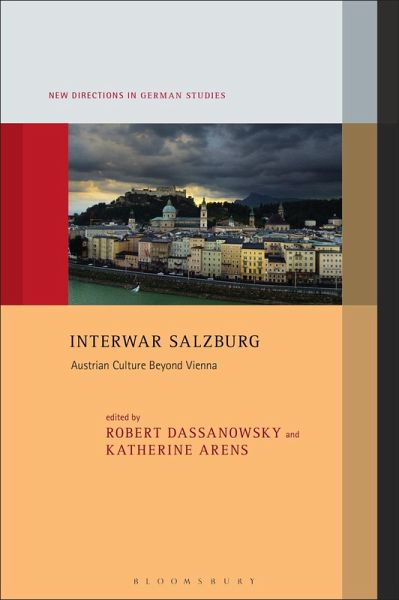
A long-overdue reassessment of post-1918 Salzburg as a distinct Austrian cultural hub that experimented in moving beyond war and empire into a modern, self-consciously inclusive, and international center for European culture. For over 300 years, Salzburg had its own legacy as a city-state at an international crossroads, less stratified than Europe's colonial capitals and seeking a political identity based in civic participation with its own economy and politics. After World War I, Salzburg became a refuge. Its urban and bucolic spaces staged encounters that had been brutally cut apart by the…mehr
A long-overdue reassessment of post-1918 Salzburg as a distinct Austrian cultural hub that experimented in moving beyond war and empire into a modern, self-consciously inclusive, and international center for European culture. For over 300 years, Salzburg had its own legacy as a city-state at an international crossroads, less stratified than Europe's colonial capitals and seeking a political identity based in civic participation with its own economy and politics. After World War I, Salzburg became a refuge. Its urban and bucolic spaces staged encounters that had been brutally cut apart by the war; its deep-seated traditions of citizenship, art, and education guided its path. In Interwar Salzburg, contributors from around the globe recover an evolving but now lost vanguard of European culture, fostering not only new identities in visual and performing arts, film, music, and literature, but also a festival culture aimed at cultivating an inclusive public (not an international elite) and a civic culture sharing public institutions, sports, tourism, and a diverse spectrum of cultural identities serving a new European ideal.
Die Herstellerinformationen sind derzeit nicht verfügbar.
Autorenporträt
Robert Dassanowsky is CU Distinguished Professor of Film and Austrian Studies at the University of Colorado, Colorado Springs, USA, and is a former President of the Austrian Studies Association. He works as an independent film producer, and his previous publications include Austrian Cinema: A History (2005) and Screening Transcendence: Film under Austrofascism and the Hollywood Hope 1933-1938 (2018). He is a jury member for the annual VIS: Vienna Shorts Film Festival. Katherine Arens is a Professor of Germanic Studies, Comparative Literature, and Women's and Gender Studies at the University of Texas at Austin, USA, and a former President of the Austrian Studies Association. Her most recent monographs are Vienna's Dreams of Europe and Belle Necropolis: Ghosts of Imperial Vienna (both 2015).
Inhaltsangabe
Introduction Robert Dassanowsky (University of Colorado, USA) and Katherine Arens (University of Texas at Austin, USA) Prologue: The Capital of Europe. A Fantasy in Salzburg, 1900 Hermann Bahr; translated by Vincent Kling (La Salle University, USA) I. Dreaming Salzburg: Hoping for hope, grasping at what it was and might have been . . . 1. Fantasy as Parody?: Hermann Bahr's Salzburg Dialogue Vincent Kling (La Salle University, USA) 2. Salzburg's Age of Aquarius: Der Wassermann as an Austrian Sonderweg in the European Arts Katherine Arens (University of Texas at Austin, USA) II. Choosing Salzburg: Cosmopolitan Refuge and the Search for a Third Way 3. On Film in Salzburg Robert Dassanowsky (University University of Colorado, Colorado Springs, USA) 4. The "World of Doomed Enchantment": Carl Zuckmayer and the 'Henndorf Circle' Christopher Dietz (Independent Scholar, Austria) III. Being Salzburg: Cultures Found and Lost 5. In the Shadow of the Salzburg Festival?: The Mozarteum Foundation and Conservatory as Protagonists in Salzburg Music Culture Between the Wars Julia Hinterberger (University of Salzburg, Austria) 6. Sports Culture Between State and Dictatorship Andreas Praher (University of Salzburg, Austria) 7. Everyman and the New Man: Festival Culture in Interwar Austria Alys X. George (Stanford University, USA) 8. Shadow Sides of Modernism: Poldi Wojtek's Designs for the Salzburg Festival and Austria's Conservative Modernity Julia Secklehner (Masaryk University, Czech Republic) IV. Eyes on Salzburg: Salzburg Trapped and the Costs It Imposed 9. Jewish Identities and Antisemitism in Salzburg after 1918 Helga Embacher (University of Salzburg, Vienna) 10. Hungarian Salzburgs: Salzburg and the Salzburg Idea as Inspiration for Cultural Policy Initiatives and Urban Tourism Development in Interwar Hungary Alexander Vari (Marywood University, USA) Afterword Bibliography Index
Introduction Robert Dassanowsky (University of Colorado, USA) and Katherine Arens (University of Texas at Austin, USA) Prologue: The Capital of Europe. A Fantasy in Salzburg, 1900 Hermann Bahr; translated by Vincent Kling (La Salle University, USA) I. Dreaming Salzburg: Hoping for hope, grasping at what it was and might have been . . . 1. Fantasy as Parody?: Hermann Bahr's Salzburg Dialogue Vincent Kling (La Salle University, USA) 2. Salzburg's Age of Aquarius: Der Wassermann as an Austrian Sonderweg in the European Arts Katherine Arens (University of Texas at Austin, USA) II. Choosing Salzburg: Cosmopolitan Refuge and the Search for a Third Way 3. On Film in Salzburg Robert Dassanowsky (University University of Colorado, Colorado Springs, USA) 4. The "World of Doomed Enchantment": Carl Zuckmayer and the 'Henndorf Circle' Christopher Dietz (Independent Scholar, Austria) III. Being Salzburg: Cultures Found and Lost 5. In the Shadow of the Salzburg Festival?: The Mozarteum Foundation and Conservatory as Protagonists in Salzburg Music Culture Between the Wars Julia Hinterberger (University of Salzburg, Austria) 6. Sports Culture Between State and Dictatorship Andreas Praher (University of Salzburg, Austria) 7. Everyman and the New Man: Festival Culture in Interwar Austria Alys X. George (Stanford University, USA) 8. Shadow Sides of Modernism: Poldi Wojtek's Designs for the Salzburg Festival and Austria's Conservative Modernity Julia Secklehner (Masaryk University, Czech Republic) IV. Eyes on Salzburg: Salzburg Trapped and the Costs It Imposed 9. Jewish Identities and Antisemitism in Salzburg after 1918 Helga Embacher (University of Salzburg, Vienna) 10. Hungarian Salzburgs: Salzburg and the Salzburg Idea as Inspiration for Cultural Policy Initiatives and Urban Tourism Development in Interwar Hungary Alexander Vari (Marywood University, USA) Afterword Bibliography Index
Es gelten unsere Allgemeinen Geschäftsbedingungen: www.buecher.de/agb
Impressum
www.buecher.de ist ein Internetauftritt der buecher.de internetstores GmbH
Geschäftsführung: Monica Sawhney | Roland Kölbl | Günter Hilger
Sitz der Gesellschaft: Batheyer Straße 115 - 117, 58099 Hagen
Postanschrift: Bürgermeister-Wegele-Str. 12, 86167 Augsburg
Amtsgericht Hagen HRB 13257
Steuernummer: 321/5800/1497
USt-IdNr: DE450055826