
37,95 €
inkl. MwSt.
Sofort per Download lieferbar
19 °P sammeln

Andere Kunden interessierten sich auch für
") Introduction to Ethical Literary Criticism (eBook, ePUB)37,95 €
Introduction to Ethical Literary Criticism (eBook, ePUB)37,95 €") An Ethical Literary Criticism of Han Suyin's Autobiography (eBook, PDF)0,00 €
An Ethical Literary Criticism of Han Suyin's Autobiography (eBook, PDF)0,00 €") Irish Theatre (eBook, PDF)41,95 €
Irish Theatre (eBook, PDF)41,95 €") The Routledge Companion to Narrative Theory (eBook, PDF)43,95 €
The Routledge Companion to Narrative Theory (eBook, PDF)43,95 €") Women and Water in Global Fiction (eBook, PDF)39,95 €
Women and Water in Global Fiction (eBook, PDF)39,95 € Objects and Intertexts in Toni Morrison's "Beloved" (eBook, PDF)41,95 €
") Seamus Heaney's American Odyssey (eBook, PDF)41,95 €
Seamus Heaney's American Odyssey (eBook, PDF)41,95 €
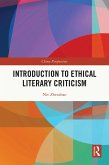

The title is a thorough introduction to ethical literary criticism, a critical methodology designed to interpret literature from the perspective of ethics, including a whole set of concepts, theories, and working mechanisms.
Drawing on ideas from both Western ethical criticism and the Chinese tradition of moral criticism, ethical literary criticism contrasts with the former in its occasional lack of a theoretical foundation and applicable methodologies and the latter that tends to make subjective moral judgments. Its most ground-breaking argument is that while natural selection answers how humans are different from animals physically, ethical selection endows human beings with reason and ethical consciousness. The ethical nature and edifying function of literature is therefore asserted, seeking to unfold in the literary text the ethical choices of human beings as a way to complete ethical selection in society within historical context. The arguments and theoretical toolbox inject a unique ethical dimension into literary criticism and help understand anew the ethical and social potency of literature.
The theoretical elucidation, exemplary textual analyses, and a supplement of key terminologies and ancillary materials make this book an essential guide for students and general readers interested in ethical literary criticism and scholars of literary criticism, ethical criticism, and literary theory.
Drawing on ideas from both Western ethical criticism and the Chinese tradition of moral criticism, ethical literary criticism contrasts with the former in its occasional lack of a theoretical foundation and applicable methodologies and the latter that tends to make subjective moral judgments. Its most ground-breaking argument is that while natural selection answers how humans are different from animals physically, ethical selection endows human beings with reason and ethical consciousness. The ethical nature and edifying function of literature is therefore asserted, seeking to unfold in the literary text the ethical choices of human beings as a way to complete ethical selection in society within historical context. The arguments and theoretical toolbox inject a unique ethical dimension into literary criticism and help understand anew the ethical and social potency of literature.
The theoretical elucidation, exemplary textual analyses, and a supplement of key terminologies and ancillary materials make this book an essential guide for students and general readers interested in ethical literary criticism and scholars of literary criticism, ethical criticism, and literary theory.
Dieser Download kann aus rechtlichen Gründen nur mit Rechnungsadresse in A, B, BG, CY, CZ, D, DK, EW, E, FIN, F, GR, HR, H, IRL, I, LT, L, LR, M, NL, PL, P, R, S, SLO, SK ausgeliefert werden.
'The noblest mission of IAELC, as formulated in Nie Zhenzhao's teachings, is to restore the critical discipline to its proper suppleness and subtlety, its engagement with central human purposes, undoctrinaire, faithful to its documents, respectful of historical knowledge, and in short empirical in the best and most sensitive readerly way.'
Claude Rawson, Yale University, USA
'It seems to me that Ethical Literary Criticism is valuable in that it seeks not just to revise moral criticism, but to modernize and "update" it for our own time. I thus think that Ethical Literary Criticism may have potentially useful things to say not just about the literature of Samuel Johnson's or Arnold's or Leavis's age, but also about earlier (and later) works.'
Galin Tihanov, Queen Mary University of London, UK
'Nie Zhenzhao's Introduction to Ethical Literary Criticism illuminates the working logistics and principles of ethical literary criticism, generating a variety of ethical events and ethical conflicts in literary works, providing a new approach to literary studies after the "ethical turn" in western deconstructive and postmodern literary theory and criticism, creating new contemporary Chinese trends in literary criticism and theory, and anticipating the future anterior of the Asian literary critical discourse.'
Youngmin Kim, Dongguk University, South Korea
Claude Rawson, Yale University, USA
'It seems to me that Ethical Literary Criticism is valuable in that it seeks not just to revise moral criticism, but to modernize and "update" it for our own time. I thus think that Ethical Literary Criticism may have potentially useful things to say not just about the literature of Samuel Johnson's or Arnold's or Leavis's age, but also about earlier (and later) works.'
Galin Tihanov, Queen Mary University of London, UK
'Nie Zhenzhao's Introduction to Ethical Literary Criticism illuminates the working logistics and principles of ethical literary criticism, generating a variety of ethical events and ethical conflicts in literary works, providing a new approach to literary studies after the "ethical turn" in western deconstructive and postmodern literary theory and criticism, creating new contemporary Chinese trends in literary criticism and theory, and anticipating the future anterior of the Asian literary critical discourse.'
Youngmin Kim, Dongguk University, South Korea