P. J. Dhrymes
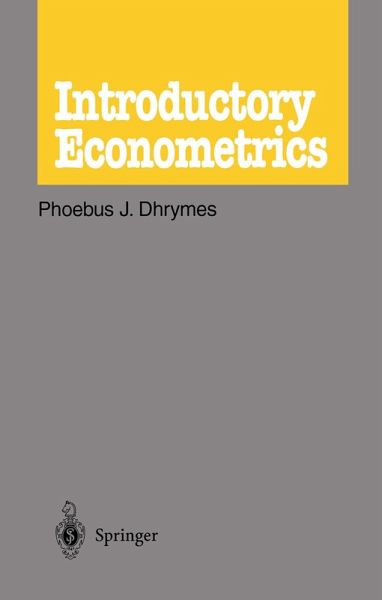
Introductory Econometrics (eBook, PDF)
40,95 €
40,95 €
inkl. MwSt.
Sofort per Download lieferbar

20 °P sammeln
40,95 €
Als Download kaufen
40,95 €
inkl. MwSt.
Sofort per Download lieferbar
20 °P sammeln
Jetzt verschenken
Alle Infos zum eBook verschenken
40,95 €
inkl. MwSt.
Sofort per Download lieferbar
Alle Infos zum eBook verschenken
20 °P sammeln

P. J. Dhrymes
Introductory Econometrics (eBook, PDF)
- Format: PDF
- Merkliste
- Auf die Merkliste
- Bewerten Bewerten
- Teilen
- Produkt teilen
- Produkterinnerung
- Produkterinnerung

Bitte loggen Sie sich zunächst in Ihr Kundenkonto ein oder registrieren Sie sich bei
bücher.de, um das eBook-Abo tolino select nutzen zu können.
Hier können Sie sich einloggen
Sie sind bereits eingeloggt. Klicken Sie auf 2. tolino select Abo, um fortzufahren.

Bitte loggen Sie sich zunächst in Ihr Kundenkonto ein oder registrieren Sie sich bei bücher.de, um das eBook-Abo tolino select nutzen zu können.
This book represents a first course in econometrics, assuming only some knowledge of elementary probability theory and statistics on the part of the student. Its rigorous and comprehensive discussion concentrates on the general linear model, treating the standard case as well as the consequences resulting from violation of the underlying assumptions.
- Geräte: PC
- ohne Kopierschutz
- eBook Hilfe
- Größe: 28.11MB
Andere Kunden interessierten sich auch für
P. J. DhrymesEconometrics (eBook, PDF)40,95 €
Paul KnottnerusLinear Models with Correlated Disturbances (eBook, PDF)72,95 €
Misspecification Analysis (eBook, PDF)72,95 €
L. BauwensBayesian Full Information Analysis of Simultaneous Equation Models Using Integration by Monte Carlo (eBook, PDF)40,95 €
Antonio VillarOperator Theorems with Applications to Distributive Problems and Equilibrium Models (eBook, PDF)40,95 €
V. L. MakarovMathematical Theory of Economic Dynamics and Equilibria (eBook, PDF)40,95 €
Fuzzy Set Approach to Multidimensional Poverty Measurement (eBook, PDF)72,95 €-
-
-
This book represents a first course in econometrics, assuming only some knowledge of elementary probability theory and statistics on the part of the student. Its rigorous and comprehensive discussion concentrates on the general linear model, treating the standard case as well as the consequences resulting from violation of the underlying assumptions.
Dieser Download kann aus rechtlichen Gründen nur mit Rechnungsadresse in A, B, BG, CY, CZ, D, DK, EW, E, FIN, F, GR, HR, H, IRL, I, LT, L, LR, M, NL, PL, P, R, S, SLO, SK ausgeliefert werden.
Produktdetails
- Produktdetails
- Verlag: Springer US
- Seitenzahl: 429
- Erscheinungstermin: 6. Dezember 2012
- Englisch
- ISBN-13: 9781461262923
- Artikelnr.: 44064388
- Verlag: Springer US
- Seitenzahl: 429
- Erscheinungstermin: 6. Dezember 2012
- Englisch
- ISBN-13: 9781461262923
- Artikelnr.: 44064388
- Herstellerkennzeichnung Die Herstellerinformationen sind derzeit nicht verfügbar.
1 The General Linear Model I.- 1.1 Introduction.- 1.2 Model Specification and Estimation.- 1.3 Goodness of Fit.- Questions and Problems.- 2 The General Linear Model II.- 2.1 Generalities.- 2.2 Distribution of the Estimator of ?.- 2.3 General Linear Restriction: Estimation and Tests.- 2.4 Mixed Estimators and the Bayesian Approach.- Questions and Problems.- 3 The General Linear Model III.- 3.1 Generalities.- 3.2 Violation of Standard Error Process Assumptions.- Questions and Problems.- 4 The General Linear Model IV.- 4.1 Multicollinearity: Failure of the Rank Condition.- 4.2 Analysis of Variance: Categorical Explanatory Variables.- 4.3 Analysis of Covariance: Some Categorical and Some Continuous Explanatory Variables.- 5 Misspecification Analysis and Errors in Variables.- 5.1 Introduction.- 5.2 Misspecification Analysis.- 5.3 Errors in Variables (EIV): Bivariate Model.- 5.4 Errors in Variables (EIV): General Model.- 5.5 Misspecification Error Analysis for EIV Models.- Questions and Problems.- 6 Systems of Simultaneous Equations.- 6.1 Introduction.- 6.2 The Simultaneous Equations Model (SEM): Definitions, Conventions, and Notation.- 6.3 The Identification Problem.- 6.4 Estimation of the GLSEM.- 6.5 Prediction from the GLSEM.- 6.6 The GLSEM and Undersized Samples.- 6.7 Maximum Likelihood (ML) Estimators.- Questions and Problems.- 7 Discrete Choice Models: Logit and Probit Analysis.- 7.1 Introduction.- 7.2 The Nature of Discrete Choice Models.- 7.3 Formulation of Dichotomous Choice Models.- 7.4 A Behavioral Justification for the Dichotomous Choice Model.- 7.5 Inapplicability of OLS Procedures 3.- 7.6 Maximum Likelihood Estimation.- 7.7 Inference for Discrete Choice Models.- 7.8 Polytomous Choice Models.- 8 Statistical and Probabilistic Background.- 8.1 Multivariate Densityand Distribution Functions.- 8.2 The Multivariate Normal Distribution.- 8.3 Point Estimation.- 8.4 Elements of Bayesian Inference.- Questions and Problems.- Tables for Testing Hypotheses on the Autoregressive Structure of the Errors in a GLM.- References.