Aditya Joshi, Pushpak Bhattacharyya, Mark J. Carman
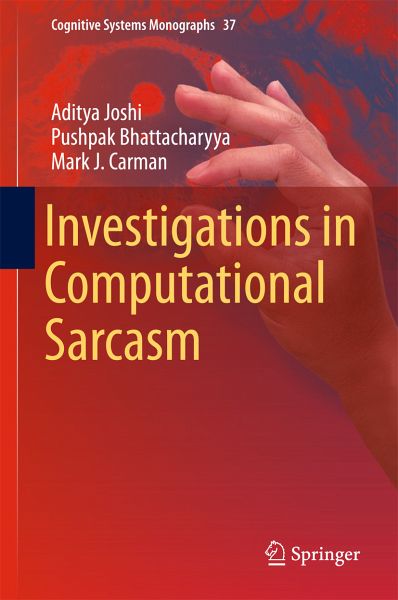
Investigations in Computational Sarcasm (eBook, PDF)
72,95 €
72,95 €
inkl. MwSt.
Sofort per Download lieferbar

36 °P sammeln
72,95 €
Als Download kaufen
72,95 €
inkl. MwSt.
Sofort per Download lieferbar
36 °P sammeln
Jetzt verschenken
Alle Infos zum eBook verschenken
72,95 €
inkl. MwSt.
Sofort per Download lieferbar
Alle Infos zum eBook verschenken
36 °P sammeln

Aditya Joshi, Pushpak Bhattacharyya, Mark J. Carman
Investigations in Computational Sarcasm (eBook, PDF)
- Format: PDF
- Merkliste
- Auf die Merkliste
- Bewerten Bewerten
- Teilen
- Produkt teilen
- Produkterinnerung
- Produkterinnerung

Bitte loggen Sie sich zunächst in Ihr Kundenkonto ein oder registrieren Sie sich bei
bücher.de, um das eBook-Abo tolino select nutzen zu können.
Hier können Sie sich einloggen
Sie sind bereits eingeloggt. Klicken Sie auf 2. tolino select Abo, um fortzufahren.

Bitte loggen Sie sich zunächst in Ihr Kundenkonto ein oder registrieren Sie sich bei bücher.de, um das eBook-Abo tolino select nutzen zu können.
Provides a tabular summary of past work in computational sarcasm Lays down linguistic foundations to computational sarcasm Employs elaborate examples motivating each module of work Describes approaches spanning multiple ML techniques such as classifiers, topic models, deep learning-based architectures, etc.
- Geräte: PC
- ohne Kopierschutz
- eBook Hilfe
- Größe: 2.56MB
Andere Kunden interessierten sich auch für
Asoke Kumar DattaTime Domain Representation of Speech Sounds (eBook, PDF)72,95 €
Josef ZelgerErforschung und Entwicklung von Communities (eBook, PDF)54,99 €
Computational Linguistics (eBook, PDF)40,95 €
Computational Intelligence: Theories, Applications and Future Directions - Volume II (eBook, PDF)160,95 €
Machine Translation (eBook, PDF)40,95 €
Computational Intelligence: Theories, Applications and Future Directions - Volume I (eBook, PDF)160,95 €
Hermann HelbigWissensverarbeitung und die Semantik der Natürlichen Sprache (eBook, PDF)29,66 €-
-
-
Provides a tabular summary of past work in computational sarcasm
Lays down linguistic foundations to computational sarcasm
Employs elaborate examples motivating each module of work
Describes approaches spanning multiple ML techniques such as classifiers, topic models, deep learning-based architectures, etc.
Dieser Download kann aus rechtlichen Gründen nur mit Rechnungsadresse in A, B, BG, CY, CZ, D, DK, EW, E, FIN, F, GR, HR, H, IRL, I, LT, L, LR, M, NL, PL, P, R, S, SLO, SK ausgeliefert werden.
Produktdetails
- Produktdetails
- Verlag: Springer Nature Singapore
- Seitenzahl: 143
- Erscheinungstermin: 16. März 2018
- Englisch
- ISBN-13: 9789811083969
- Artikelnr.: 56812339
- Verlag: Springer Nature Singapore
- Seitenzahl: 143
- Erscheinungstermin: 16. März 2018
- Englisch
- ISBN-13: 9789811083969
- Artikelnr.: 56812339
- Herstellerkennzeichnung Die Herstellerinformationen sind derzeit nicht verfügbar.
Aditya Joshi has been a PhD student at IITB-Monash Research Academy, Mumbai, a joint PhD programme run by the Indian Institute of Technology Bombay (IIT Bombay) and Monash University, Australia, since January 2013. His primary research focus is computational sarcasm, and he has explored different ways in which incongruity can be captured in order to detect and generate sarcasm. In addition, he has worked on innovative applications of natural language processing (NLP) such as sentiment analysis for Indian languages, drunk-texting prediction, news headline translation, and political issue extraction. The monograph is an outcome of Aditya's PhD research.
Dr. Pushpak Bhattacharyya is the current president of The Association for Computational Linguistics (ACL) (2016-17). He is the Director of the Indian Institute of Technology Patna (IIT Patna) and Vijay and Sita Vashee Chair Professor at the Department of Computer Science and Engineering, Indian Institute of Technology Bombay (IIT Bombay). He was educated at the Indian Institute of Technology Kharagpur (IIT Kharagpur) (B.Tech), Indian Institute of Technology Kanpur (IIT Kanpur) (M.Tech.) and IIT Bombay (PhD).
He has been a visiting scholar and faculty member at the Massachusetts Institute of Technology (MIT), Stanford, UT Houston and University Joseph Fouriere (France). Prof. Bhattacharyya's research areas include natural language processing, machine learning and artificial intelligence (AI). Loved by his students for his inspiring teaching and mentorship, he has guided more than 250 students (PhD, Masters and Bachelors). He has published over 250 research papers, is author of the textbook 'Machine Translation' and has led government and industry projects of international and national importance. His significant contributions in the field include multilingual lexical knowledge bases and projection. Prof. Bhattacharyya is a fellow of the National Academy of Engineering and recipient of the IIT Bombay Patwardhan Award and the Indian Institute of Technology Roorkee (IIT Roorkee) VNMM award,both for technology development. He has also received IBM, Microsoft, Yahoo and United Nations faculty grants.
Dr. Mark J. Carman is a senior lecturer at the Faculty of Information Technology, Monash University, Australia. He obtained a Ph.D. from the University of Trento, Italy in 2004. His research and interests span theoretical studies (e.g. investigating statistical properties of information retrieval measures), to practical applications (e.g. technology for assisting police during digital forensic investigations). Dr. Carman has authored a large number of publications in prestigious venues, including full papers at SIGIR, KDD, IJCAI, CIKM, WSDM, CoNLL, and ECIR, and articles in TOIS, IR, JMLR, ML, PR, JAIR and IP&M.
Dr. Pushpak Bhattacharyya is the current president of The Association for Computational Linguistics (ACL) (2016-17). He is the Director of the Indian Institute of Technology Patna (IIT Patna) and Vijay and Sita Vashee Chair Professor at the Department of Computer Science and Engineering, Indian Institute of Technology Bombay (IIT Bombay). He was educated at the Indian Institute of Technology Kharagpur (IIT Kharagpur) (B.Tech), Indian Institute of Technology Kanpur (IIT Kanpur) (M.Tech.) and IIT Bombay (PhD).
He has been a visiting scholar and faculty member at the Massachusetts Institute of Technology (MIT), Stanford, UT Houston and University Joseph Fouriere (France). Prof. Bhattacharyya's research areas include natural language processing, machine learning and artificial intelligence (AI). Loved by his students for his inspiring teaching and mentorship, he has guided more than 250 students (PhD, Masters and Bachelors). He has published over 250 research papers, is author of the textbook 'Machine Translation' and has led government and industry projects of international and national importance. His significant contributions in the field include multilingual lexical knowledge bases and projection. Prof. Bhattacharyya is a fellow of the National Academy of Engineering and recipient of the IIT Bombay Patwardhan Award and the Indian Institute of Technology Roorkee (IIT Roorkee) VNMM award,both for technology development. He has also received IBM, Microsoft, Yahoo and United Nations faculty grants.
Dr. Mark J. Carman is a senior lecturer at the Faculty of Information Technology, Monash University, Australia. He obtained a Ph.D. from the University of Trento, Italy in 2004. His research and interests span theoretical studies (e.g. investigating statistical properties of information retrieval measures), to practical applications (e.g. technology for assisting police during digital forensic investigations). Dr. Carman has authored a large number of publications in prestigious venues, including full papers at SIGIR, KDD, IJCAI, CIKM, WSDM, CoNLL, and ECIR, and articles in TOIS, IR, JMLR, ML, PR, JAIR and IP&M.
1. Introduction.- 2. Literature Survey.- 3. Understanding the Phenomenon of Sarcasm.- 4. Sarcasm Detection using Incongruity within Target Text.- 5. Sarcasm Detection using Contextual Incongruity.- 6. Sarcasm Generation.- 7. Conclusion & Future Work.