5,99 €
inkl. MwSt.
Sofort per Download lieferbar
0 °P sammeln

Andere Kunden interessierten sich auch für
") Pragmatism (eBook, ePUB)5,99 €
Pragmatism (eBook, ePUB)5,99 €") Nihilism (eBook, ePUB)5,99 €
Nihilism (eBook, ePUB)5,99 €") 100 pagine di filosofia (eBook, ePUB)1,99 €
100 pagine di filosofia (eBook, ePUB)1,99 €") You, the Jury: principled decisions (eBook, ePUB)8,49 €
You, the Jury: principled decisions (eBook, ePUB)8,49 €") Heraclitus: Commentaries on the Fragments of Heraclitus (eBook, ePUB)6,49 €
Heraclitus: Commentaries on the Fragments of Heraclitus (eBook, ePUB)6,49 €") The Virtue of Playfulness (eBook, ePUB)22,95 €
The Virtue of Playfulness (eBook, ePUB)22,95 € (eBook, ePUB)") Existentialism is a Humanism by Jean-Paul Sartre (Book Analysis) (eBook, ePUB)9,99 €
Existentialism is a Humanism by Jean-Paul Sartre (Book Analysis) (eBook, ePUB)9,99 €





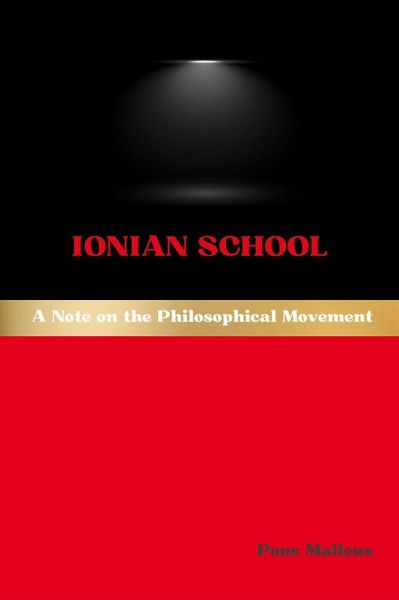
The Ionian School of philosophy, born in the ancient city-states of Asia Minor, marks the dawn of rational inquiry and the search for natural explanations of the world. Before this intellectual revolution, myths and gods were often invoked to explain natural phenomena. The Ionian thinkers, however, dared to look beyond the mythological narratives to explore the fundamental nature of reality. This shift, away from the divine to the natural, laid the groundwork for much of Western philosophy, providing a foundation that would influence the course of intellectual history for millennia.
The city of Miletus, located along the Ionian coast in present-day Turkey, stands as the birthplace of this philosophical awakening. It was here that figures such as Thales, Anaximander, and Anaximenes would challenge prevailing understandings of the world, turning their attention to the cosmos, nature, and the origin of all things. These early philosophers were not content to simply accept traditional religious or mythological explanations. Instead, they sought to understand the world in terms of natural causes and principles. They were the first to attempt a rational description of the universe, breaking away from the imaginative fables that had previously suffused Greek thought.
Thales of Miletus, often regarded as the first philosopher, posited that water was the fundamental substance from which everything emerged. For Thales, water was the arche-a Greek word meaning "origin" or "first principle." In doing so, Thales became the first to suggest that there is a unifying substance underlying all existence, a notion that would become central to later philosophical thought. His inquiry into the nature of reality was revolutionary, for it initiated a long tradition of materialistic and naturalistic explanations of the universe.
Thales' successors, Anaximander and Anaximenes, further developed these ideas. Anaximander, perhaps the most speculative of the Ionians, introduced the concept of the apeiron-the boundless or infinite. For Anaximander, the arche was not a specific substance but an indeterminate, infinite principle from which all things arise and to which they return. This abstract notion of the origin of the cosmos reflects a shift toward a more philosophical and metaphysical understanding of the world. Anaximenes, on the other hand, returned to a more materialistic view, arguing that air, rather than water, was the primary substance. His idea that the transformation of one substance into another could account for the diversity of the natural world would resonate through future generations of philosophers.
What binds the Ionian thinkers together is their commitment to a rational, systematic exploration of the cosmos. They were not content with mythological stories or religious dogma. They sought to uncover the principles and causes behind the phenomena they observed, laying the foundation for later scientific thought. Their pursuit of knowledge was motivated by a profound belief in the order and intelligibility of the universe. This was an intellectual revolution, for it was the first time in human history that the world was seen as a place governed by natural laws, not capricious gods.
Despite their groundbreaking contributions, the Ionian philosophers were not without their critics. Plato, for instance, would later argue that their emphasis on physical explanations of the cosmos neglected the more abstract, metaphysical dimensions of reality. Yet, the Ionian School's contributions cannot be overstated. They set the stage for the development of both philosophy and science, not only in ancient Greece but throughout the Western intellectual tradition. Their exploration of nature, logic, and the cosmos paved the way for later thinkers like Pythagoras, Heraclitus, and even Aristotle.
The city of Miletus, located along the Ionian coast in present-day Turkey, stands as the birthplace of this philosophical awakening. It was here that figures such as Thales, Anaximander, and Anaximenes would challenge prevailing understandings of the world, turning their attention to the cosmos, nature, and the origin of all things. These early philosophers were not content to simply accept traditional religious or mythological explanations. Instead, they sought to understand the world in terms of natural causes and principles. They were the first to attempt a rational description of the universe, breaking away from the imaginative fables that had previously suffused Greek thought.
Thales of Miletus, often regarded as the first philosopher, posited that water was the fundamental substance from which everything emerged. For Thales, water was the arche-a Greek word meaning "origin" or "first principle." In doing so, Thales became the first to suggest that there is a unifying substance underlying all existence, a notion that would become central to later philosophical thought. His inquiry into the nature of reality was revolutionary, for it initiated a long tradition of materialistic and naturalistic explanations of the universe.
Thales' successors, Anaximander and Anaximenes, further developed these ideas. Anaximander, perhaps the most speculative of the Ionians, introduced the concept of the apeiron-the boundless or infinite. For Anaximander, the arche was not a specific substance but an indeterminate, infinite principle from which all things arise and to which they return. This abstract notion of the origin of the cosmos reflects a shift toward a more philosophical and metaphysical understanding of the world. Anaximenes, on the other hand, returned to a more materialistic view, arguing that air, rather than water, was the primary substance. His idea that the transformation of one substance into another could account for the diversity of the natural world would resonate through future generations of philosophers.
What binds the Ionian thinkers together is their commitment to a rational, systematic exploration of the cosmos. They were not content with mythological stories or religious dogma. They sought to uncover the principles and causes behind the phenomena they observed, laying the foundation for later scientific thought. Their pursuit of knowledge was motivated by a profound belief in the order and intelligibility of the universe. This was an intellectual revolution, for it was the first time in human history that the world was seen as a place governed by natural laws, not capricious gods.
Despite their groundbreaking contributions, the Ionian philosophers were not without their critics. Plato, for instance, would later argue that their emphasis on physical explanations of the cosmos neglected the more abstract, metaphysical dimensions of reality. Yet, the Ionian School's contributions cannot be overstated. They set the stage for the development of both philosophy and science, not only in ancient Greece but throughout the Western intellectual tradition. Their exploration of nature, logic, and the cosmos paved the way for later thinkers like Pythagoras, Heraclitus, and even Aristotle.
Dieser Download kann aus rechtlichen Gründen nur mit Rechnungsadresse in A, B, BG, CY, CZ, D, DK, EW, E, FIN, F, GR, H, IRL, I, LT, L, LR, M, NL, PL, P, R, S, SLO, SK ausgeliefert werden.