39,95 €
39,95 €
inkl. MwSt.
Sofort per Download lieferbar

20 °P sammeln
39,95 €
Als Download kaufen
39,95 €
inkl. MwSt.
Sofort per Download lieferbar
20 °P sammeln
Jetzt verschenken
Alle Infos zum eBook verschenken
39,95 €
inkl. MwSt.
Sofort per Download lieferbar
Alle Infos zum eBook verschenken
20 °P sammeln

Andere Kunden interessierten sich auch für
") Isaiah Berlin and the Politics of Freedom (eBook, ePUB)41,95 €
Isaiah Berlin and the Politics of Freedom (eBook, ePUB)41,95 €") Isaiah Berlin in the Twenty-First Century (eBook, ePUB)39,95 €
Isaiah Berlin in the Twenty-First Century (eBook, ePUB)39,95 € (eBook, ePUB)") Liberalisms (Routledge Revivals) (eBook, ePUB)55,95 €
Liberalisms (Routledge Revivals) (eBook, ePUB)55,95 €") Counter-Enlightenments (eBook, ePUB)55,95 €
Counter-Enlightenments (eBook, ePUB)55,95 €") Liberalism and Naval Strategy (eBook, ePUB)27,95 €
Liberalism and Naval Strategy (eBook, ePUB)27,95 €") Raymond Aron and International Relations (eBook, ePUB)41,95 €
Raymond Aron and International Relations (eBook, ePUB)41,95 €") American Leadership in World Affairs (eBook, ePUB)32,95 €
American Leadership in World Affairs (eBook, ePUB)32,95 €


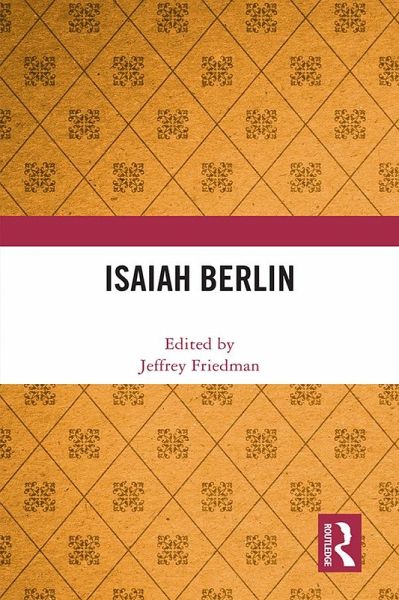
Isaiah Berlin's liberalism seems both dated and essential in an era of ideological extremes. Berlin's vision of liberalism rejected metaphysics, philosophies of history, and particular conceptions of the good, setting a pattern for Anglo-American political thought that is still influential and may offer resources for understanding the resurgence of ideology in the twenty-first century, but one that also seems to be firmly embedded in the Cold War opposition of liberalism against Marxism.
In this volume, ten political theorists reconsider Berlin's thought-especially his famous essay, "Two Concepts of Liberty"-in the light of contemporary political developments such as populism. Several contributors focus on Berlin's neglected idea of political "maturity" as holding a key to his thought, making it an important site of contestation over his legacy. Others analyse Berlin's notoriously fraught definition of liberty and his understanding of value pluralism; situate him as a Cold War liberal; and relate his work to that of contemporaries such as Raymond Aron and Leo Strauss.
This book was originally published as a special issue of Critical Review.
In this volume, ten political theorists reconsider Berlin's thought-especially his famous essay, "Two Concepts of Liberty"-in the light of contemporary political developments such as populism. Several contributors focus on Berlin's neglected idea of political "maturity" as holding a key to his thought, making it an important site of contestation over his legacy. Others analyse Berlin's notoriously fraught definition of liberty and his understanding of value pluralism; situate him as a Cold War liberal; and relate his work to that of contemporaries such as Raymond Aron and Leo Strauss.
This book was originally published as a special issue of Critical Review.
Dieser Download kann aus rechtlichen Gründen nur mit Rechnungsadresse in A, B, BG, CY, CZ, D, DK, EW, E, FIN, F, GR, HR, H, IRL, I, LT, L, LR, M, NL, PL, P, R, S, SLO, SK ausgeliefert werden.