100,00 €
inkl. MwSt.
Sofort per Download lieferbar
0 °P sammeln

Andere Kunden interessierten sich auch für
") Prepare the Way of the Lord (eBook, PDF)160,95 €
Prepare the Way of the Lord (eBook, PDF)160,95 €") The Hour of Justification in the Fourth Gospel (eBook, PDF)89,00 €
The Hour of Justification in the Fourth Gospel (eBook, PDF)89,00 €") The Fourth Pentecostal Wave in South Africa (eBook, PDF)42,95 €
The Fourth Pentecostal Wave in South Africa (eBook, PDF)42,95 €") The Enigma of the Fourth Gospel (eBook, PDF)52,95 €
The Enigma of the Fourth Gospel (eBook, PDF)52,95 €") Johannine Studies 1975-2017 (eBook, PDF)219,00 €
Johannine Studies 1975-2017 (eBook, PDF)219,00 €") Theology and History in the Fourth Gospel (eBook, PDF)33,95 €
Theology and History in the Fourth Gospel (eBook, PDF)33,95 €") The Divine Name in the Gospel of John (eBook, PDF)94,00 €
The Divine Name in the Gospel of John (eBook, PDF)94,00 €


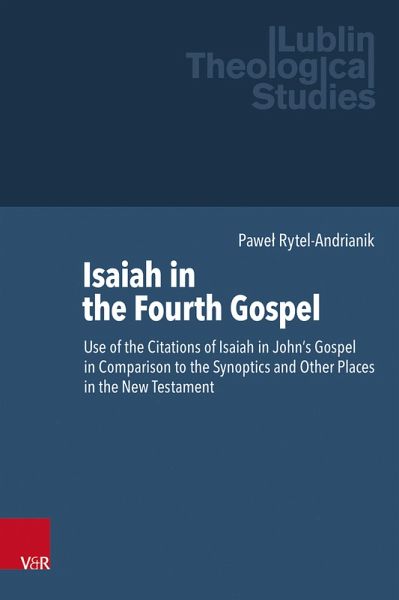
In this study Pawel Rytel-Andrianik focuses on the meaning and function of Isaianic citations in both their original and new contexts. He offers a linguistic analyses of each of the citations in order to identify the source of the citation and understand the editorial approach of a New Testament writer. The author then examines how the original text acquires new meaning and function in its New Testament setting. Among other issues, it challenges the assumption that according to the Jewish sources Elijah had to come to prepare the way for the Messiah. It also proposes a new solution to the problem of why in the Synoptic Gospels John the Baptist is called Elijah, while in John he is not. Throughout this book it is argued that the very same citation from the Old Testament can be used in two different places in the New Testament with two distinct meanings.
Dieser Download kann aus rechtlichen Gründen nur mit Rechnungsadresse in A, B, BG, CY, CZ, D, DK, EW, E, FIN, F, GR, H, IRL, I, LT, L, LR, M, NL, PL, P, R, S, SLO, SK ausgeliefert werden.