18,95 €
18,95 €
inkl. MwSt.
Sofort per Download lieferbar

9 °P sammeln
18,95 €
Als Download kaufen
18,95 €
inkl. MwSt.
Sofort per Download lieferbar
9 °P sammeln
Jetzt verschenken
Alle Infos zum eBook verschenken
18,95 €
inkl. MwSt.
Sofort per Download lieferbar
Alle Infos zum eBook verschenken
9 °P sammeln

Andere Kunden interessierten sich auch für
") Gardens in the Modern Landscape (eBook, ePUB)29,95 €
Gardens in the Modern Landscape (eBook, ePUB)29,95 €") Contemporary Asian Pools and Gardens (eBook, ePUB)8,95 €
Contemporary Asian Pools and Gardens (eBook, ePUB)8,95 €") Essay on Gardens (eBook, ePUB)37,95 €
Essay on Gardens (eBook, ePUB)37,95 €") Shed Heaven (eBook, ePUB)7,49 €
Shed Heaven (eBook, ePUB)7,49 €") Il sogno babilonese (eBook, ePUB)4,99 €
Il sogno babilonese (eBook, ePUB)4,99 €") Hanging Gardens of Babylon (eBook, ePUB)0,00 €
Hanging Gardens of Babylon (eBook, ePUB)0,00 €") Of Gardens (eBook, ePUB)25,95 €
Of Gardens (eBook, ePUB)25,95 €






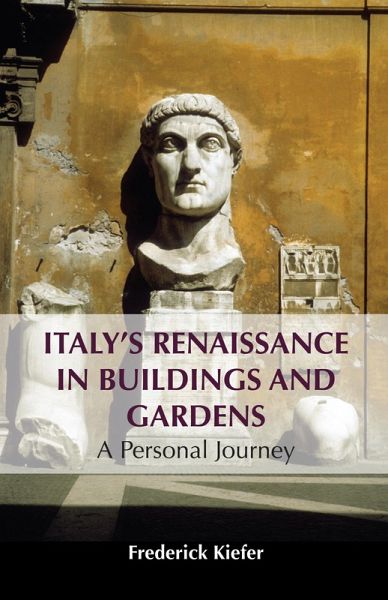
Palaces, villas and churches. These were the highlights of my first visit to Italy. I took a lot of photos and looked forward to sharing them with friends and family. Back home, though, I found that I didn't recall much about the places that impressed me. Although I had the benefit of a half-day guide in Rome, Florence and Venice, I sometimes had difficulty hearing what was said on crowded streets and busy interiors. The guides were capable but had only enough time to mention a few major features. As a rule, they skimped on actually describing buildings that intrigued me. And so they were not especially helpful in providing the insights I wanted. Upon my return, I found myself wondering: Where did the architects actually find their ideas? What did they want to accomplish? And what do their choices tell us about their time? My sojourn in Italy would have been more satisfying if I had come away with a fuller account of what I had seen. What I most needed was context. This book supplies that context.
Contemplation of antiquity and the exchange of views among architects released a surge of intellectual energy not seen for a millennium, a development that would never have happened so quickly were it not for Johannes Gutenberg's invention of printing with movable type. This development, in turn, led to architects' heightened self-awareness of their collective enterprise. They read what their fellow architects wrote and thereby gained in sophistication. They were no longer merely masons. They became architects in the modern sense. They took pride in their achievements and shared a conviction that the visual culture they created was far superior to that of the previous thousand years.
Their embrace of classical civilisation had a visceral urgency. Rome, after all, was a culture with a storied past, peopled by larger-than-life figures. To learn what the ancients had created in word or stone could supply a shortcut to wisdom. And emulating the Romans would provide new models of aesthetic excellence. This endeavour became known as the Renaissance, or rebirth. The Reformation, however, changed everything. Martin Luther brought to issue a quandary: How exactly was Christianity to be reconciled with the pagan past, if at all? Could one source of inspiration be sustained without compromising the other? Religious reform questioned the aesthetic achievements of the previous hundred years. The story of Renaissance architecture represents the effort to find an accommodation.
Contemplation of antiquity and the exchange of views among architects released a surge of intellectual energy not seen for a millennium, a development that would never have happened so quickly were it not for Johannes Gutenberg's invention of printing with movable type. This development, in turn, led to architects' heightened self-awareness of their collective enterprise. They read what their fellow architects wrote and thereby gained in sophistication. They were no longer merely masons. They became architects in the modern sense. They took pride in their achievements and shared a conviction that the visual culture they created was far superior to that of the previous thousand years.
Their embrace of classical civilisation had a visceral urgency. Rome, after all, was a culture with a storied past, peopled by larger-than-life figures. To learn what the ancients had created in word or stone could supply a shortcut to wisdom. And emulating the Romans would provide new models of aesthetic excellence. This endeavour became known as the Renaissance, or rebirth. The Reformation, however, changed everything. Martin Luther brought to issue a quandary: How exactly was Christianity to be reconciled with the pagan past, if at all? Could one source of inspiration be sustained without compromising the other? Religious reform questioned the aesthetic achievements of the previous hundred years. The story of Renaissance architecture represents the effort to find an accommodation.
Dieser Download kann aus rechtlichen Gründen nur mit Rechnungsadresse in A, D ausgeliefert werden.