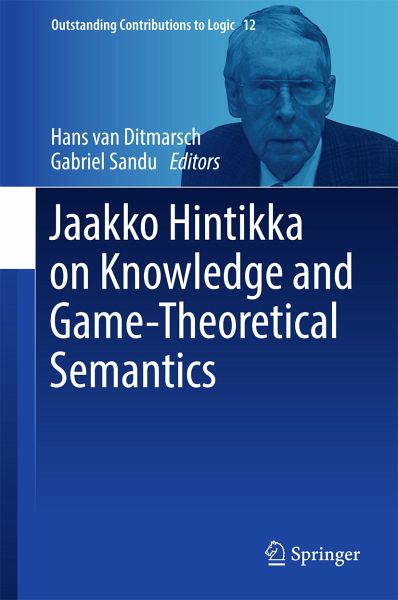
Jaakko Hintikka on Knowledge and Game-Theoretical Semantics (eBook, PDF)
Redaktion: Ditmarsch, Hans Van; Sandu, Gabriel
120,95 €
120,95 €
inkl. MwSt.
Sofort per Download lieferbar

60 °P sammeln
120,95 €
Als Download kaufen
120,95 €
inkl. MwSt.
Sofort per Download lieferbar
60 °P sammeln
Jetzt verschenken
Alle Infos zum eBook verschenken
120,95 €
inkl. MwSt.
Sofort per Download lieferbar
Alle Infos zum eBook verschenken
60 °P sammeln

Jaakko Hintikka on Knowledge and Game-Theoretical Semantics (eBook, PDF)
Redaktion: Ditmarsch, Hans Van; Sandu, Gabriel
- Format: PDF
- Merkliste
- Auf die Merkliste
- Bewerten Bewerten
- Teilen
- Produkt teilen
- Produkterinnerung
- Produkterinnerung

Bitte loggen Sie sich zunächst in Ihr Kundenkonto ein oder registrieren Sie sich bei
bücher.de, um das eBook-Abo tolino select nutzen zu können.
Hier können Sie sich einloggen
Sie sind bereits eingeloggt. Klicken Sie auf 2. tolino select Abo, um fortzufahren.

Bitte loggen Sie sich zunächst in Ihr Kundenkonto ein oder registrieren Sie sich bei bücher.de, um das eBook-Abo tolino select nutzen zu können.
Is dedicated to the memory and work of Jaakko Hintikka
Focuses on game-theoretical semantics and epistemic logic
Consists of 23 contributions from scholars from around the world
- Geräte: PC
- ohne Kopierschutz
- eBook Hilfe
- Größe: 7.1MB
Andere Kunden interessierten sich auch für
Nicolas ClerboutLinking Game-Theoretical Approaches with Constructive Type Theory (eBook, PDF)40,95 €
Woosuk ParkPhilosophy's Loss of Logic to Mathematics (eBook, PDF)48,95 €
The Age of Alternative Logics (eBook, PDF)120,95 €
Richard RoutleyUltralogic as Universal? (eBook, PDF)68,95 €
Eric PacuitNeighborhood Semantics for Modal Logic (eBook, PDF)32,95 €
Fenrong LiuReasoning about Preference Dynamics (eBook, PDF)72,95 €
The Philosophy of Logical Atomism (eBook, PDF)104,95 €-
-
-
Is dedicated to the memory and work of Jaakko Hintikka
Focuses on game-theoretical semantics and epistemic logic
Consists of 23 contributions from scholars from around the world
Focuses on game-theoretical semantics and epistemic logic
Consists of 23 contributions from scholars from around the world
Dieser Download kann aus rechtlichen Gründen nur mit Rechnungsadresse in A, B, BG, CY, CZ, D, DK, EW, E, FIN, F, GR, HR, H, IRL, I, LT, L, LR, M, NL, PL, P, R, S, SLO, SK ausgeliefert werden.
Produktdetails
- Produktdetails
- Verlag: Springer International Publishing
- Seitenzahl: 632
- Erscheinungstermin: 31. Januar 2018
- Englisch
- ISBN-13: 9783319628646
- Artikelnr.: 52944230
- Verlag: Springer International Publishing
- Seitenzahl: 632
- Erscheinungstermin: 31. Januar 2018
- Englisch
- ISBN-13: 9783319628646
- Artikelnr.: 52944230
- Herstellerkennzeichnung Die Herstellerinformationen sind derzeit nicht verfügbar.
Hans van Ditmarsch has been a senior researcher at the CNRS (the French national organization for scientific research) since 2012 and is based at LORIA (Laboratoire Lorrain de Recherche en Informatique et ses Applications) in Nancy. He is also an associated researcher at the IMSc (Institute of Mathematical Sciences), Chennai. His research focuses on the dynamics of knowledge, information-based security protocols, modal logics for belief revision, proof tools for epistemic logics, combinatorics, and computer and information science education. Gabriel Sandu has been a professor of philosophy at the University of Helsinki since 1998, and is also a professor of philosophy at the Sorbonne University of Paris (Paris 1). His research chiefly concerns theories of truth, dependence and independence between quantifiers, and the application of game-theoretical methods to the study of formal languages that extend ordinary first-order languages (IF languages). This work, pursued in collaboration with Professor Jaakko Hintikka, challenges the universalist conception of logic and language, according to which one cannot express semantic relations in one and the same language. The most recent focus has been on importing concepts from classical game theory (Nash equilibria) into logic. The resulting notions of truth and logical consequence have led to Nash equilibrium semantics.
Short overview of the development of Hintikka's work in logic.- From Pictures to Semantical Games: Hintikka's Journey through Semantic Representationalism.- Is natural semantics possible? - ordinary English, formal deformationscum-reformations and the limits of model theory.- Knowing-who in quantified epistemic logic.- Group Knowledge in Interrogative Epistemology.- Known Unknowns: Time bounds and Knowledge of Ignorance.- Topological Subset Space Models for Public Announcements.- Seeing is Believing: Formalising False-Belief Tasks in Dynamic Epistemic Logic.- Playing Cards with Hintikka.- On Semantic Games for Lukasiewicz Logic.- Hintikka and Frege on Quantifiers.- Dynamic Logics of Imperfect Information: From Teams and Games to Transitions.- Logical Dialogues with Explicit Preference Profiles and Strategy Selection.- Hintikka's Knowledge and Belief in Flux.- Possible worlds semantics based on observation and communication.- Knowledge, Time, and Paradox: Introducing Sequential Epistemic Logic.- Borel Sets in the Generalized Baire Space and Infinitary Languages.- Questions of Epistemic Logic in Hintikka.- The Proof Theory of Common Knowledge.- Knowability and a New Paradox of Happiness.- Some Tools for Analyzing Strategic Games of Independence-Friendly Logic and Their Applications.- Beyond knowing that: A new generation of epistemic logics.- Epistemic Logic with Evidence and Relevant Alternatives