80,95 €
80,95 €
inkl. MwSt.
Sofort per Download lieferbar

40 °P sammeln
80,95 €
Als Download kaufen
80,95 €
inkl. MwSt.
Sofort per Download lieferbar
40 °P sammeln
Jetzt verschenken
Alle Infos zum eBook verschenken
80,95 €
inkl. MwSt.
Sofort per Download lieferbar
Alle Infos zum eBook verschenken
40 °P sammeln

Andere Kunden interessierten sich auch für
") Jazz Griots (eBook, ePUB)80,95 €
Jazz Griots (eBook, ePUB)80,95 €") John Eliot and the Praying Indians of Massachusetts Bay (eBook, PDF)36,95 €
John Eliot and the Praying Indians of Massachusetts Bay (eBook, PDF)36,95 €") A Nation Within a Nation (eBook, PDF)30,95 €
A Nation Within a Nation (eBook, PDF)30,95 €") Know Your Price (eBook, PDF)18,95 €
Know Your Price (eBook, PDF)18,95 €") African Americans in the U.S. Economy (eBook, PDF)100,95 €
African Americans in the U.S. Economy (eBook, PDF)100,95 €") Playing the Game, Self-Presentation, and Black Male College Athletes (eBook, PDF)68,95 €
Playing the Game, Self-Presentation, and Black Male College Athletes (eBook, PDF)68,95 €") Race, Social Reform, and the Making of a Middle Class (eBook, PDF)32,95 €
Race, Social Reform, and the Making of a Middle Class (eBook, PDF)32,95 €




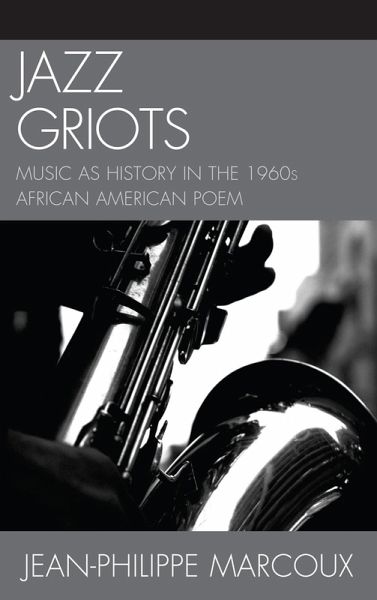
This book studies how four representative African American poets of the 1960s, Langston Hughes, Umbra's David Henderson, and the Black Arts Movement's Sonia Sanchez, and Amiri Baraka engage, in the tradition of griots, in poetic dialogues with aesthetics, music, politics, and Black History. In so doing they narrate, using jazz as meta-language, genealogies, etymologies, cultural legacies, and Black (hi)stories. In intersecting and complementary ways, Hughes, Henderson, Sanchez, and Baraka fashioned their griotism from theorizations of artistry as political engagement, and, in turn, formulated a Black aesthetic based on jazz performativity-on a series of jazz-infused iterations that form a complex pattern of literary, musical, historical, and political moments in constant cross-fertilizing dialogues with one another. This form of poetic call-and-response becomes a definitional literary template for these poets, as it allows both the possibility of intergenerational dialogues between poets and musicians and dialogic potential between song and politics, between Africa and Black America, between vernacular continuums, in their poems.