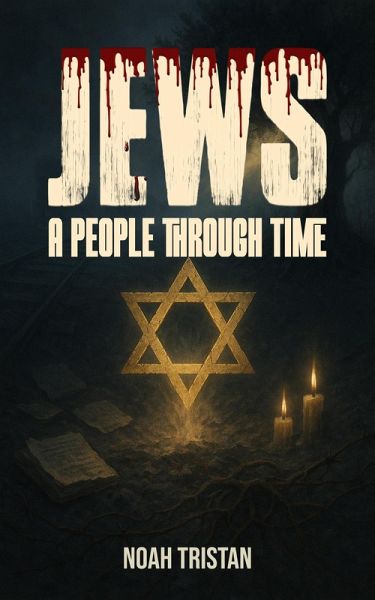
6,99 €
inkl. MwSt.
Sofort per Download lieferbar
0 °P sammeln

Andere Kunden interessierten sich auch für
") Hiroshima (eBook, ePUB)3,99 €
Hiroshima (eBook, ePUB)3,99 €") Four Red Sweaters (eBook, ePUB)13,61 €
Four Red Sweaters (eBook, ePUB)13,61 €") The Dressmakers of Auschwitz (eBook, ePUB)4,39 €
The Dressmakers of Auschwitz (eBook, ePUB)4,39 €") Night of the Assassins (eBook, ePUB)10,99 €
Night of the Assassins (eBook, ePUB)10,99 €") Book and Dagger (eBook, ePUB)14,29 €
Book and Dagger (eBook, ePUB)14,29 €") The Girl Bandits of the Warsaw Ghetto (eBook, ePUB)13,61 €
The Girl Bandits of the Warsaw Ghetto (eBook, ePUB)13,61 €") A Quiet Company of Dangerous Men (eBook, ePUB)10,95 €
A Quiet Company of Dangerous Men (eBook, ePUB)10,95 €





The Jewish people have a history spanning millennia, originating in the ancient Near East and evolving through periods of both prosperity and persecution. Over centuries, Jews migrated across Europe, establishing vibrant communities that contributed to local economies, scholarship, and culture, even while enduring systemic discrimination, restrictions on settlement, and intermittent violence. By the 19th and early 20th centuries, substantial Jewish populations had developed in Eastern Europe, particularly in Belarus, Latvia, Lithuania, and Poland, often forming dense communities in towns and cities known as shtetls. These communities maintained religious, educational, and social traditions, while simultaneously navigating complex relationships with surrounding populations and state authorities.
The onset of the 20th century brought new challenges, as rising nationalism, antisemitism, and political upheaval in the region intensified the marginalisation of Jews. With the outbreak of the Second World War, Nazi Germany implemented a deliberate, systematic plan to annihilate the Jewish people, known as the Holocaust. In the occupied territories of Belarus, Latvia, and Lithuania, Jewish populations suffered immediate and catastrophic losses. Einsatzgruppen, mobile killing units, followed the German armies, carrying out mass executions of men, women, and children. Local collaborators, often motivated by antisemitism, nationalism, or opportunism, assisted in rounding up Jews, administering ghettos, and facilitating the killings.
In Belarus, the majority of the Jewish population perished, with entire communities destroyed through shootings and ghettoisation. Riga and other Latvian cities witnessed pogroms, mass shootings, and the forced relocation of Jews into tightly controlled ghettos. In Lithuania, the genocide was especially rapid and devastating, with more than 95 percent of the Jewish population exterminated, often with active support from local militias. Massacres occurred at sites such as Ponary, Kaunas, and Vilnius, where Jews were shot in pits near their homes, often alongside other targeted groups. While some individuals and families risked their lives to shelter Jews, the sheer scale of violence and collaboration meant that survival was extraordinarily difficult.
By the end of the German occupation, the Jewish communities of Belarus, Latvia, and Lithuania had been almost entirely destroyed, with only small numbers of survivors left in ghettos, forced labour camps, or hiding. The Holocaust in these regions represents one of the earliest and most complete implementations of Hitler's Final Solution, illustrating the lethal combination of Nazi ideology, organised bureaucracy, and local complicity. Post-war memory and historiography have been shaped by efforts to recognise victims, prosecute perpetrators, and understand the complex roles of collaborators and rescuers. Today, the Holocaust stands as a stark testament to the destructive power of hatred, prejudice, and indifference, and a reminder of the enduring importance of preserving historical truth and promoting human rights.
The onset of the 20th century brought new challenges, as rising nationalism, antisemitism, and political upheaval in the region intensified the marginalisation of Jews. With the outbreak of the Second World War, Nazi Germany implemented a deliberate, systematic plan to annihilate the Jewish people, known as the Holocaust. In the occupied territories of Belarus, Latvia, and Lithuania, Jewish populations suffered immediate and catastrophic losses. Einsatzgruppen, mobile killing units, followed the German armies, carrying out mass executions of men, women, and children. Local collaborators, often motivated by antisemitism, nationalism, or opportunism, assisted in rounding up Jews, administering ghettos, and facilitating the killings.
In Belarus, the majority of the Jewish population perished, with entire communities destroyed through shootings and ghettoisation. Riga and other Latvian cities witnessed pogroms, mass shootings, and the forced relocation of Jews into tightly controlled ghettos. In Lithuania, the genocide was especially rapid and devastating, with more than 95 percent of the Jewish population exterminated, often with active support from local militias. Massacres occurred at sites such as Ponary, Kaunas, and Vilnius, where Jews were shot in pits near their homes, often alongside other targeted groups. While some individuals and families risked their lives to shelter Jews, the sheer scale of violence and collaboration meant that survival was extraordinarily difficult.
By the end of the German occupation, the Jewish communities of Belarus, Latvia, and Lithuania had been almost entirely destroyed, with only small numbers of survivors left in ghettos, forced labour camps, or hiding. The Holocaust in these regions represents one of the earliest and most complete implementations of Hitler's Final Solution, illustrating the lethal combination of Nazi ideology, organised bureaucracy, and local complicity. Post-war memory and historiography have been shaped by efforts to recognise victims, prosecute perpetrators, and understand the complex roles of collaborators and rescuers. Today, the Holocaust stands as a stark testament to the destructive power of hatred, prejudice, and indifference, and a reminder of the enduring importance of preserving historical truth and promoting human rights.
Dieser Download kann aus rechtlichen Gründen nur mit Rechnungsadresse in A, B, CY, CZ, D, DK, EW, E, FIN, F, GR, H, IRL, I, LT, L, LR, M, NL, PL, P, R, S, SLO, SK ausgeliefert werden.