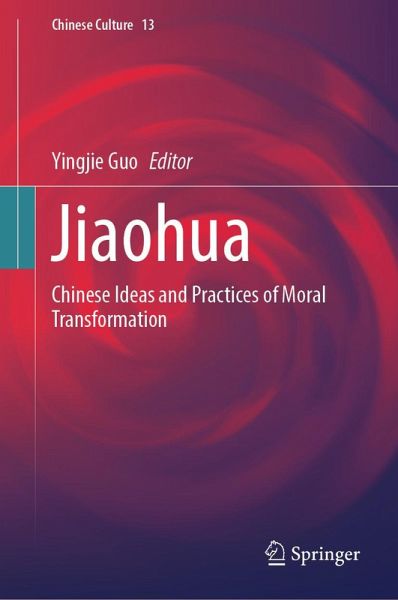
Jiaohua (eBook, PDF)
Chinese Ideas and Practices of Moral Transformation
Redaktion: Guo, Yingjie
104,95 €
104,95 €
inkl. MwSt.
Sofort per Download lieferbar

52 °P sammeln

104,95 €
Als Download kaufen
104,95 €
inkl. MwSt.
Sofort per Download lieferbar
52 °P sammeln
Jetzt verschenken
Alle Infos zum eBook verschenken
104,95 €
inkl. MwSt.
Sofort per Download lieferbar
Alle Infos zum eBook verschenken
52 °P sammeln
Jiaohua (eBook, PDF)
Chinese Ideas and Practices of Moral Transformation
Redaktion: Guo, Yingjie
- Format: PDF
- Merkliste
- Auf die Merkliste
- Bewerten Bewerten
- Teilen
- Produkt teilen
- Produkterinnerung
- Produkterinnerung

Bitte loggen Sie sich zunächst in Ihr Kundenkonto ein oder registrieren Sie sich bei
bücher.de, um das eBook-Abo tolino select nutzen zu können.
Hier können Sie sich einloggen
Sie sind bereits eingeloggt. Klicken Sie auf 2. tolino select Abo, um fortzufahren.

Bitte loggen Sie sich zunächst in Ihr Kundenkonto ein oder registrieren Sie sich bei bücher.de, um das eBook-Abo tolino select nutzen zu können.
Chapters "Jiaohua through Humanistic Buddhism: Integrating Transcendence with Worldly Matters" and "Jiaohua through Humanistic Buddhism: Integrating Transcendence with Worldly Matters" are available open access under a Creative Commons Attribution 4.0 International License via link.springer.com.
- Geräte: PC
- ohne Kopierschutz
- eBook Hilfe
- Größe: 3.35MB
Andere Kunden interessierten sich auch für
Ye LangInsights into Chinese Culture (eBook, PDF)128,95 €
S. TrevaskesThe Death Penalty in Contemporary China (eBook, PDF)72,95 €
Regenerating Cultural Religious Heritage (eBook, PDF)72,95 €
Transcultural Diplomacy and International Law in Heritage Conservation (eBook, PDF)104,95 €
Siobhan LyonsDeath and the Machine (eBook, PDF)44,95 €
Helena MachadoEthical Assemblages of Artificial Intelligence (eBook, PDF)32,95 €
Thomas CroftsSexting and Young People (eBook, PDF)40,95 €-
-
-
Chapters "Jiaohua through Humanistic Buddhism: Integrating Transcendence with Worldly Matters" and "Jiaohua through Humanistic Buddhism: Integrating Transcendence with Worldly Matters" are available open access under a Creative Commons Attribution 4.0 International License via link.springer.com.
Dieser Download kann aus rechtlichen Gründen nur mit Rechnungsadresse in A, B, BG, CY, CZ, D, DK, EW, E, FIN, F, GR, HR, H, IRL, I, LT, L, LR, M, NL, PL, P, R, S, SLO, SK ausgeliefert werden.
Produktdetails
- Produktdetails
- Verlag: Springer Nature Singapore
- Seitenzahl: 213
- Erscheinungstermin: 4. Februar 2025
- Englisch
- ISBN-13: 9789819794874
- Artikelnr.: 73267555
- Verlag: Springer Nature Singapore
- Seitenzahl: 213
- Erscheinungstermin: 4. Februar 2025
- Englisch
- ISBN-13: 9789819794874
- Artikelnr.: 73267555
- Herstellerkennzeichnung Die Herstellerinformationen sind derzeit nicht verfügbar.
Yingjie Guo is Professor in Chinese Studies. He received his B.A. and M.A. from Shanghai International Studies University, China, and Ph.D. from the University of Tasmania, Australia. His research focuses on China's cultural nationalism and Chinese cultural identities and the discourse of class in post-Mao China. He is Author of Cultural Nationalism in Contemporary China: Searching for National identity under Reform and Co-Author of Nationalism, National Identity and Democratization in China. His recent publications include Unequal China: Political Economy and Culture Politics, Handbook of Class and Stratification in the People's Republic of China, and Local Elites in Post-Mao China.
Chapter 1. Reconstructing Confucianism as an Edification (Jiaohua)
Tradition: A New Trend in China's Contemporary Confucian Revival.- Chapter
2. The Scripture on Great Peace: A Daoist Approach to the People's
Edification.- Chapter 3. Buddhist Jiaohua: Edification and the Practice of
Buddhist Storytelling.- Chapter 4. Jiaohua through Humanistic
Buddhism: From Master Taixu to Master Xingyun.- Chapter 5. Moral
Cultivation in the Chinese Legal System: Contradiction or Complementary
Relationship?.- Chapter 6. Jiaohua in Ming Collections of Gong'an Short
Stories: Law, Punishment, and Popular Conceptions of Justice.- Chapter 7.
Theatre as a Conveyor of the Way: Moral Education and Transformation
through Mulianxi in Premodern China.- Chapter 8. Tool of Domination or Road
to Subjectification: Rethinking Jiaohua in a Modern and Contemporary
Confucian Context.- Chapter 9. Confucianism, Legalism and Jiaohua:
Competing Traditions in Chinese Higher Education.- Chapter 10. Two Visions,
Two Talks: Jiaohua in Mao's Yan'an Talks and Xi's Beijing Talks.- Chapter
11. Jiaohua: Shaping People's Mind through Education in the Xi Jinping Era.
Tradition: A New Trend in China's Contemporary Confucian Revival.- Chapter
2. The Scripture on Great Peace: A Daoist Approach to the People's
Edification.- Chapter 3. Buddhist Jiaohua: Edification and the Practice of
Buddhist Storytelling.- Chapter 4. Jiaohua through Humanistic
Buddhism: From Master Taixu to Master Xingyun.- Chapter 5. Moral
Cultivation in the Chinese Legal System: Contradiction or Complementary
Relationship?.- Chapter 6. Jiaohua in Ming Collections of Gong'an Short
Stories: Law, Punishment, and Popular Conceptions of Justice.- Chapter 7.
Theatre as a Conveyor of the Way: Moral Education and Transformation
through Mulianxi in Premodern China.- Chapter 8. Tool of Domination or Road
to Subjectification: Rethinking Jiaohua in a Modern and Contemporary
Confucian Context.- Chapter 9. Confucianism, Legalism and Jiaohua:
Competing Traditions in Chinese Higher Education.- Chapter 10. Two Visions,
Two Talks: Jiaohua in Mao's Yan'an Talks and Xi's Beijing Talks.- Chapter
11. Jiaohua: Shaping People's Mind through Education in the Xi Jinping Era.
Chapter 1. Reconstructing Confucianism as an Edification (Jiaohua)
Tradition: A New Trend in China's Contemporary Confucian Revival.- Chapter
2. The Scripture on Great Peace: A Daoist Approach to the People's
Edification.- Chapter 3. Buddhist Jiaohua: Edification and the Practice of
Buddhist Storytelling.- Chapter 4. Jiaohua through Humanistic
Buddhism: From Master Taixu to Master Xingyun.- Chapter 5. Moral
Cultivation in the Chinese Legal System: Contradiction or Complementary
Relationship?.- Chapter 6. Jiaohua in Ming Collections of Gong'an Short
Stories: Law, Punishment, and Popular Conceptions of Justice.- Chapter 7.
Theatre as a Conveyor of the Way: Moral Education and Transformation
through Mulianxi in Premodern China.- Chapter 8. Tool of Domination or Road
to Subjectification: Rethinking Jiaohua in a Modern and Contemporary
Confucian Context.- Chapter 9. Confucianism, Legalism and Jiaohua:
Competing Traditions in Chinese Higher Education.- Chapter 10. Two Visions,
Two Talks: Jiaohua in Mao's Yan'an Talks and Xi's Beijing Talks.- Chapter
11. Jiaohua: Shaping People's Mind through Education in the Xi Jinping Era.
Tradition: A New Trend in China's Contemporary Confucian Revival.- Chapter
2. The Scripture on Great Peace: A Daoist Approach to the People's
Edification.- Chapter 3. Buddhist Jiaohua: Edification and the Practice of
Buddhist Storytelling.- Chapter 4. Jiaohua through Humanistic
Buddhism: From Master Taixu to Master Xingyun.- Chapter 5. Moral
Cultivation in the Chinese Legal System: Contradiction or Complementary
Relationship?.- Chapter 6. Jiaohua in Ming Collections of Gong'an Short
Stories: Law, Punishment, and Popular Conceptions of Justice.- Chapter 7.
Theatre as a Conveyor of the Way: Moral Education and Transformation
through Mulianxi in Premodern China.- Chapter 8. Tool of Domination or Road
to Subjectification: Rethinking Jiaohua in a Modern and Contemporary
Confucian Context.- Chapter 9. Confucianism, Legalism and Jiaohua:
Competing Traditions in Chinese Higher Education.- Chapter 10. Two Visions,
Two Talks: Jiaohua in Mao's Yan'an Talks and Xi's Beijing Talks.- Chapter
11. Jiaohua: Shaping People's Mind through Education in the Xi Jinping Era.