72,95 €
72,95 €
inkl. MwSt.
Sofort per Download lieferbar

36 °P sammeln
72,95 €
Als Download kaufen
72,95 €
inkl. MwSt.
Sofort per Download lieferbar
36 °P sammeln
Jetzt verschenken
Alle Infos zum eBook verschenken
72,95 €
inkl. MwSt.
Sofort per Download lieferbar
Alle Infos zum eBook verschenken
36 °P sammeln

Andere Kunden interessierten sich auch für
") Autós (eBook, ePUB)86,95 €
Autós (eBook, ePUB)86,95 €") Social Institutions and the Politics of Recognition (eBook, ePUB)29,95 €
Social Institutions and the Politics of Recognition (eBook, ePUB)29,95 €") Political Corruption and Democratic Governance (eBook, ePUB)27,95 €
Political Corruption and Democratic Governance (eBook, ePUB)27,95 €") Political Theory on Death and Dying (eBook, ePUB)41,95 €
Political Theory on Death and Dying (eBook, ePUB)41,95 €") Crude Oil, Crude Money (eBook, ePUB)24,95 €
Crude Oil, Crude Money (eBook, ePUB)24,95 €") The Patenting of Life, Limiting Liberty, and the Corporate Pursuit of Seeds (eBook, ePUB)36,95 €
The Patenting of Life, Limiting Liberty, and the Corporate Pursuit of Seeds (eBook, ePUB)36,95 €") Pursuing the Honorable (eBook, ePUB)68,95 €
Pursuing the Honorable (eBook, ePUB)68,95 €







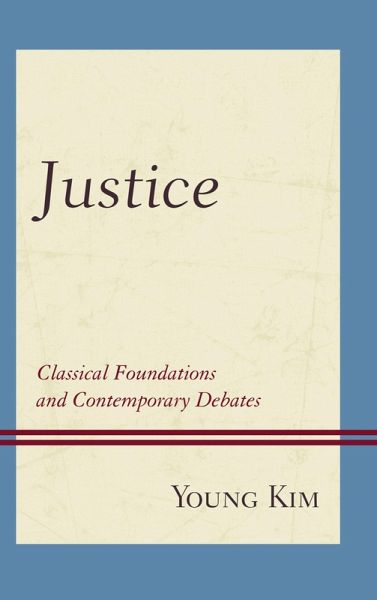
The moral inquiry into the nature of justice is often marginalized, as contemporary discussions focus primarily on political considerations. Yet, the need to examine the moral framework of justice is fundamental. What is the point of justice, after all, if not to establish a moral framework for political interactions? The question resonates especially when recognizing that no monocultures exist over time and space. In examining Plato's thoughts on individual and social morality (dikaiosune) and Aristotle's focus on individual virtue (arête) and the pursuit of well-being (eudaimonia), the author proffers foundational resources for today's discussions of justice. Moreover, he brings this nexus of thought into conversation with theories that have emerged over the centuries, such as Kant's concept of due concern and respect, individual rights and responsibilities as in Hobbes, Locke and J.S. Mill. Thus, he engages contemporary disputes of justice including distributive vs. relational schemes, choice vs. chance considerations, group rights theories, value pluralism, the right vs. the good, as well as international and future justice. His inquiry concludes with the provision of a deontological framework set against a liberal political context, justice as right actions, for further examination of questions of justice.