2,99 €
2,99 €
inkl. MwSt.
Sofort per Download lieferbar

0 °P sammeln
2,99 €
Als Download kaufen
2,99 €
inkl. MwSt.
Sofort per Download lieferbar
0 °P sammeln
Jetzt verschenken
Alle Infos zum eBook verschenken
2,99 €
inkl. MwSt.
Sofort per Download lieferbar
Alle Infos zum eBook verschenken
0 °P sammeln

Andere Kunden interessierten sich auch für
") Rheumatoid Arthritis, A Simple Guide To The Condition, Diagnosis, Treatment And Related Conditions (eBook, ePUB)2,99 €
Rheumatoid Arthritis, A Simple Guide To The Condition, Diagnosis, Treatment And Related Conditions (eBook, ePUB)2,99 €, A Simple Guide To The Condition, Diagnosis, Treatment And Related Conditions (eBook, ePUB)") Lymphedema (Lymph Obstruction), A Simple Guide To The Condition, Diagnosis, Treatment And Related Conditions (eBook, ePUB)2,99 €
Lymphedema (Lymph Obstruction), A Simple Guide To The Condition, Diagnosis, Treatment And Related Conditions (eBook, ePUB)2,99 €") Goodpasture Syndrome, A Simple Guide To The Condition, Diagnosis, Treatment And Related Conditions (eBook, ePUB)2,99 €
Goodpasture Syndrome, A Simple Guide To The Condition, Diagnosis, Treatment And Related Conditions (eBook, ePUB)2,99 €") Idiopathic Thrombocytopenic Purpura, A Simple Guide to The Condition, Treatment And Related Conditions (eBook, ePUB)2,99 €
Idiopathic Thrombocytopenic Purpura, A Simple Guide to The Condition, Treatment And Related Conditions (eBook, ePUB)2,99 € A Simple Guide To The Condition, Diagnosis, Treatment And Related Conditions (eBook, ePUB)") Ganglion, (Gideon disease) A Simple Guide To The Condition, Diagnosis, Treatment And Related Conditions (eBook, ePUB)2,99 €
Ganglion, (Gideon disease) A Simple Guide To The Condition, Diagnosis, Treatment And Related Conditions (eBook, ePUB)2,99 €") Posterior Tibial Tendon Dysfunction, A Simple Guide To The Condition, Diagnosis, Treatment And Related Conditions (eBook, ePUB)2,99 €
Posterior Tibial Tendon Dysfunction, A Simple Guide To The Condition, Diagnosis, Treatment And Related Conditions (eBook, ePUB)2,99 € A Simple Guide To The Condition, Diagnosis, Treatment And Related Conditions (eBook, ePUB)") Baker's Cyst, (Popliteal Cyst) A Simple Guide To The Condition, Diagnosis, Treatment And Related Conditions (eBook, ePUB)2,99 €
Baker's Cyst, (Popliteal Cyst) A Simple Guide To The Condition, Diagnosis, Treatment And Related Conditions (eBook, ePUB)2,99 €







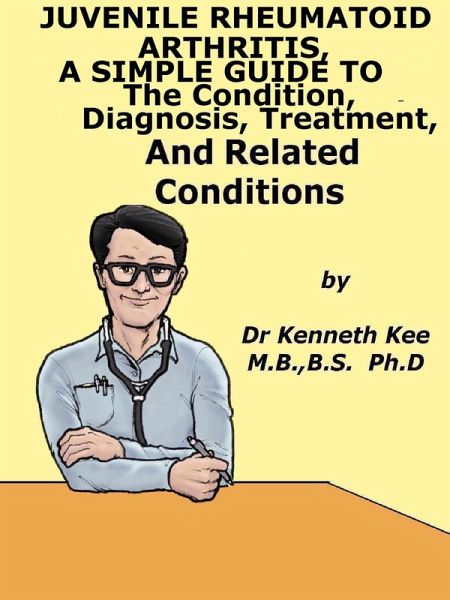
Juvenile rheumatoid arthritis (JRA) is a medical group of related diseases which occur in children before the age of 16 years.
It is a chronic disorder which results in joint pain and swelling.
The cause is believed to be the result of an autoimmune illness.
This suggests that the body cells attacks and destroys healthy joint tissue by mistake.
JRA most often occurs before age 16.
Symptoms may begin as early as 6 months old.
There are three main types of JRA:
1. Pauciarticular JRA affects four or fewer joints, most often the knees, or wrists.
It also involves the eyes.
It is the most frequent type of JRA.
2. Polyarticular JRA affects many joints.
This type of JRA may become rheumatoid arthritis.
It may affect five or more large and small joints of the legs and arms, as well as the jaw and neck.
3. Systemic (bodywide) JRA affects the joint pain or swelling, rash, and fevers.
It is the least frequent form.
Symptoms of JRA are:
1. Swollen, red, or warm joint
2. Limping or difficulty using a limb
Diagnosis is confirmed with:
1. Erythrocyte sedimentation rate (ESR) raised
2. ANA and RA factor positive
3. Full blood count (FBC)
4. HLA antigens for HLA B27 present
Aspiration of Joint Fluid may help in the diagnosis and treatment.
The treatment of JRA is by:
Non-steroidal anti-inflammatory drugs (NSAIDs) such as ibuprofen or naproxen are sufficient to reduce symptoms
Corticosteroids may be given for more severe joint inflammation
New disease-modifying antirheumatic drugs (DMARDs) are used such as methotrexate
Biologic drugs, such as such as infliximab, etanercept are even more helpful
Children with JRA need to stay active.
There is no cure for juvenile rheumatoid arthritis.
Table of Content
Introduction
Chapter 1 Juvenile Rheumatoid Arthritis
Chapter 2 Causes
Chapter 3 Symptoms
Chapter 4 Diagnosis
Chapter 5 Treatment
Chapter 6 Prognosis
Chapter 7 Rheumatoid Arthritis
Chapter 8 Reiter Syndrome
Epilogue
It is a chronic disorder which results in joint pain and swelling.
The cause is believed to be the result of an autoimmune illness.
This suggests that the body cells attacks and destroys healthy joint tissue by mistake.
JRA most often occurs before age 16.
Symptoms may begin as early as 6 months old.
There are three main types of JRA:
1. Pauciarticular JRA affects four or fewer joints, most often the knees, or wrists.
It also involves the eyes.
It is the most frequent type of JRA.
2. Polyarticular JRA affects many joints.
This type of JRA may become rheumatoid arthritis.
It may affect five or more large and small joints of the legs and arms, as well as the jaw and neck.
3. Systemic (bodywide) JRA affects the joint pain or swelling, rash, and fevers.
It is the least frequent form.
Symptoms of JRA are:
1. Swollen, red, or warm joint
2. Limping or difficulty using a limb
Diagnosis is confirmed with:
1. Erythrocyte sedimentation rate (ESR) raised
2. ANA and RA factor positive
3. Full blood count (FBC)
4. HLA antigens for HLA B27 present
Aspiration of Joint Fluid may help in the diagnosis and treatment.
The treatment of JRA is by:
Non-steroidal anti-inflammatory drugs (NSAIDs) such as ibuprofen or naproxen are sufficient to reduce symptoms
Corticosteroids may be given for more severe joint inflammation
New disease-modifying antirheumatic drugs (DMARDs) are used such as methotrexate
Biologic drugs, such as such as infliximab, etanercept are even more helpful
Children with JRA need to stay active.
There is no cure for juvenile rheumatoid arthritis.
Table of Content
Introduction
Chapter 1 Juvenile Rheumatoid Arthritis
Chapter 2 Causes
Chapter 3 Symptoms
Chapter 4 Diagnosis
Chapter 5 Treatment
Chapter 6 Prognosis
Chapter 7 Rheumatoid Arthritis
Chapter 8 Reiter Syndrome
Epilogue
Dieser Download kann aus rechtlichen Gründen nur mit Rechnungsadresse in A, B, CY, CZ, D, DK, EW, E, FIN, F, GR, H, IRL, I, LT, L, LR, M, NL, PL, P, R, S, SLO, SK ausgeliefert werden.