8,99 €
inkl. MwSt.
Sofort per Download lieferbar
0 °P sammeln

Andere Kunden interessierten sich auch für
") A Child for the Reich (eBook, ePUB)6,29 €
A Child for the Reich (eBook, ePUB)6,29 €") The Banned Books of Berlin (eBook, ePUB)9,78 €
The Banned Books of Berlin (eBook, ePUB)9,78 €") The Secret Pianist (eBook, ePUB)4,34 €
The Secret Pianist (eBook, ePUB)4,34 €") A Call to Service (eBook, ePUB)5,99 €
A Call to Service (eBook, ePUB)5,99 €") Under Occupation (eBook, ePUB)5,49 €
Under Occupation (eBook, ePUB)5,49 €") The Girl from the Channel Islands (eBook, ePUB)6,14 €
The Girl from the Channel Islands (eBook, ePUB)6,14 €") Pernkopf's Atlas (eBook, ePUB)2,13 €
Pernkopf's Atlas (eBook, ePUB)2,13 €





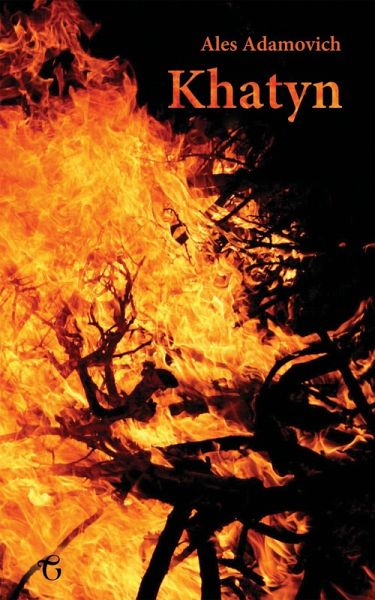
Based on previously sealed war archives and rare witness records of the survivors, Khatyn is a heart wrenching story of the people who fought for their lives under the Nazi occupation during World War II. Through the prism of the retrospect perception as narrated by the novel's main character Flyora - a boy who matures during the war - author Ales Adamovich beholds genocide and horrific crimes against humanity. The former teen partisan goes back in time and remembers atrocities of 1943. The novel's pages become the stage where perished people come to life for one last time, get to say their last word, all at the backdrop of blood chilling cries of women and children being burned alive by a Nazi death squad that, accompanied by the Vlasov's unit, surges a Belarusian village.
The first edition of Khatyn was censored and the reader outside USSR never saw the original. Forty years later Glagoslav releases the unaltered version of the novel as was the author's intent. This year Glagoslav Publications will bring more titles of Belarusian literature in English translations to the attention of wide international audience.
Today the book is part of Belarusian cultural heritage and its actuality is even more so apparent - having marked the zones of fire on the world map, the on-going blood baths have scarred the surface of our planet, begging mankind to "never again''.
Khatyn became the leading story in the screenplay of the WWII movie Come and See which was co-written by Ales Adamovich.
The first edition of Khatyn was censored and the reader outside USSR never saw the original. Forty years later Glagoslav releases the unaltered version of the novel as was the author's intent. This year Glagoslav Publications will bring more titles of Belarusian literature in English translations to the attention of wide international audience.
Today the book is part of Belarusian cultural heritage and its actuality is even more so apparent - having marked the zones of fire on the world map, the on-going blood baths have scarred the surface of our planet, begging mankind to "never again''.
Khatyn became the leading story in the screenplay of the WWII movie Come and See which was co-written by Ales Adamovich.
Dieser Download kann aus rechtlichen Gründen nur mit Rechnungsadresse in A, B, BG, CY, CZ, D, DK, EW, E, FIN, F, GR, H, IRL, I, LT, L, LR, M, NL, PL, P, R, S, SLO, SK ausgeliefert werden.