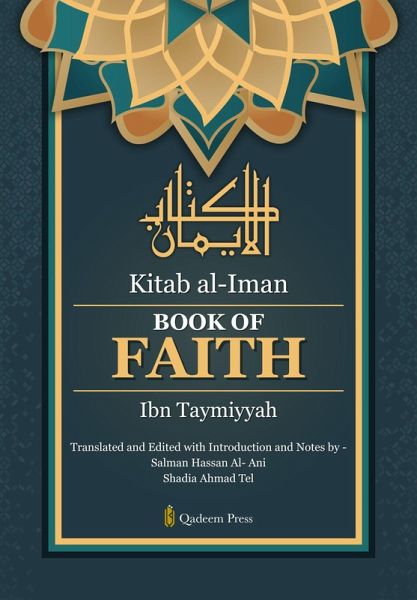
7,99 €
7,99 €
inkl. MwSt.
Sofort per Download lieferbar

4 °P sammeln
7,99 €
Als Download kaufen
7,99 €
inkl. MwSt.
Sofort per Download lieferbar
4 °P sammeln
Jetzt verschenken
Alle Infos zum eBook verschenken
7,99 €
inkl. MwSt.
Sofort per Download lieferbar
Alle Infos zum eBook verschenken
4 °P sammeln

Andere Kunden interessierten sich auch für
") Saviours of Islamic Spirit - Vol. 2 (eBook, ePUB)5,99 €
Saviours of Islamic Spirit - Vol. 2 (eBook, ePUB)5,99 €![Kitab Al-Siyar Al-Saghir [The Shorter Book on Muslim International Law] (eBook, ePUB)]( "Kitab Al-Siyar Al-Saghir [The Shorter Book on Muslim International Law] (eBook, ePUB)") Kitab Al-Siyar Al-Saghir [The Shorter Book on Muslim International Law] (eBook, ePUB)6,99 €
Kitab Al-Siyar Al-Saghir [The Shorter Book on Muslim International Law] (eBook, ePUB)6,99 €") Arguments for God's Existence in Classical Islamic Thought (eBook, ePUB)87,95 €
Arguments for God's Existence in Classical Islamic Thought (eBook, ePUB)87,95 €") Islamische Theologie im 14. Jahrhundert (eBook, ePUB)129,95 €
Islamische Theologie im 14. Jahrhundert (eBook, ePUB)129,95 € (eBook, ePUB)") Große Frauen im Islam (El Iman Edition, #1) (eBook, ePUB)7,99 €
Große Frauen im Islam (El Iman Edition, #1) (eBook, ePUB)7,99 €") Human Rights in Islamic Societies (eBook, ePUB)38,95 €
Human Rights in Islamic Societies (eBook, ePUB)38,95 €") Revelation and Reason in Islam (eBook, ePUB)32,95 €
Revelation and Reason in Islam (eBook, ePUB)32,95 €
![Kitab Al-Siyar Al-Saghir [The Shorter Book on Muslim International Law] (eBook, ePUB)](https://bilder.buecher.de/produkte/75/75987/75987852m.jpg "Kitab Al-Siyar Al-Saghir [The Shorter Book on Muslim International Law] (eBook, ePUB)")

COURSE APPLICATIONS
Kitab al-Iman is a high-value primary source for courses across Religious Studies, Islamic Studies, Philosophy, History, and Comparative Religion. Its blend of doctrinal clarity, engagement with rival schools, and textual rigor makes it especially suitable for upper-level undergraduate and graduate seminars.
Recommended Courses:
• Islamic Theology and Creed (advanced undergraduate / graduate) • Medieval Islamic Intellectual History (graduate) • Islamic Philosophy and Thought (upper-level undergraduate / graduate) • Sectarian Movements in Islam (advanced undergraduate / graduate) • Comparative Theology (upper-level undergraduate / graduate) • Classical Islamic Texts in Translation (graduate) • History of Islamic Legal Thought (graduate) • Religion and Society in Medieval Islam (upper-level undergraduate)
Pedagogical Approach:
The text works best when paired with secondary scholarship on medieval Islamic theology, Ibn Taymiyyah's biography, and the history of Islamic sects. Students should ideally possess basic familiarity with Islamic history, Qur'anic structure, and Hadith literature.
In advanced courses, instructors may assign the entire work across several weeks, organizing class sessions around thematic clusters (e.g., Faith and Works, Sectarian Debates, Language and Theology). In survey courses, selected chapters can illustrate Ibn Taymiyyah's method and highlight key controversies.
Learning Objectives:
Students engaging with Kitab al-Iman will:
Discussion Questions (selected):
Foundational Concepts:
Methodological Analysis: 4. How does Ibn Taymiyyah approach Qur'an and Hadith as sources of knowledge? What interpretive principles does he apply? 5. Compare his method with that of the Ashʿarites or another school he critiques. Where do their methodological assumptions diverge? 6. How does he use linguistic analysis of Arabic terms (Iman, Islam, kufr, nifaq) to construct theological arguments?
Theological Debates: 7. How does Ibn Taymiyyah present and refute Murji'ite positions on faith? Are his refutations persuasive? 8. What is at stake in the debate over whether faith increases and decreases? How do different positions affect views of salvation and sin? 9. How does he address the status of Muslims who commit major sins, and in what sense is his view a middle path?
Comparative Perspectives and Contemporary Relevance can follow as in the provided list (questions 1017).
Assignment Suggestions (selected):
Short (35 pages): • Comparative Analysis of Ibn Taymiyyah's definition of faith with another school. • Methodological Examination of his interpretive strategy in one chapter.
Medium (812 pages): • Theological Controversy Research Paper on a single debate (e.g., faith and works). • Sectarian Identity and Theology in medieval Islam.
Major (1525 pages): • Ibn Taymiyyah's Influence on Modern Movements (including Salafism). • Comprehensive Theological Analysis of his doctrine of faith.
Creative / Applied and Graduate-level assignments can follow the structure already laid out (debate simulations, annotated translation projects, historiographical essays, etc.).
Kitab al-Iman is a high-value primary source for courses across Religious Studies, Islamic Studies, Philosophy, History, and Comparative Religion. Its blend of doctrinal clarity, engagement with rival schools, and textual rigor makes it especially suitable for upper-level undergraduate and graduate seminars.
Recommended Courses:
• Islamic Theology and Creed (advanced undergraduate / graduate) • Medieval Islamic Intellectual History (graduate) • Islamic Philosophy and Thought (upper-level undergraduate / graduate) • Sectarian Movements in Islam (advanced undergraduate / graduate) • Comparative Theology (upper-level undergraduate / graduate) • Classical Islamic Texts in Translation (graduate) • History of Islamic Legal Thought (graduate) • Religion and Society in Medieval Islam (upper-level undergraduate)
Pedagogical Approach:
The text works best when paired with secondary scholarship on medieval Islamic theology, Ibn Taymiyyah's biography, and the history of Islamic sects. Students should ideally possess basic familiarity with Islamic history, Qur'anic structure, and Hadith literature.
In advanced courses, instructors may assign the entire work across several weeks, organizing class sessions around thematic clusters (e.g., Faith and Works, Sectarian Debates, Language and Theology). In survey courses, selected chapters can illustrate Ibn Taymiyyah's method and highlight key controversies.
Learning Objectives:
Students engaging with Kitab al-Iman will:
- Analyze the theological concept of Iman (faith) in the Islamic tradition.
- Compare competing theological positions on faith (Murji'ite, Kharijite, Ashʿarite, Hanbali).
- Evaluate Ibn Taymiyyah's exegetical and methodological approach to Qur'an and Hadith.
- Examine the relationship between theology, law, and communal identity in Islam.
- Assess how interpretation of scripture shapes doctrinal boundaries.
- Situate Ibn Taymiyyah within the political and intellectual context of 13th14th-century Islam.
- Trace his intellectual influence on later scholars and modern movements.
- Develop skills in close reading and analysis of primary religious texts.
Discussion Questions (selected):
Foundational Concepts:
- How does Ibn Taymiyyah distinguish between Iman, Islam, and I?san, and why is this distinction crucial for his theology?
- What arguments does he use to show that faith includes actions? How does he respond to those who restrict faith to internal belief?
- In what ways does the Hadith of Gabriel structure his entire framework for understanding religion?
Methodological Analysis: 4. How does Ibn Taymiyyah approach Qur'an and Hadith as sources of knowledge? What interpretive principles does he apply? 5. Compare his method with that of the Ashʿarites or another school he critiques. Where do their methodological assumptions diverge? 6. How does he use linguistic analysis of Arabic terms (Iman, Islam, kufr, nifaq) to construct theological arguments?
Theological Debates: 7. How does Ibn Taymiyyah present and refute Murji'ite positions on faith? Are his refutations persuasive? 8. What is at stake in the debate over whether faith increases and decreases? How do different positions affect views of salvation and sin? 9. How does he address the status of Muslims who commit major sins, and in what sense is his view a middle path?
Comparative Perspectives and Contemporary Relevance can follow as in the provided list (questions 1017).
Assignment Suggestions (selected):
Short (35 pages): • Comparative Analysis of Ibn Taymiyyah's definition of faith with another school. • Methodological Examination of his interpretive strategy in one chapter.
Medium (812 pages): • Theological Controversy Research Paper on a single debate (e.g., faith and works). • Sectarian Identity and Theology in medieval Islam.
Major (1525 pages): • Ibn Taymiyyah's Influence on Modern Movements (including Salafism). • Comprehensive Theological Analysis of his doctrine of faith.
Creative / Applied and Graduate-level assignments can follow the structure already laid out (debate simulations, annotated translation projects, historiographical essays, etc.).
Dieser Download kann aus rechtlichen Gründen nur mit Rechnungsadresse in A, D ausgeliefert werden.