Sie sind bereits eingeloggt. Klicken Sie auf 2. tolino select Abo, um fortzufahren.
Bitte loggen Sie sich zunächst in Ihr Kundenkonto ein oder registrieren Sie sich bei bücher.de, um das eBook-Abo tolino select nutzen zu können.
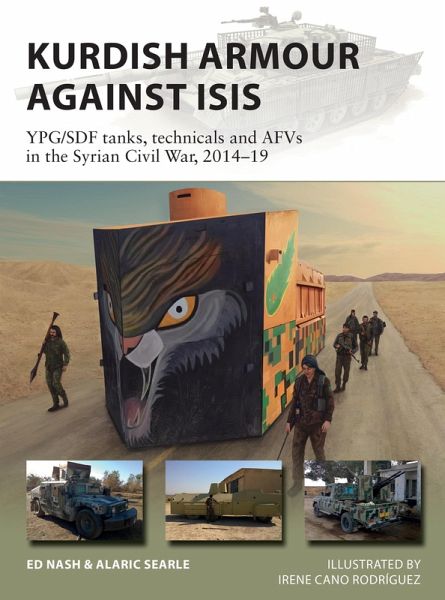
One of the most remarkable mechanized campaigns of recent years pitted the brutal and heavily armed jihadis of Islamic State against an improvised force belonging to the Kurdish YPG (later the SDF). While some Kurdish vehicles were originally from Syrian Army stocks or captured from ISIS, many others were extraordinary homemade AFVs based on truck or digger mechanicals, or duskas , the Kurds' version of the technical. Before US air power was sent to Syria, these were the Kurds' most powerful and mobile weapons. Co-written by a British volunteer who fought with the Kurds and an…mehr
One of the most remarkable mechanized campaigns of recent years pitted the brutal and heavily armed jihadis of Islamic State against an improvised force belonging to the Kurdish YPG (later the SDF).
While some Kurdish vehicles were originally from Syrian Army stocks or captured from ISIS, many others were extraordinary homemade AFVs based on truck or digger mechanicals, or duskas, the Kurds' version of the technical. Before US air power was sent to Syria, these were the Kurds' most powerful and mobile weapons.
Co-written by a British volunteer who fought with the Kurds and an academic expert on armoured warfare, this study explains how the Kurds built and used their AFVs in the war against 'Daesh', and identifies as far as possible which vehicles took part in major battles, such as Kobane, Manbij and Raqqa. With detailed new artwork depicting the Kurds' range of armour and many previously unpublished photos, this is an original and fascinating look at modern improvised mechanized warfare.
Die Herstellerinformationen sind derzeit nicht verfügbar.
Autorenporträt
Ed Nash fought for the YPG in 2015/16, participating in a number of offensives against the so-called Islamic State. He has recounted his experiences in a memoir entitled Desert Sniper (Little, Brown, 2018). He holds a degree in History; and, he has published a number of articles on counter-insurgency, weapons technology and military affairs.
Alaric Searle is Professor of History at University of Potsdam, Germany, and Academic Director, Head of Research and Deputy Commander at the Bundeswehr Centre for Military History and Social Sciences, Potsdam, Germany.
Irene Cano Rodríguez (known as Araire) is a freelance artist working and living in Spain. Since 2014, she has worked as a specialized historical illustrator, recreating historical scenes for museums, studios, editorials and magazines.
Inhaltsangabe
INTRODUCTION THE ROLE OF ARMOURED FORCES IN SYRIA ARMED GROUPS IN THE SYRIAN CIVIL WAR The YPG/YPJ The Islamic State in Iraq and Syria The Syrian Democratic Forces IMPROVISED ARMOURED FIGHTING VEHICLES Improvised tanks Improvised armoured cars Improvised armoured support vehicles Improvised armoured personnel carriers AFV SOURCES: SYRIAN ARMY, ISIS AND COALITION SUPPLIED Soviet armour BRDM-2 scout vehicles Armoured personnel carriers M1117 armoured security vehicle The US Army Humvee Other US-supplied wheeled vehicles 'TECHNICALS' 12.7mm heavy machine guns 14.5mm KPV 23mm cannon 57mm recoilless rifles and multiple rocket launchers UNIT STRUCTURE AND TACTICS THE YPG/SDF WAR AGAINST ISIS Initial ISIS attacks (2013-14) The battle of Kobanê (15 September 2014-26 January 2015) The al-Hasakah offensives (21 February-17 March 2015 and 6 May-31 May 2015) The Tell Abyad offensive (31 May-10 July 2015) The battle of Sarrin (18 June-27 July 2015) The battle of al-Hasakah (23 June-1 August 2015) The al-Hawl offensive (31 October-30 November 2015) Tishrin Dam (23-30 December 2015) The al-Shaddadi offensive (16-24 February 2016) The Manbij offensive (31 May-21 August 2016) The Raqqa campaign (6 November 2016-20 October 2017) Setbacks and victory over ISIS (2017-19) CONCLUSION BIBLIOGRAPHY INDEX
INTRODUCTION THE ROLE OF ARMOURED FORCES IN SYRIA ARMED GROUPS IN THE SYRIAN CIVIL WAR The YPG/YPJ The Islamic State in Iraq and Syria The Syrian Democratic Forces IMPROVISED ARMOURED FIGHTING VEHICLES Improvised tanks Improvised armoured cars Improvised armoured support vehicles Improvised armoured personnel carriers AFV SOURCES: SYRIAN ARMY, ISIS AND COALITION SUPPLIED Soviet armour BRDM-2 scout vehicles Armoured personnel carriers M1117 armoured security vehicle The US Army Humvee Other US-supplied wheeled vehicles 'TECHNICALS' 12.7mm heavy machine guns 14.5mm KPV 23mm cannon 57mm recoilless rifles and multiple rocket launchers UNIT STRUCTURE AND TACTICS THE YPG/SDF WAR AGAINST ISIS Initial ISIS attacks (2013-14) The battle of Kobanê (15 September 2014-26 January 2015) The al-Hasakah offensives (21 February-17 March 2015 and 6 May-31 May 2015) The Tell Abyad offensive (31 May-10 July 2015) The battle of Sarrin (18 June-27 July 2015) The battle of al-Hasakah (23 June-1 August 2015) The al-Hawl offensive (31 October-30 November 2015) Tishrin Dam (23-30 December 2015) The al-Shaddadi offensive (16-24 February 2016) The Manbij offensive (31 May-21 August 2016) The Raqqa campaign (6 November 2016-20 October 2017) Setbacks and victory over ISIS (2017-19) CONCLUSION BIBLIOGRAPHY INDEX
Es gelten unsere Allgemeinen Geschäftsbedingungen: www.buecher.de/agb
Impressum
www.buecher.de ist ein Internetauftritt der buecher.de internetstores GmbH
Geschäftsführung: Monica Sawhney | Roland Kölbl | Günter Hilger
Sitz der Gesellschaft: Batheyer Straße 115 - 117, 58099 Hagen
Postanschrift: Bürgermeister-Wegele-Str. 12, 86167 Augsburg
Amtsgericht Hagen HRB 13257
Steuernummer: 321/5800/1497
USt-IdNr: DE450055826