26,95 €
26,95 €
inkl. MwSt.
Sofort per Download lieferbar

13 °P sammeln
26,95 €
Als Download kaufen
26,95 €
inkl. MwSt.
Sofort per Download lieferbar
13 °P sammeln
Jetzt verschenken
Alle Infos zum eBook verschenken
26,95 €
inkl. MwSt.
Sofort per Download lieferbar
Alle Infos zum eBook verschenken
13 °P sammeln

Andere Kunden interessierten sich auch für
") Kurdish Identity, Islamism, and Ottomanism (eBook, ePUB)26,95 €
Kurdish Identity, Islamism, and Ottomanism (eBook, ePUB)26,95 €") Arab Worlds Beyond the Middle East and North Africa (eBook, PDF)25,95 €
Arab Worlds Beyond the Middle East and North Africa (eBook, PDF)25,95 €") Revolutionary Egypt in the Eyes of the Muslim Brotherhood (eBook, PDF)25,95 €
Revolutionary Egypt in the Eyes of the Muslim Brotherhood (eBook, PDF)25,95 €") Broadcasting Change (eBook, PDF)35,95 €
Broadcasting Change (eBook, PDF)35,95 € The Struggle of Entertainment and Neoliberal Postcolonial Capitalist Politics in "New" Saudi Arabia (eBook, PDF)62,95 €
") Media in the Middle East (eBook, PDF)80,95 €
Media in the Middle East (eBook, PDF)80,95 €") The Iraqi Spring (eBook, PDF)42,95 €
The Iraqi Spring (eBook, PDF)42,95 €



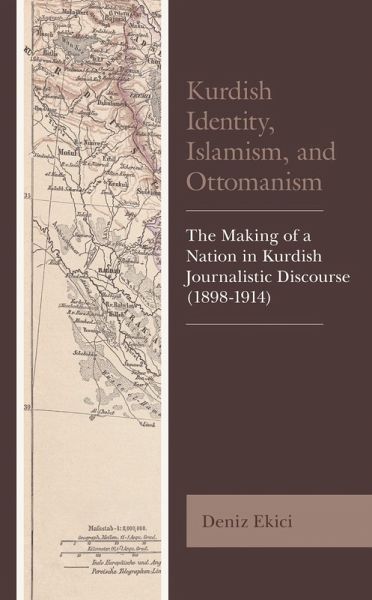
A major common misconception in scholarship on Kurdish journalistic discourses is that Kurdish intellectuals of the late Ottoman period cannot be portrayed as Kurdish nationalists. This theory prevails because of the belief that they not only endorsed and promoted Pan-Islamism and Ottoman nationalism instead of Kurdish ethnic nationalism, but also because they allegedly eschewed political demands and instead concerned themselves with ethno-cultural issues to articulate forms of "Kurdism" rather than "Kurdish nationalism." Refuting this underlying misconstruction of the nexus between Pan-Islamism, Ottomanism, and Kurdish nationalism, this book argues, based on empirical findings, that the Kurdish periodicals of the late Ottoman period served as a communicative space in which Kurdish intellectuals negotiated and disseminated an unmistakable form of Kurdish nationalism. It claims that hegemonic Ottomanist and Pan-Islamist political thought were used in pragmatic ways in the service of burgeoning Kurdish nationalism, but were rejected altogether when they were no longer useful to fostering Kurdish nationalism.