40,95 €
40,95 €
inkl. MwSt.
Sofort per Download lieferbar

20 °P sammeln
40,95 €
Als Download kaufen
40,95 €
inkl. MwSt.
Sofort per Download lieferbar
20 °P sammeln
Jetzt verschenken
Alle Infos zum eBook verschenken
40,95 €
inkl. MwSt.
Sofort per Download lieferbar
Alle Infos zum eBook verschenken
20 °P sammeln

Andere Kunden interessierten sich auch für
") Nonlinear Conservation Laws and Applications (eBook, PDF)112,95 €
Nonlinear Conservation Laws and Applications (eBook, PDF)112,95 €") Semi-Discretization for Time-Delay Systems (eBook, PDF)40,95 €
Semi-Discretization for Time-Delay Systems (eBook, PDF)40,95 €") Almost Periodic Oscillations and Waves (eBook, PDF)40,95 €
Almost Periodic Oscillations and Waves (eBook, PDF)40,95 €") Principles of Discontinuous Dynamical Systems (eBook, PDF)40,95 €
Principles of Discontinuous Dynamical Systems (eBook, PDF)40,95 €") Dynamical Systems and Chaos (eBook, PDF)40,95 €
Dynamical Systems and Chaos (eBook, PDF)40,95 €") Physics of Fractal Operators (eBook, PDF)40,95 €
Physics of Fractal Operators (eBook, PDF)40,95 €") Relative Equilibria of the Curved N-Body Problem (eBook, PDF)72,95 €
Relative Equilibria of the Curved N-Body Problem (eBook, PDF)72,95 €


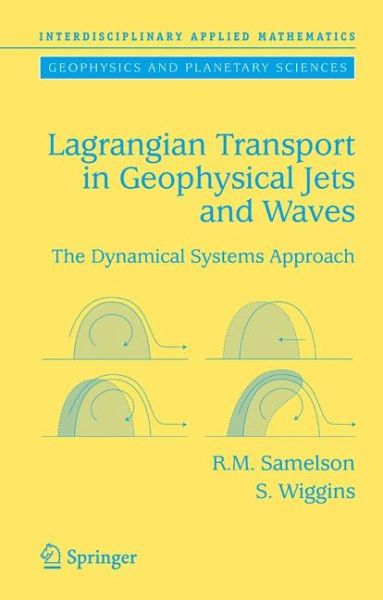
Written by a specialist in geophysical fluid dynamics and an applied mathematician, this is the first accessible introduction to a new set of methods for analysing Lagrangian motion in geophysical flows. Early chapters establish context and fundamental mathematical concepts and definitions, explore simple cases of steady flow, and touch on important topics from the classical theory of Hamiltonian systems. The main body of the book examines elements and methods of Lagrangian transport analysis in time-dependent flows. A concluding chapter surveys research in geophysical fluid dynamics that makes use of this new approach. Supplementary material is provided in the appendices. The book will appeal to graduate students, research scientists, and educators in any branch of geophysical science in which the motion and transport of fluid, and of materials carried by the fluid, is of interest. It will also interest applied mathematicians seeking an introduction to this area of geophysical fluid dynamics.
Dieser Download kann aus rechtlichen Gründen nur mit Rechnungsadresse in A, B, BG, CY, CZ, D, DK, EW, E, FIN, F, GR, HR, H, IRL, I, LT, L, LR, M, NL, PL, P, R, S, SLO, SK ausgeliefert werden.
A successful introduction to this subject should facilitate this description, and this fine monograph by Roger Samelson and Steve Wiggins does so effectively. The techniques and examples discussed provide a unique view of important processes that form the basis for general intuition about fluid flows. LARRY PRATT Woods Hole Oceanographic Institution
From the reviews:
"A strong understanding of Lagrangian approaches to the transport and stirring of fluid often benefits from mental visualization. One must picture diverging fluid and evolving material curves that deform and tangle about each other. A successful introduction to this subject should facilitate this description, and this fine monograph by Roger Samelson and Steve Wiggins does so effectively. The book is written primarily for students and researchers in the geosciences." (Larry Pratt, SIAM Review, Vol. 49 (4), 2007)
"Samelson and Wiggins aim to provide an accessible introduction to modern mathematical techniques to explore transport and exchange in geophysical flows. ... The book is very well structured. ... Each chapter has a good introduction and concludes with a good summary. The book undoubtedly reads well. ... The four appendices provide interesting extra information. The two page index is adequate. Over nine pages of references ensures the bibliography provides valuable pointers into recent research. ... In summary: lovely material, well written ... ." (Anthony John Roberts, Mathematical Reviews, Issue 2008 f)
"The purpose of the monograph is to explore some of the new insights into Lagrangian motion in geophysical flows followed from such approach and to present an accessible introduction to the basic elements of some of these methods. ... The monograph will be useful for applied mathematicians, especially working in geophysical fluid dynamics." (Boris V. Loginov, Zentralblatt MATH, Vol. 1132 (10), 2008)
"A strong understanding of Lagrangian approaches to the transport and stirring of fluid often benefits from mental visualization. One must picture diverging fluid and evolving material curves that deform and tangle about each other. A successful introduction to this subject should facilitate this description, and this fine monograph by Roger Samelson and Steve Wiggins does so effectively. The book is written primarily for students and researchers in the geosciences." (Larry Pratt, SIAM Review, Vol. 49 (4), 2007)
"Samelson and Wiggins aim to provide an accessible introduction to modern mathematical techniques to explore transport and exchange in geophysical flows. ... The book is very well structured. ... Each chapter has a good introduction and concludes with a good summary. The book undoubtedly reads well. ... The four appendices provide interesting extra information. The two page index is adequate. Over nine pages of references ensures the bibliography provides valuable pointers into recent research. ... In summary: lovely material, well written ... ." (Anthony John Roberts, Mathematical Reviews, Issue 2008 f)
"The purpose of the monograph is to explore some of the new insights into Lagrangian motion in geophysical flows followed from such approach and to present an accessible introduction to the basic elements of some of these methods. ... The monograph will be useful for applied mathematicians, especially working in geophysical fluid dynamics." (Boris V. Loginov, Zentralblatt MATH, Vol. 1132 (10), 2008)